

On this page
What happens when ethyne passes through a red-hot iron tube?
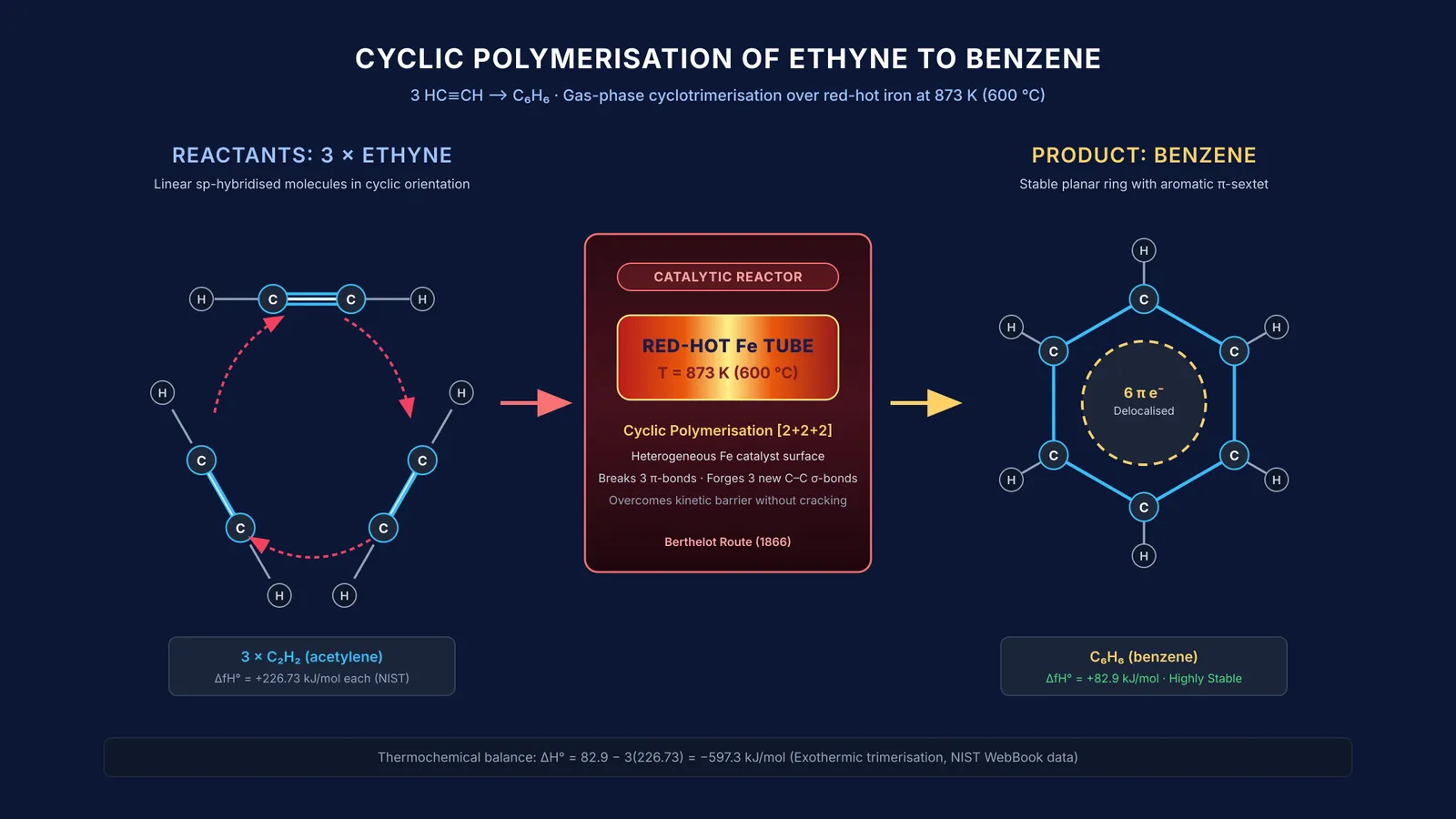
When ethyne (acetylene) gas is passed through a red-hot iron tube at 873 K (600 °C), three molecules of ethyne combine in a cyclic trimerisation to form benzene: 3 HC≡CH → C6H6. First discovered by Marcellin Berthelot in 1866 and known in chemical literature as alkyne cyclotrimerisation, this reaction is termed cyclic polymerisation in curriculum syllabi such as Unit 9 of NCERT Class 11 Chemistry. It provides organic chemistry's most direct synthetic route from open-chain aliphatic hydrocarbons to an aromatic ring.
In isolated ethyne, each carbon atom is sp-hybridised, forming a linear molecule with one σ-bond and two perpendicular π-bonds. At room temperature, ethyne behaves as an aliphatic gas whose terminal protons exhibit the characteristic acidity of terminal alkynes. Inside the iron tube at 873 K, thermal energy and the catalytic iron surface activate one π-bond per molecule. These three electron pairs reorganise, forging three new carbon-carbon σ-bonds that join the fragments into a six-membered hexagonal ring. The remaining six π-electrons delocalise across the ring, establishing the stable aromatic sextet of benzene.
Why does the conversion require 873 K and an iron catalyst?
From a thermodynamic perspective, turning ethyne into benzene is exceptionally favourable. According to the NIST Chemistry WebBook for ethyne, the standard gas-phase enthalpy of formation of ethyne is 226.73 kJ/mol. In contrast, the NIST Chemistry WebBook for benzene gives the standard gas-phase enthalpy of formation of benzene as 82.9 kJ/mol. Combining three moles of ethyne into one mole of benzene yields an enthalpy of reaction of ΔH° = 82.9 − (3 × 226.73) = −597.3 kJ/mol.
Although the process releases 597.3 kJ/mol of heat, ethyne does not spontaneously convert to benzene at room temperature. The activation energy required to deform and cleave strong carbon-carbon triple bonds is formidable. Additionally, bringing three independent gas molecules together into one ring incurs an entropic penalty (ΔS° < 0). The iron tube acts as a heterogeneous catalyst to lower this activation barrier. Quantum chemical modelling by Gordeev, Pentsak, and Ananikov in the Journal of the American Chemical Society demonstrated that acetylene cyclotrimerisation on catalytic surfaces proceeds through unpaired electron delocalisation and sequential bond formation rather than a simultaneous six-electron collision.
The 873 K temperature supplies sufficient thermal energy to achieve a practical conversion rate while remaining below 1000 K, where thermal cracking would decompose benzene into elemental soot and hydrogen.
How does cyclic polymerisation work for substituted alkynes?
Cyclic polymerisation also applies to substituted alkynes under identical conditions:
Propyne (CH3-C≡CH): Passing propyne over red-hot iron at 873 K yields 1,3,5-trimethylbenzene (mesitylene). Symmetrical 1,3,5-mesitylene forms preferentially over 1,2,4-trimethylbenzene because alternating methyl substituents minimise steric crowding around the ring.
But-2-yne (CH3-C≡C-CH3): Passing this symmetrical internal alkyne over red-hot iron produces hexamethylbenzene, C6(CH3)6, with methyl groups on all six ring carbons.
Once the aromatic ring forms, further functionalisation proceeds via classical electrophilic substitution in benzene.
How to solve aliphatic-to-aromatic conversions in JEE and NEET?
Competitive examinations frequently test cyclic polymerisation as an intermediate step in synthesis roadmaps:
Calcium carbide to aniline:
Hydrolysing calcium carbide yields ethyne: CaC2 + 2 H2O → Ca(OH)2 + C2H2. Heating ethyne in an iron tube at 873 K produces benzene. Nitrating benzene with concentrated HNO3 and H2SO4 gives nitrobenzene, which reduces to aniline with iron and hydrochloric acid, as outlined in our guide on reducing nitrobenzene to aniline.
Methane to benzoic acid:
Passing methane through an electric arc at 1773 K yields ethyne. Trimerisation at 873 K over iron yields benzene. Friedel-Crafts alkylation with chloromethane and anhydrous AlCl3 gives toluene, which oxidises under hot alkaline KMnO4 to yield benzoic acid.
1,2-Dibromoethane to chlorobenzene:
Dehydrohalogenating 1,2-dibromoethane with alcoholic KOH followed by NaNH2 gives ethyne. After cyclisation to benzene at 873 K, electrophilic chlorination with Cl2 and anhydrous FeCl3 delivers chlorobenzene.
When working through multi-step roadmaps, tracking carbon stoichiometry and functional group compatibility is critical. The Fermi Problem Library provides worked problems with a step-by-step solver that explains the reasoning rather than printing an answer. For mastering reaction mechanisms, the Fermi Concept Library covers every concept in chemistry, each with its own lesson and its place in the map.


