

On this page
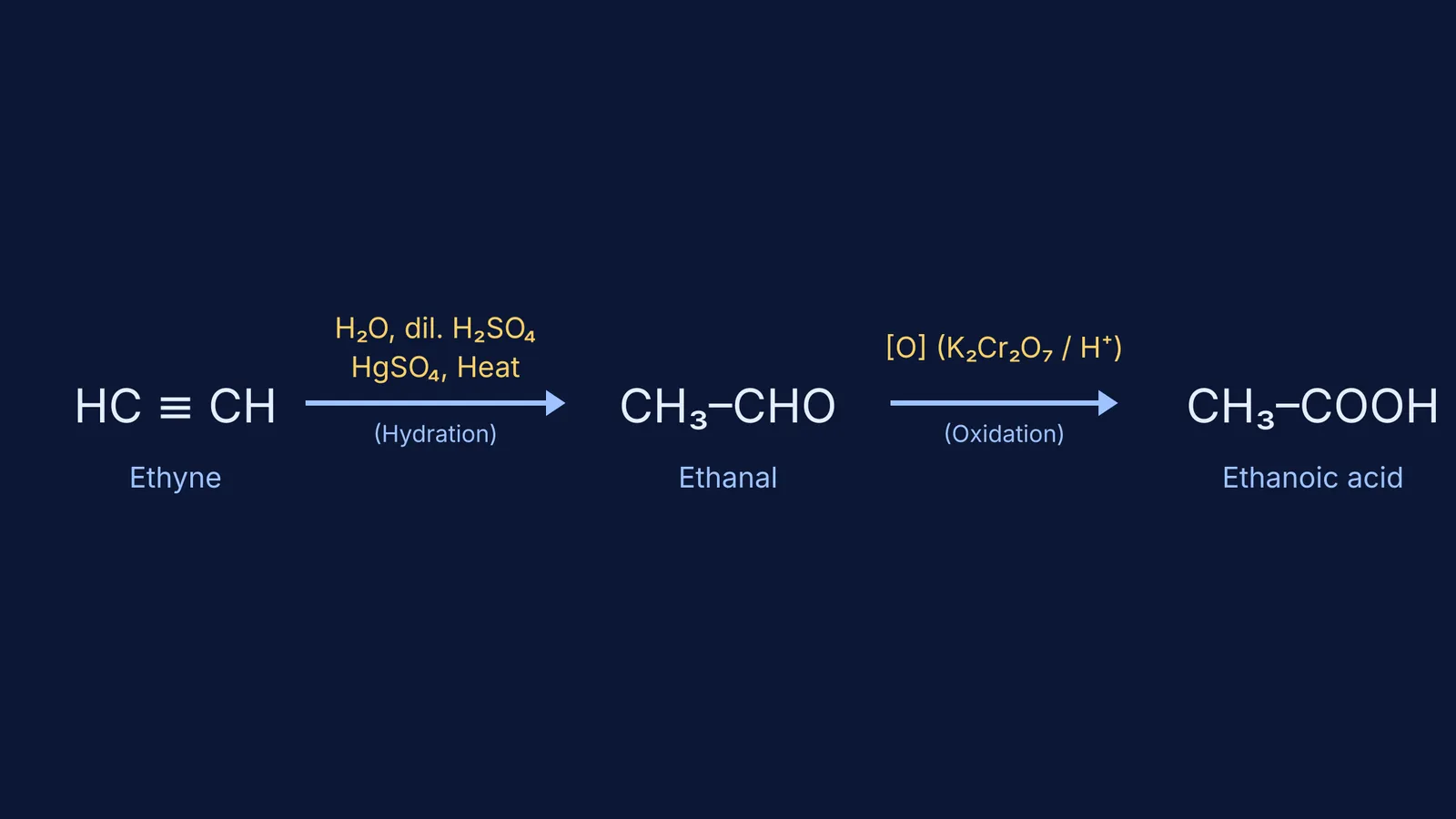
Converting acetylene to acetic acid involves two major stages: adding water across the triple bond to form an aldehyde, and then oxidising that aldehyde into a carboxylic acid.
In IUPAC terms, you are converting ethyne to ethanoic acid via an ethanal intermediate. This sequence is a classic organic chemistry transformation that connects alkyne chemistry with carbonyl and acid reactions.
How do you hydrate acetylene to acetaldehyde?
Alkynes do not react with water easily. To hydrate acetylene, you must pass the gas through an acidic medium of dilute sulfuric acid (H₂SO₄) containing a mercury(II) sulfate catalyst (HgSO₄).
The mercury(II) ion attaches to the carbon-carbon triple bond, allowing a water molecule to attack. This initially forms an unstable intermediate called vinyl alcohol (CH₂=CH–OH). Because vinyl alcohol is an enol, it rapidly undergoes tautomerisation to form the more stable keto form, which is acetaldehyde (ethanal, CH₃CHO).
This process, known as the Kucherov reaction, was historically the primary industrial method for producing acetaldehyde.
The hydration equation is HC≡CH + H₂O → CH₃CHO (using dilute H₂SO₄ and HgSO₄).
What is the mechanism of the Kucherov reaction?
The hydration of alkynes is an electrophilic addition. The Hg²⁺ ion from the mercuric sulfate acts as an electrophile. It attacks the triple bond of acetylene to form a cyclic mercurinium ion intermediate.
Water, acting as a nucleophile, then attacks one of the carbon atoms in this three-membered ring. This ring-opening step creates an organomercury intermediate. In the acidic environment provided by the dilute sulfuric acid, the mercury is replaced by a proton (H⁺), a step known as demercuration.
This sequence results in vinyl alcohol. Vinyl alcohol is highly unstable and immediately rearranges its atoms—a process called keto-enol tautomerism—to become the stable aldehyde, acetaldehyde.
What oxidises acetaldehyde to acetic acid?
Once you have acetaldehyde, the next step is oxidation. Aldehydes are easily oxidised to carboxylic acids because the carbonyl carbon still has a hydrogen atom attached to it.
You can achieve this conversion using a strong oxidising agent such as acidified potassium permanganate (KMnO₄ / H⁺) or chromium-based reagents like the Jones reagent (chromium trioxide in aqueous sulfuric acid). When acetaldehyde is warmed with a strong oxidant, it is oxidised to acetic acid (ethanoic acid, CH₃COOH).
The oxidation equation is CH₃CHO + [O] → CH₃COOH.
If you are trying to remember reaction maps for exams, Fermi's Concept Library groups these oxidations logically so you can see how primary alcohols, aldehydes, and carboxylic acids connect.
What happens during the oxidation step?
The oxidation of primary alcohols to carboxylic acids typically proceeds through an aldehyde intermediate. When you start with an aldehyde like acetaldehyde, you are already halfway there.
In the presence of water, acetaldehyde exists in equilibrium with its hydrate (a gem-diol). Strong oxidising agents, such as the Jones reagent, interact with this hydrate to form a chromate ester. The elimination of a proton and a chromium species from this ester forms the carbon-oxygen double bond of the carboxylic acid, completing the conversion to acetic acid.
Because this second step requires water to form the hydrate, chemists who want to stop an oxidation at the aldehyde stage must perform the reaction in strictly anhydrous conditions.
Are there industrial alternatives to this conversion?
While the two-step hydration and oxidation route is common in textbooks, the chemical industry has largely shifted away from it.
Historically, the Kucherov reaction was the main way to produce acetaldehyde. However, due to the toxicity and environmental hazards associated with mercury catalysts, it was replaced by the Wacker process. The Wacker process oxidises ethylene (CH₂=CH₂) directly to acetaldehyde using a palladium and copper catalyst system.
Similarly, while acetaldehyde oxidation was once a major source of acetic acid, modern industrial plants mostly rely on methanol carbonylation. Processes like the Monsanto and Cativa methods react methanol directly with carbon monoxide to yield acetic acid, which is far more efficient on a large scale.
How do you plan organic conversions?
When you face a conversion problem in a chemistry exam, do not try to guess the reagents all at once. Use this three-step framework:
Count the carbons. Acetylene has two carbon atoms, and acetic acid has two. Since the carbon count is the same, you do not need step-up reactions or step-down reactions like Hofmann bromamide degradation.
Check the functional group. You are moving from a triple bond (alkyne) to a carboxylic acid. There is no standard single-step reagent for this.
Find the bridge. The bridge between hydrocarbons and acids is often an oxygen-containing intermediate. Adding water to an alkyne creates a carbonyl group, which can then be oxidised to an acid. For instance, hydration of alkynes is the standard way to bridge ethyne and ethanal.
If you are stuck on planning a multi-step synthesis, Fermi's AI tutor can work out what you already know and build a plan for the session, guiding you through the reaction map one step at a time.


