

On this page
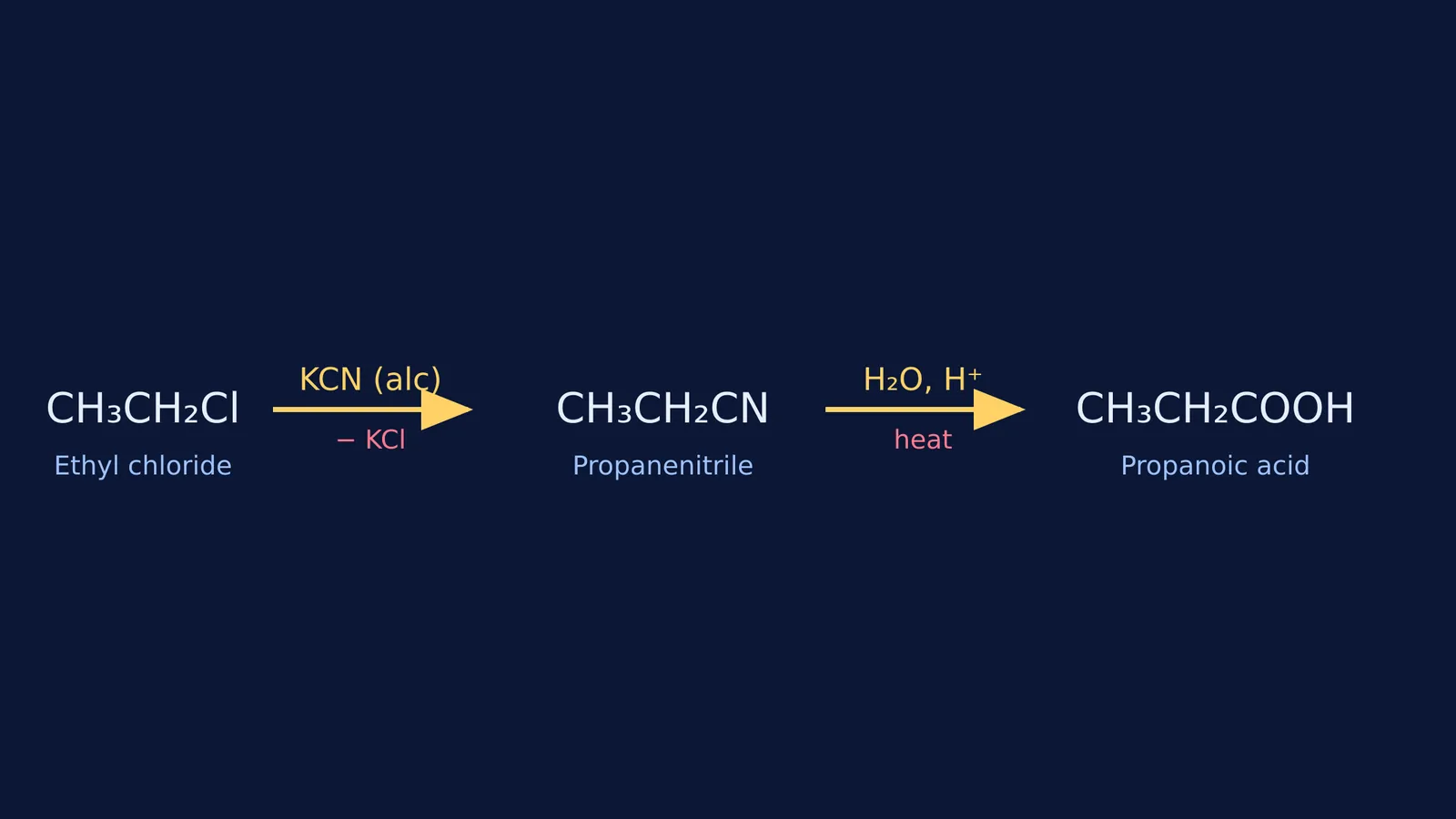
This conversion is a classic "step-up" reaction in organic chemistry. It takes a two-carbon molecule (ethyl chloride) and turns it into a three-carbon carboxylic acid (propanoic acid). It appears frequently in JEE and NEET organic chemistry sequences because it tests your understanding of nucleophiles and hydrolysis.
Here is how the transformation works, step by step, and why choosing the right cyanide reagent is essential for getting the correct product.
How do you convert ethyl chloride to propanenitrile?
To increase the length of the carbon chain, we need a reagent that provides a carbon-based nucleophile. Potassium cyanide (KCN) in an ethanolic solution is the standard choice.
When ethyl chloride (CH₃CH₂Cl) is heated with ethanolic KCN, a nucleophilic substitution (SN2) reaction occurs. The chlorine atom is displaced by the cyanide group, yielding propanenitrile (also called ethyl cyanide).
CH₃CH₂Cl + KCN → CH₃CH₂C≡N + KCl
The carbon-carbon bond formed here is very stable, making this an excellent way to grow an organic molecule.
Why use KCN instead of AgCN?
You might wonder why we specify potassium cyanide (KCN) rather than silver cyanide (AgCN). The difference lies in the bonding of the reagent.
An ambident nucleophile is a chemical species that possesses two or more nucleophilic sites and can attack an electrophile from different positions. The cyanide ion (CN⁻) is an ambident nucleophile because it can attack from either its carbon atom or its nitrogen atom.
KCN is an ionic compound that dissociates in solution to provide free cyanide ions. Because a C–C bond is stronger than a C–N bond, the attack happens through the carbon atom, giving a nitrile (R–C≡N) as the major product.
If you were to use AgCN instead, the outcome changes completely. AgCN is mostly covalent, meaning the silver-carbon bond does not break easily. This leaves only the lone pair on the nitrogen atom free to attack the ethyl chloride. The result is an isocyanide (ethyl isocyanide, CH₃CH₂NC), which cannot be hydrolyzed into propanoic acid.
If you are struggling to remember which reagent gives which product, the Fermi Concept Library has every concept in physics, chemistry, biology, mathematics and computing, each with its own lesson and its place in the map, helping you see the mechanism rather than just memorising the rule. For a broader look at substitution versus elimination choices, see our guide on aqueous vs alcoholic KOH.
What happens during the hydrolysis of propanenitrile?
Once you have propanenitrile, the final step is to turn the nitrile group (–C≡N) into a carboxylic acid group (–COOH). This is done through hydrolysis.
The nitrile is heated with water in the presence of a strong acid, typically dilute hydrochloric acid (HCl) or sulfuric acid (H₂SO₄). The reaction converts the nitrile into an amide intermediate, which then undergoes further hydrolysis to yield the carboxylic acid.
CH₃CH₂C≡N + 2H₂O + H⁺ → CH₃CH₂COOH + NH₄⁺
The final product is propanoic acid. The nitrogen from the nitrile group ends up as an ammonium ion (NH₄⁺) in the acidic solution.
Base-mediated hydrolysis of a nitrile with NaOH produces the sodium salt of the acid, requiring an extra acidification step to release the free acid. Because of this extra step, acidic hydrolysis is often preferred when the goal is the free carboxylic acid.
How do you plan step-up conversions in organic chemistry?
Exam questions often ask you to synthesize a compound that has one more carbon atom than your starting material. These are known as "step-up" conversions.
Whenever you notice that the product has exactly one more carbon atom than the reactant—like moving from the two-carbon ethyl chloride to the three-carbon propanoic acid—you should immediately think of the cyanide ion. The cyanide group (–C≡N) is uniquely useful because it introduces that extra carbon atom while also providing a handle for further transformations.
Once the nitrile is formed, it acts as a gateway functional group. From a nitrile, you can not only hydrolyze it to a carboxylic acid, but you can also perform a partial hydrolysis to get an amide, or use a reducing agent like LiAlH₄ to convert the nitrile into a primary amine. Recognizing this pattern will save you time in the exam hall and prevent you from memorising isolated reactions.
If you find multi-step conversions tricky during exam prep, the Fermi Problem Library has worked problems with a step-by-step solver that explains the reasoning rather than printing an answer, so you learn to design the sequence yourself. You can also read more about other ambident reactions in our post on KCN vs AgCN and KNO2 vs AgNO2.


