

On this page
A frequent challenge in senior school organic synthesis asks you to prepare ethyl ethanoate using ethanol as the only organic starting material. When students first meet this problem in the CBSE Senior Secondary Chemistry Curriculum, many stall because standard laboratory esterification requires both a carboxylic acid and an alcohol. You are given only ethanol (CH₃CH₂OH).
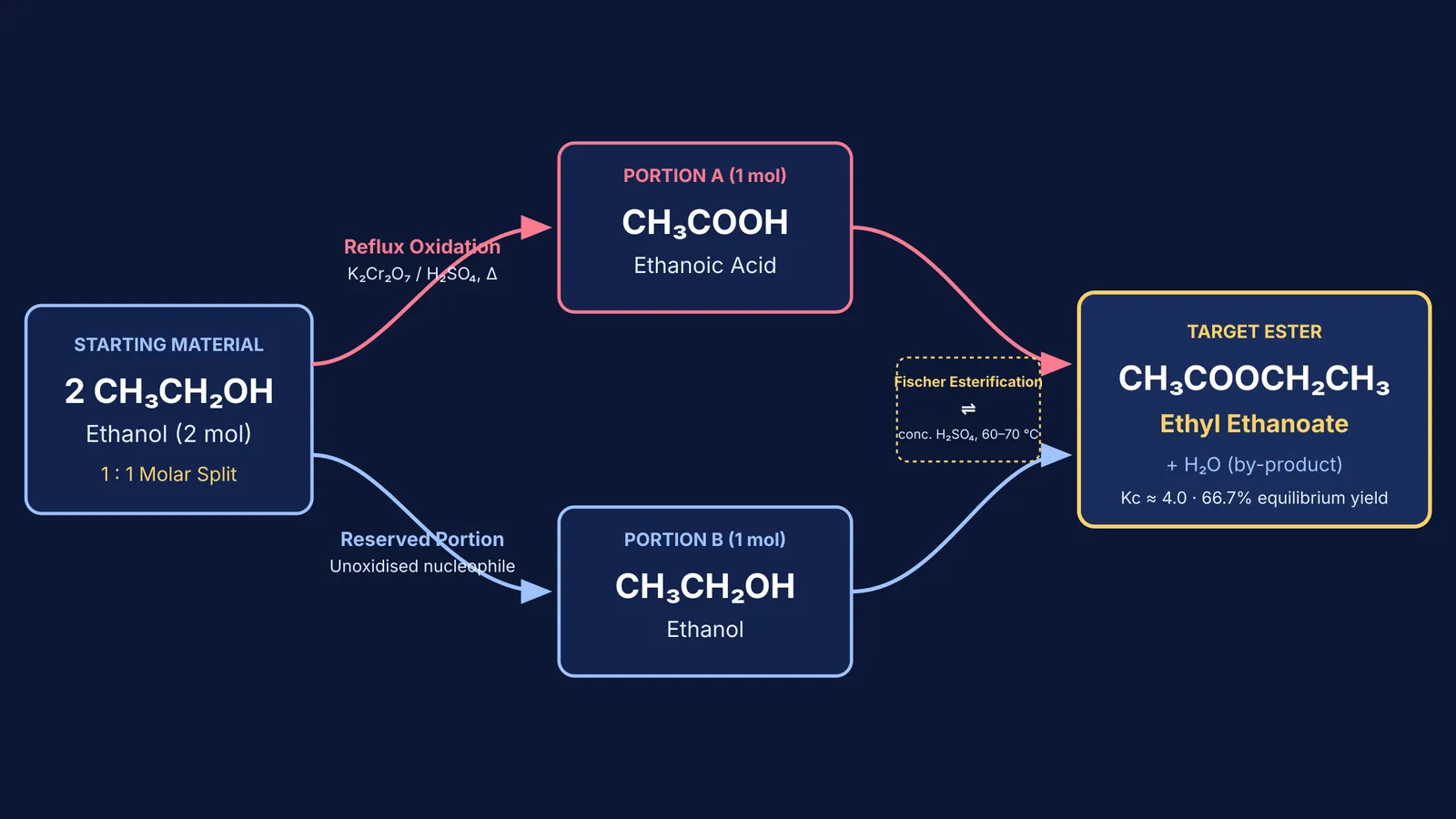
The solution lies in recognising that the target molecule, ethyl ethanoate (CH₃COOCH₂CH₃), contains two distinct two-carbon units: an acyl group derived from ethanoic acid and an alkoxy group derived from ethanol. Because ethanol already contains two carbon atoms, a single flask of ethanol can supply both halves if you partition the reagent before starting any chemical transformation.
Why split the ethanol into two equal portions?
To synthesise one mole of ethyl ethanoate, stoichiometry requires exactly one mole of ethanoic acid and one mole of ethanol. According to molecular data from the National Center for Biotechnology Information on Ethanol and Ethyl acetate, both compounds share the same two-carbon chain backbone.
Dividing your initial ethanol into two equal portions provides a 1:1 molar ratio. If you oxidise all your ethanol immediately, you produce pure ethanoic acid with no alcohol partner left to perform nucleophilic attack. Conversely, leaving too much unoxidised ethanol wastes starting material. Understanding how functional groups interconvert—as reviewed in our guide on ethanol and ethanoic acid in Class 10—allows you to treat one batch as an electrophilic precursor and reserve the other as a nucleophile.
How does complete oxidation convert ethanol into ethanoic acid?
Take the first portion of ethanol and place it in a round-bottom flask fitted with a reflux condenser. Add a strong oxidising mixture, such as potassium dichromate acidified with dilute sulphuric acid (K₂Cr₂O₇ in H₂SO₄) or alkaline potassium permanganate (KMnO₄) followed by acid workup:
CH₃CH₂OH + 2[O] → CH₃COOH + H₂O
The apparatus design is critical. Ethanol oxidises first to ethanal (acetaldehyde), which has a low boiling point of 20.2 °C compared to ethanol's 78.4 °C and ethanoic acid's 118 °C, as catalogued in compound data from Ethanol. Heating under reflux ensures that any escaping ethanal vapour condenses on the cold condenser jacket, drops back into the boiling liquid, and undergoes complete oxidation to ethanoic acid. Our guide on oxidation and reduction in organic chemistry contrasts this reflux method with the controlled distillations used when an aldehyde is the desired end product.
How does Fischer esterification form the ester?
Once you have obtained ethanoic acid from the first batch, combine it directly with the reserved second portion of ethanol. Following the acid-catalysed condensation protocol formulated by Emil Fischer and Arthur Speier (Fischer and Speier, 1895), add a catalytic quantity of concentrated sulphuric acid (H₂SO₄) and warm the mixture gently in a water bath at 60 °C to 70 °C:
CH₃COOH + CH₃CH₂OH ⇌ CH₃COOCH₂CH₃ + H₂O
Concentrated sulphuric acid plays two distinct roles during the condensation:
Acid catalyst: It protonates the carbonyl oxygen of ethanoic acid, increasing the positive charge on the carbonyl carbon and making it receptive to attack by the hydroxyl oxygen of ethanol.
Dehydrating agent: Because esterification is reversible, accumulating water pushes the reaction backward. Concentrated sulphuric acid binds free water, shifting equilibrium toward the ester via Le Chatelier's principle.
In an equimolar system without continuous water removal, the forward and reverse rates balance at a fixed limit. Classical mass-action stoichiometry establishes that an equilibrium constant Kc of approximately 4 limits conversion to roughly 66.7% ester yield; in laboratory investigations published in the *Journal of Chemical Education*, Edward Sarlo, Paris Svoronos, and Patricia Kulas demonstrated titrimetric procedures determining an experimental equilibrium constant of approximately 4.86 (Sarlo et al., 1990). Detailed electron-pushing steps are explored in our walkthrough of the Fischer esterification mechanism.
Can ethanol convert directly into ethyl ethanoate in industry?
In industrial manufacturing, dividing feedstock into two separate batches and using stoichiometric chromium salts produces toxic heavy-metal effluent. Chemical plants instead use a single-step catalytic dehydrogenative coupling:
2 CH₃CH₂OH → CH₃COOCH₂CH₃ + 2 H₂
Passing ethanol vapour over copper-based catalysts such as copper chromite (Cu-Cr₂O₃) or copper-zirconia at temperatures between 200 °C and 260 °C achieves direct conversion. As demonstrated by G. Carotenuto and co-workers in *Catalysis Today*, operating between 220 °C and 240 °C enables copper surface sites to dehydrogenate ethanol into adsorbed ethanal, which couples with unreacted ethanol through a hemiacetal intermediate to yield ethyl ethanoate alongside clean hydrogen gas (Carotenuto et al., 2013).
What is the laboratory protocol for this synthesis?
To solve or carry out this two-step conversion systematically—as outlined in practical exercises for the CBSE Senior Secondary Chemistry Curriculum—follow this four-step workflow:
Divide the ethanol stock: Measure your starting ethanol and divide it into two equal molar portions (Portion A and Portion B).
Reflux Portion A: Heat Portion A with acidified potassium dichromate under reflux until oxidation to ethanoic acid is complete and the orange dichromate turns deep green.
Condense with Portion B: Mix the isolated ethanoic acid with unoxidised Portion B, add concentrated sulphuric acid, and heat on a water bath for 10 to 15 minutes.
Neutralise and isolate: Pour the cooled mixture into dilute sodium carbonate solution to neutralise unreacted acid. The sweet-smelling ethyl ethanoate separates as an upper organic layer ready for drying and fractional distillation.
When tackling multi-step synthesis problems, mapping functional group pathways prevents confusion. The Fermi Concept Library offers every concept in physics, chemistry, biology, mathematics and computing, each with its own lesson and its place in the map. For exam numericals and multi-stage organic transformations, the Fermi Problem Library provides worked problems with a step-by-step solver that explains the reasoning rather than printing an answer.


