

On this page
Converting a two-carbon molecule into a four-carbon alkyne is a classic exam problem that tests your ability to plan a logical synthetic route. When your only source of carbon is ethanol, you cannot simply buy the two halves off a shelf; you must build the target molecule by synthesising both building blocks yourself in the laboratory.
During your exam prep, whenever a problem asks you to convert a molecule with 'n' carbons into one with '2n' carbons, you should immediately think of coupling two smaller fragments. The Wurtz reaction is one way to couple alkyl halides, but it only creates single bonds. When the target molecule contains a triple bond, like but-1-yne, the most reliable way to build the new carbon-carbon bond is an Sₙ2 substitution. This requires two pieces: an electrophile (a two-carbon alkyl halide) and a nucleophile (a two-carbon acetylide).
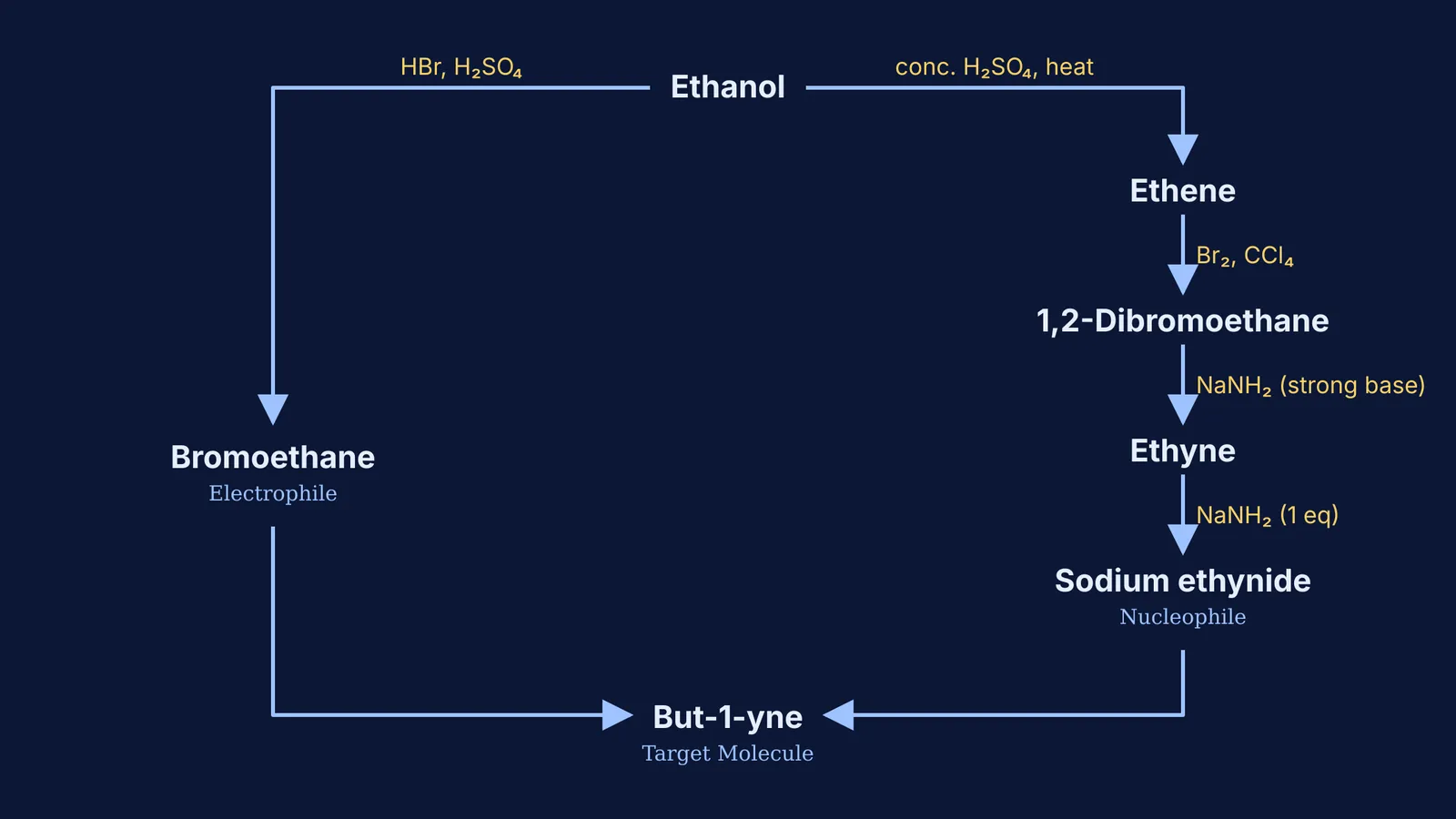
How do we make the bromoethane electrophile?
Take the first batch of ethanol. The hydroxyl group is a poor leaving group, so we need to swap it for a halogen.
According to chemical references for bromoethane, the molecule is typically prepared by reacting ethanol with hydrobromic and sulfuric acids. The acid protonates the alcohol, and the bromide ion substitutes it, producing the electrophile bromoethane (CH₃CH₂Br). This covers the first half of our hydrocarbon reactions roadmap.
How do we make the sodium ethynide nucleophile?
The second batch of ethanol must be converted into an alkyne, which requires a longer series of transformations.
Dehydration: Heat the ethanol with concentrated sulfuric acid to eliminate water. This leaves you with ethene (CH₂=CH₂).
Halogenation: Add bromine dissolved in carbon tetrachloride (Br₂ / CCl₄). The bromine adds across the double bond to form 1,2-dibromoethane. The reddish-brown colour of the bromine solution disappears as the reaction proceeds, confirming that the ethene has fully reacted to form the vicinal dihalide.
Double Dehydrohalogenation: Dehydrohalogenation is an elimination reaction that removes a hydrogen halide to synthesise alkenes or alkynes. By adding a strong base like sodamide (NaNH₂), we strip away two equivalents of hydrogen bromide to form a triple bond, yielding ethyne (HC≡CH). Weaker bases often stall after removing the first equivalent, so sodamide is necessary to drive the reaction all the way to the alkyne.
Deprotonation: Terminal alkynes are unusually acidic. Treating the ethyne with another equivalent of sodamide deprotonates the terminal carbon, producing our required nucleophile: sodium ethynide (Na⁺C⁻≡CH).
Why do we use sodium ethynide and a primary halide?
When coupling the two halves, you must avoid side reactions. Sodium ethynide is a very strong nucleophile, but it is also a powerful base. If we tried to react it with a secondary or tertiary alkyl halide, the base would trigger an elimination reaction (E2) rather than the desired substitution (Sₙ2). Instead of building a carbon-carbon bond, we would accidentally recreate an alkene.
Because we deliberately chose to make bromoethane—a primary alkyl halide—the carbon atom is relatively exposed. The nucleophile can attack the carbon directly without being blocked by bulky side groups, ensuring the Sₙ2 substitution pathway dominates.
Step 3: Coupling the pieces to form but-1-yne
With both branches complete, we bring the two molecules together.
The sodium ethynide anion attacks the primary carbon of the bromoethane. The acetylide cleanly displaces the bromide leaving group in a one-step Sₙ2 substitution. The two-carbon chain joins the other two-carbon chain, yielding the final product: but-1-yne (CH₃CH₂C≡CH), with sodium bromide (NaBr) as a by-product.
Practising multi-step conversions builds your intuition for organic chemistry and trains you to spot these hidden building blocks. If you struggle to remember why one reagent causes an elimination reaction while another causes a clean substitution, the Fermi Concept Library breaks down the specific electron mechanisms of each step so you see the underlying logic. Once the chemical theory makes complete sense to you, you can confidently tackle dozens of complex multi-step conversions using the step-by-step solver in the Fermi Problem Library, which carefully explains the reasoning behind every reagent choice and pathway decision.


