

On this page
In modular arithmetic, operations "wrap around" after reaching a certain value called the modulus Wikipedia. When the modulus is 3, integers are grouped based on whether their difference is a multiple of 3. This grouping forms what mathematicians call an equivalence relation.
According to the mathematical definition, an equivalence relation splits a set into distinct groups called equivalence classes Wikipedia. When applied to the set of all integers, congruence modulo 3 partitions the set into exactly three equivalence classes Wikipedia.
What are the equivalence classes of congruence modulo 3?
Two integers a and b are congruent modulo 3 if their difference (a − b) is divisible by 3, written as a ≡ b (mod 3). Equivalently, two numbers are congruent modulo 3 if they leave the same remainder when divided by 3.
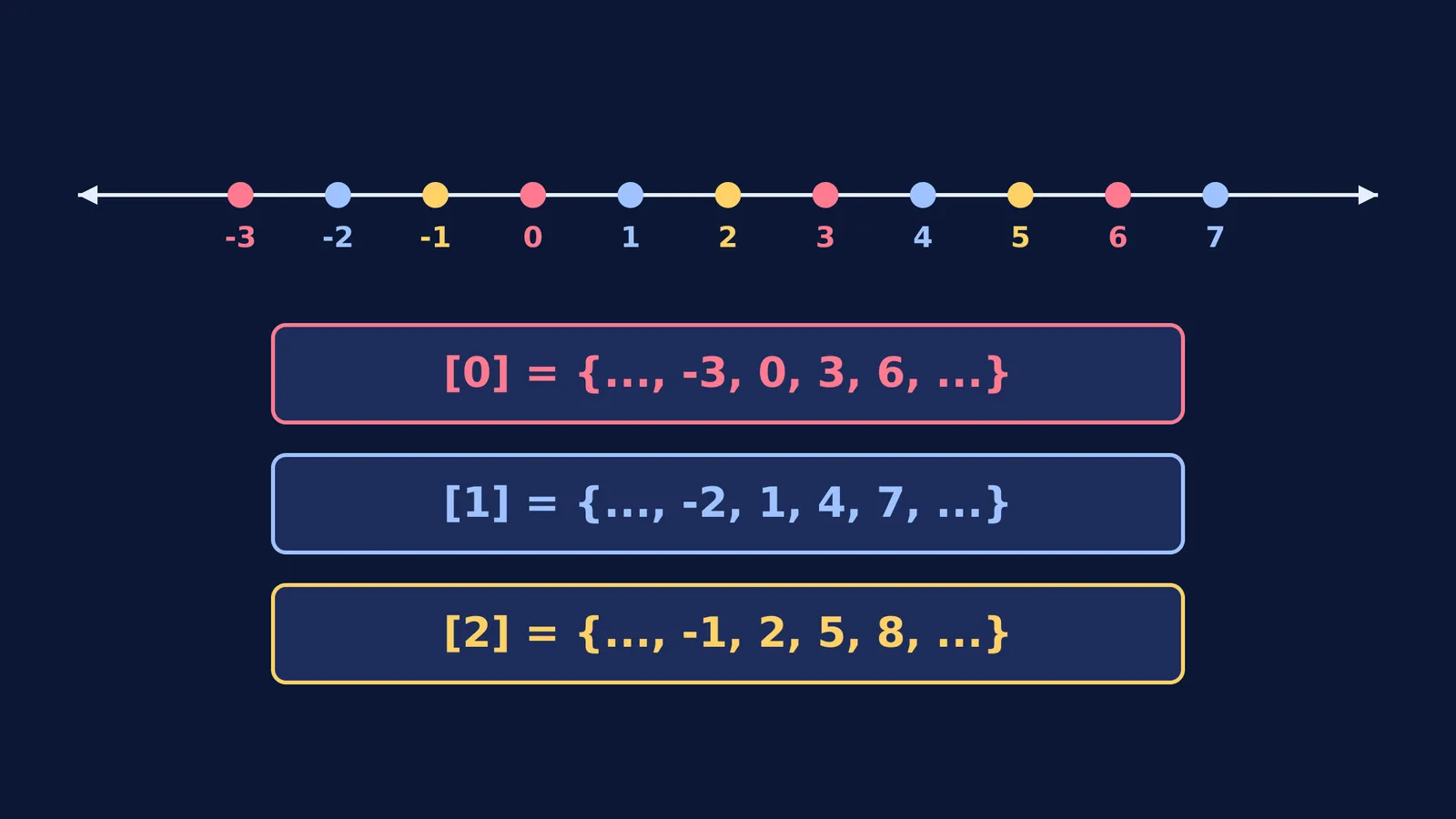
Because dividing any integer by 3 yields a remainder of exactly 0, 1, or 2, there are three equivalence classes Wikipedia. We usually write them as [0], [1], and [2]:
[0] contains all integers that leave a remainder of 0 (the multiples of 3).
[0] = {..., −6, −3, 0, 3, 6, ...}
[1] contains all integers that leave a remainder of 1.
[1] = {..., −5, −2, 1, 4, 7, ...}
[2] contains all integers that leave a remainder of 2.
[2] = {..., −4, −1, 2, 5, 8, ...}
If you are stuck trying to prove properties about remainders on paper, seeing a step-by-step breakdown is the best way to learn the technique. The Fermi Problem Library has worked problems with a step-by-step solver that explains the reasoning rather than printing an answer.
Why are equivalence classes disjoint?
A key property of equivalence classes is that they are pairwise disjoint Wikipedia. This means that no integer can belong to more than one class.
For congruence modulo 3, an integer cannot leave a remainder of both 1 and 2 when divided by 3. By the division algorithm, any integer n can be expressed uniquely in the form n = 3q + r, where q is the quotient and r is the remainder (with 0 ≤ r < 3). Because the remainder r is unique for a given integer, the integer maps to exactly one equivalence class. Thus, the intersection of any two different equivalence classes is the empty set.
How do equivalence classes cover the set?
According to the fundamental theorem of equivalence relations, the equivalence classes of any equivalence relation form a partition of the underlying set Wikipedia. A partition means that the classes are completely disjoint and their union equals the entire original set.
Because every integer yields a remainder of 0, 1, or 2 when divided by 3, every integer is accounted for. There are no integers left "floating" outside these classes. The union of [0], [1], and [2] contains every single integer from negative infinity to positive infinity.
When you study properties of sets and relations, visualising how a set is cut into pieces helps fix the idea. The Fermi Concept Library maps out every concept in physics, chemistry, biology, mathematics and computing, each with its own lesson and its place in the map.
Can you add and multiply equivalence classes?
One of the most powerful features of modular arithmetic is that you can perform addition and multiplication directly on the equivalence classes Wikipedia. This creates a new mathematical structure known as the ring of integers modulo 3.
To add two equivalence classes, you simply pick any integer from the first class and any integer from the second class, add them together, and find the equivalence class of the result. For example, to add [1] and [2], you can pick 4 from [1] and 5 from [2]. Their sum is 9, which belongs to [0]. Therefore, [1] + [2] = [0].
This property is well-defined, meaning that no matter which representatives you choose from the classes, the result will always land in the same final equivalence class. The same principle applies to multiplication. Multiplying [2] by [2] gives [4], and since 4 leaves a remainder of 1 when divided by 3, the result simplifies to [1].
How do you find the equivalence class of any integer?
When asked to find the equivalence class of a large positive or negative integer modulo 3, use this systematic approach:
Perform integer division: Divide the number by 3.
Find the remainder:
For positive numbers, this is the standard remainder. For example, 17 ÷ 3 gives a quotient of 5 and a remainder of 2. Thus, 17 belongs to [2].
For negative numbers, remainders in modular arithmetic must be positive. To find the remainder of −14 modulo 3, divide −14 by 3. The nearest multiple of 3 less than −14 is −15 (which is 3 × −5). The difference is −14 − (−15) = 1. Thus, the remainder is 1, so −14 belongs to [1].
Verify: Check if (a − r) is a multiple of 3. For −14 in [1], we check (−14 − 1) = −15. Since −15 is a multiple of 3, the classification is correct.
Using this checklist ensures you handle tricky negative numbers correctly on exams.
If you are reviewing discrete mathematics and counting, see our guides on the number of subsets and the power set: counting with 2ⁿ and the sum of all numbers formed from given digits: the column trick.


