

On this page
What is the difference between equal sets and equivalent sets?
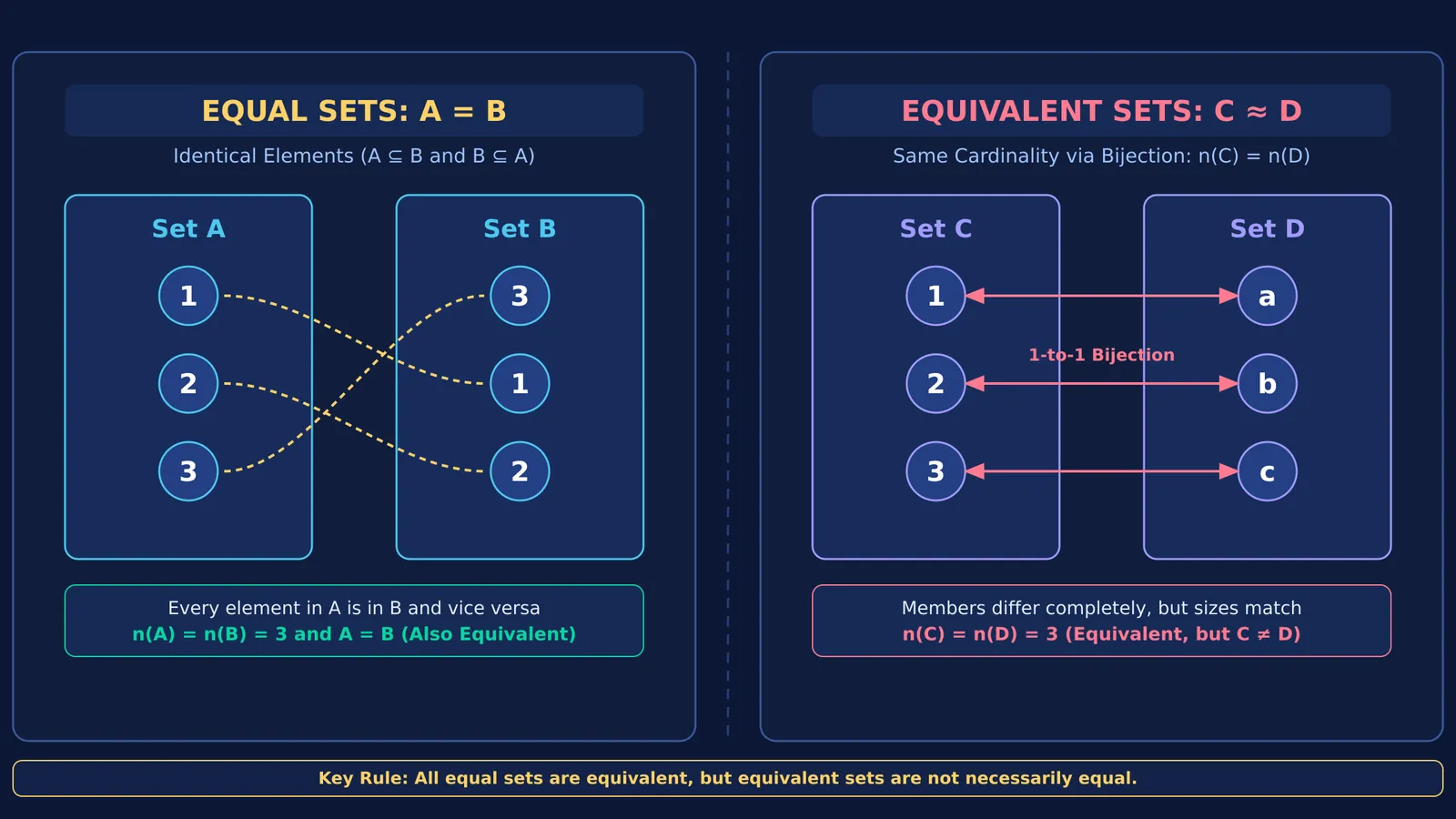
Two sets A and B are equal if and only if they possess the exact same elements. In mathematical notation, A = B requires every element of A to belong to B (A ⊆ B) and every element of B to belong to A (B ⊆ A). As defined in OpenStax Contemporary Mathematics, two sets are equal when they have precisely the same members; otherwise, they are unequal (A ≠ B).
Two sets are equivalent (denoted A ≈ B or A ~ B) when they share the same cardinality, or cardinal number of elements: n(A) = n(B). In the CBSE senior secondary curriculum, equivalence means there exists a one-to-one correspondence, or bijection, between the elements of both sets. As Georg Cantor established in his 1878 paper in Crelle's Journal (doi:10.1515/crll.1878.84.242), two sets share the same power or cardinality when each element of one set can be uniquely paired with an element of the other without leftovers.
All equal sets are equivalent because possessing identical members guarantees having the same count. However, equivalent sets are not necessarily equal. For instance, {1, 2, 3} and {x, y, z} are equivalent because both have a cardinality of 3, but they are unequal because their elements differ completely.
Why do repeated elements not change a set?
When writing sets in roster form, students often ask how to treat duplicate entries, such as {1, 2, 2, 3} versus {1, 2, 3}.
In set theory, a set is an unordered collection of distinct, well-defined objects. Membership is binary: either an element belongs to the set (x ∈ S) or it does not (x ∉ S). Listing an element multiple times adds no new membership information.
This principle is codified formally in axiomatic set theory through the Axiom of Extensionality, formulated by Ernst Zermelo in 1908 in Mathematische Annalen (doi:10.1007/BF01449999). The axiom states that two sets are identical if and only if they have the same members. Writing {2, 2, 1, 3, 3} specifies the exact same members as {1, 2, 3}. Therefore, the sets are equal, and their cardinality is 3.
Recognising distinct elements is vital when calculating subsets. In our guide on the number of subsets and the power set, the formula 2ⁿ relies strictly on the count of distinct elements n. Miscounting repeated listings as separate members leads to incorrect cardinalities and power sets.
How do you test finite versus infinite sets?
Comparing sets changes significantly when moving from finite collections to infinite ones.
For finite sets, testing equivalence requires simple arithmetic: count the distinct elements in each set. If n(A) = n(B), they are equivalent. When analyzing overlaps, as covered in three-set Venn diagram problems, cardinality formulas like inclusion-exclusion track counts across intersections.
For infinite sets, elements cannot be counted to an end number. Instead, following Georg Cantor's 1874 work on infinite collections in Crelle's Journal (doi:10.1515/crll.1874.77.258), you test whether a bijective function f: A → B exists that pairs every element of A with a unique element of B.
This establishes a defining property of infinite sets: an infinite set can be equivalent to one of its proper subsets.
Consider the natural numbers ℕ = {1, 2, 3, 4, ...} and the positive even numbers E = {2, 4, 6, 8, ...}:
E is a proper subset of ℕ (E ⊂ ℕ), proving that E and ℕ are not equal sets since odd numbers like 1 belong to ℕ but not E.
The rule f(n) = 2n establishes a bijection pairing every natural number with a unique even number.
Because this bijection exists, ℕ and E share the same cardinality (aleph-null, ℵ₀). They are equivalent sets, even though one is strictly contained within the other. This phenomenon, known as Galileo's paradox from 1638, demonstrates why equality and equivalence represent fundamentally different concepts.
How can you test whether two sets are equal or equivalent?
To determine whether any two given sets are equal, equivalent, or neither, apply this four-step sequence:
Simplify representations: Remove duplicate elements and evaluate set-builder conditions to identify distinct members in roster form.
Check cardinalities: Count distinct elements for finite sets, or find a bijection for infinite sets. If cardinalities differ, the sets are neither equal nor equivalent.
Test mutual inclusion: If cardinalities match, verify whether A ⊆ B and B ⊆ A. If all elements match, the sets are both equal and equivalent (A = B and A ≈ B).
Check for distinct elements: If cardinalities match but any members differ, the sets are equivalent but unequal (A ≈ B, but A ≠ B).
Worked examples demonstrate these steps in practice:
Case 1: Let A = {x : x² − 5x + 6 = 0} and B = {2, 3, 3}. Solving the equation yields A = {2, 3}. Removing duplicates gives B = {2, 3}. Because members match identically and n(A) = n(B) = 2, the sets are equal and equivalent.
Case 2: Let A = {1, 2, 3} and B = {p, q, r}. Both have cardinality 3, making them equivalent, but their different elements mean A ≠ B.
Case 3: Let A = {1, 2} and B = {1, 2, 4}. Because n(A) = 2 and n(B) = 3, differing cardinalities mean they are neither equal nor equivalent.
How does mastering set definitions help in entrance exams?
Set theory provides the foundation for relations, functions, and probability across the CBSE curriculum and JEE Main. Determining whether domains and codomains are equal or merely equivalent prevents errors when classifying injective and surjective functions.
The Fermi Concept Library maps every concept in mathematics with dedicated lessons that clarify foundational definitions, helping you see where set theory connects to calculus and discrete mathematics. When practicing numericals or abstract problems, the Fermi Problem Library offers worked problems with a step-by-step solver that explains the reasoning rather than printing an answer. If you find yourself second-guessing whether two collections have identical identity or simply matching sizes, Fermi's AI tutor can work out what you already know and build a plan for the session, noticing where you get stuck and checking your understanding as you work through each example.


