

On this page
If a question says two matrices are equal and asks for x and y, it is really handing you a set of ordinary equations. The marks are in setting them up correctly and checking that they all agree. Here is the method, a worked example and two common traps.
When are two matrices equal?
The NCERT Class 12 Mathematics textbook (Chapter 3, Matrices, section 3.3.1) gives the definition: two matrices A = [aᵢⱼ] and B = [bᵢⱼ] are equal if they are of the same order and each element of A equals the corresponding element of B, that is aᵢⱼ = bᵢⱼ for all i and j (NCERT Class 12 Maths, Chapter 3).
Both conditions matter. "Corresponding" means same row and same column: the entry in row 2, column 1 of A is matched only with the entry in row 2, column 1 of B.
Why check the order before you start?
A 2 × 3 matrix can never equal a 3 × 2 matrix, whatever x and y are, even if both contain the same six numbers. If the orders differ, no values exist and you can stop.
The order also tells you how many equations to expect. The same NCERT chapter notes that a matrix of order m × n has mn elements (NCERT Class 12 Maths, Chapter 3), so two equal 2 × 2 matrices give you exactly 4 equations and two equal 3 × 3 matrices give 9. Some will be plain numbers, such as 3 = 3. These tell you nothing new, but they must still be true: if one reads 5 = 4, the matrices cannot be equal.
How do you find x and y from two equal matrices?
Check that both matrices have the same order.
Write one equation per position, row by row, so you do not skip any.
Solve the simplest equations first, ideally ones with a single unknown.
Substitute your values into every equation you did not use.
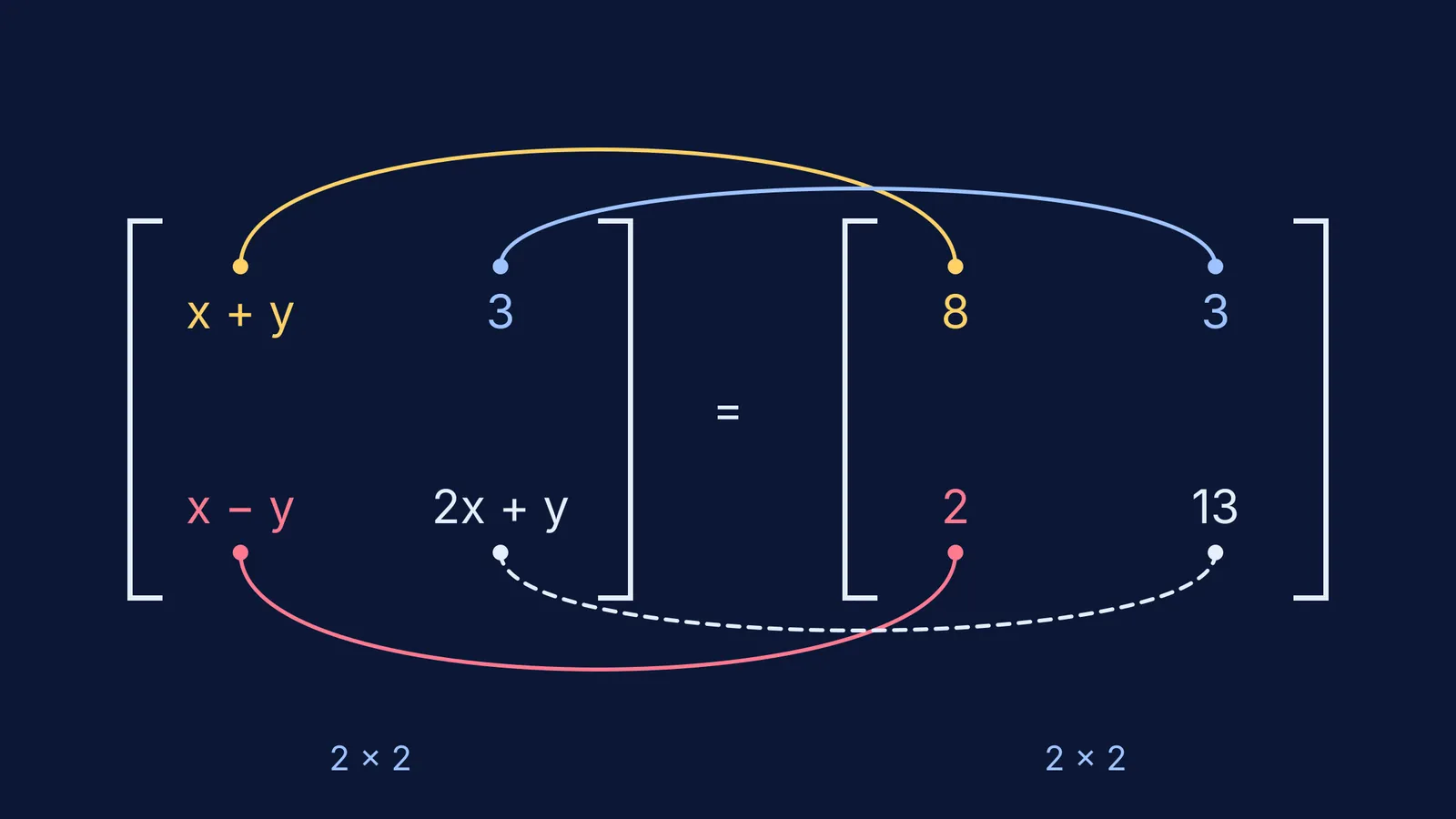
Here is a worked example. Find x and y if [x + y, 3; x − y, 2x + y] = [8, 3; 2, 13], where a semicolon separates the rows.
Order: both are 2 × 2, so expect 4 equations.
Row 1: x + y = 8, and 3 = 3 (true, nothing new).
Row 2: x − y = 2, and 2x + y = 13.
Add the first two equations: 2x = 10, so x = 5, and then y = 3.
Check the unused equation: 2(5) + 3 = 13. It holds, so x = 5 and y = 3.
That step is Class 10 elimination; our guide to linear equations in two variables by substitution, elimination and graphs revises it.
What if the equations disagree or give two answers?
NCERT's own exercise sets this trap. Exercise 3.1, question 9, asks which values of x and y make [3x + 7, 5; y + 1, 2 − 3x] equal to [0, y − 2; 8, 4] (NCERT Class 12 Maths, Chapter 3). The top-left entries give 3x + 7 = 0, so x = −7/3. The bottom-right entries give 2 − 3x = 4, so x = −2/3. One x cannot take two values, so the matrices cannot be equal, which is why "Not possible to find" is among the options. Both y equations agree (y = 7), which makes the wrong options tempting if you stop early.
The opposite trap is an equation that is not linear. Question 6(ii) in the same exercise leads to x + y = 6, 5 + z = 5 and xy = 8. Here z = 0, and x and y are the roots of t² − 6t + 8 = 0, so (x, y) = (2, 4) or (4, 2). Write both pairs; stopping at one gives an incomplete answer.
What should you check before writing the final answer?
Same order on both sides? If not, no values exist.
One equation for every position, so the count equals rows × columns.
Every constant position, such as 3 = 3, is actually true.
Every equation you did not use still holds with your values.
Any non-linear equation (xy, x², √x)? List every solution, then check each one.
The same habit of equating entries comes back in bigger matrix questions, from symmetric and skew-symmetric matrices, where you set A equal to its transpose, to the shortcuts in matrices and determinants for JEE.
For more practice, the Fermi Problem Library has worked problems with a step-by-step solver that explains the reasoning rather than printing an answer, so you can see exactly which equation was set up wrong. If the definitions themselves feel shaky, the Fermi Concept Library gives each mathematics concept its own lesson.
Next time you see two equal matrices, count the equations before you solve them.


