

On this page
When an object is dropped from rest, gravity causes its speed to increase continuously. Because it travels faster with each passing metre, it takes less and less time to cover each new block of distance. The ratio of times taken to fall successive equal distances is a standard result in kinematics, often tested in exams because it relies on taking the difference between square roots.
What is the time to fall successive equal distances ratio?
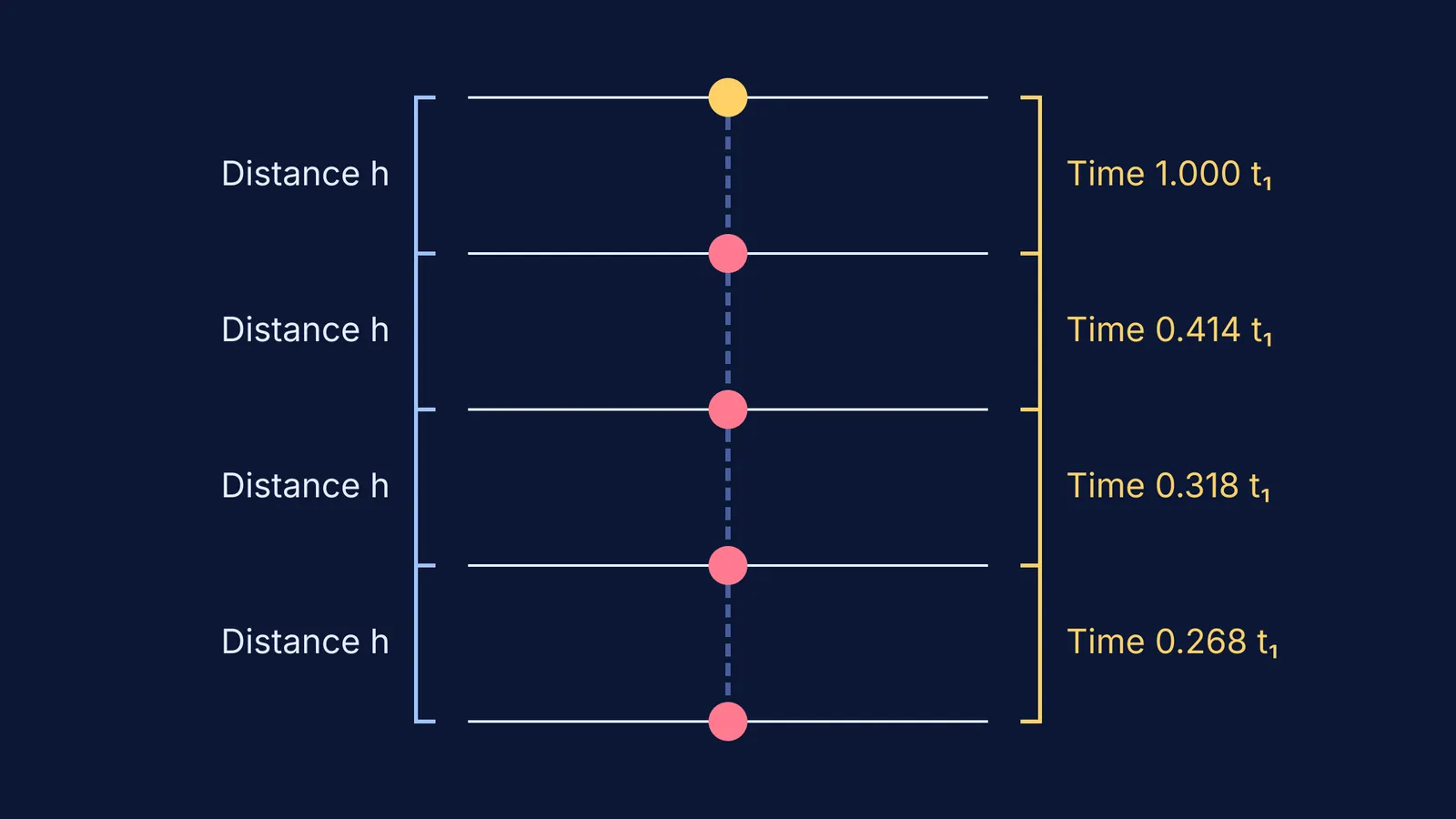
For a body falling freely from rest in a vacuum, the ratio of the times taken to fall successive equal distances is 1 : (√2 − 1) : (√3 − √2) : (√4 − √3), and so forth.
As the object continues to fall, each successive equal distance is covered in a shorter time. The first block takes the longest, the second takes about 41% of the original time, and the third takes about 32% (Wikipedia). If you were to measure the first four intervals, the times would scale as 1.000 : 0.414 : 0.318 : 0.268.
How do you derive the ratio?
The standard kinematic equations for a falling body give the distance d fallen in time t from rest as d = 1/2 gt², which rearranges to t = √(2d/g) (Wikipedia).
Imagine a tall tower marked out in equal intervals of height h. Let us find the time taken to cross each interval:
First interval (0 to h): The total distance fallen from the top is h. The time taken is t₁ = √(2h/g).
Second interval (h to 2h): The time to fall the total distance 2h from the top is t_total = √(4h/g) = √2 × t₁. The time taken for this second interval *only* is the difference: √2 × t₁ − t₁ = (√2 − 1)t₁.
Third interval (2h to 3h): The time to fall the total distance 3h from the top is √(6h/g) = √3 × t₁. The time taken for this third interval *only* is √3 × t₁ − √2 × t₁ = (√3 − √2)t₁.
Fourth interval (3h to 4h): Following the pattern, the time to reach 4h is √4 × t₁ = 2t₁. The interval time is √4 × t₁ − √3 × t₁ = (√4 − √3)t₁.
Comparing these interval times, the ratio for the successive equal distances h is exactly 1 : (√2 − 1) : (√3 − √2) : (√4 − √3).
If you struggle to picture how distance and time scale together, the Fermi Concept Library holds every concept in physics, chemistry, biology, mathematics and computing, each with its own lesson and its place in the map.
Why does the time decrease for each interval?
Because gravity constantly pulls on the object, its velocity increases by approximately 9.8 m/s every second. By the time it enters the second interval of distance, it is already moving quickly, so it sweeps through that same distance h in a fraction of the original time (√2 − 1 ≈ 0.414). By the third interval, it is going even faster, completing it in an even smaller fraction (√3 − √2 ≈ 0.318).
Do not confuse this with another famous kinematic rule. Galileo's law of odd numbers states that the *distances* fallen in successive equal *time* intervals are in the ratio of 1 : 3 : 5 : 7. The situation is flipped: if you fix the time intervals, the distances grow; if you fix the distance intervals, the times shrink.
This logic applies strictly to one-dimensional motion under constant acceleration, just as analyzing the distance in the nth second requires careful use of the sₙ formula. For motion in two dimensions, you would instead separate the components to find the equation of trajectory of a projectile.
What happens if the object is thrown downwards?
The ratio 1 : (√2 − 1) : (√3 − √2) only works if the initial velocity is zero. If you throw the object downwards, it starts with an initial velocity u > 0. The times for successive equal distances will still decrease because the object is still accelerating, but they will no longer follow this exact mathematical ratio. The time equation becomes a quadratic equation (h = ut + 1/2 gt²), meaning the square root trick no longer isolates the time neatly.
How do you solve problems on this ratio?
When a question tests this concept, it usually asks you to compare specific intervals or provides the time for one block and asks for another. You do not need to recalculate from scratch every time; you can apply the ratio derived from standard kinematics directly (Wikipedia).
Worked Example: A stone is dropped from a cliff and takes 2 seconds to fall the first 20 metres. How long will it take to fall the next 20 metres?
Identify that the distances are successive and equal (both 20 metres) and the stone is dropped from rest.
Use the ratio for the first two intervals: t₁ : t₂ = 1 : (√2 − 1).
Substitute the known time: t₁ = 2 s.
Calculate t₂: t₂ = 2 × (√2 − 1).
Since √2 ≈ 1.414, the time t₂ = 2 × 0.414 = 0.828 s.
This confirms the physics: the second 20-metre block takes less than half the time of the first block. If you often get stuck substituting the wrong variables into kinematics equations, the Fermi Problem Library has worked problems with a step-by-step solver that explains the reasoning rather than printing an answer.


