

On this page
When working with real numbers, finding an unknown is straightforward algebra. Complex numbers are different because they have two separate components. According to the mathematical definition of a complex number on Wikipedia, two complex numbers are equal if and only if their real parts are equal and their imaginary parts are equal.
This double condition is powerful. A single complex equation gives you two separate real equations, allowing you to solve for two unknown variables at the same time.
What does it mean for complex numbers to be equal?
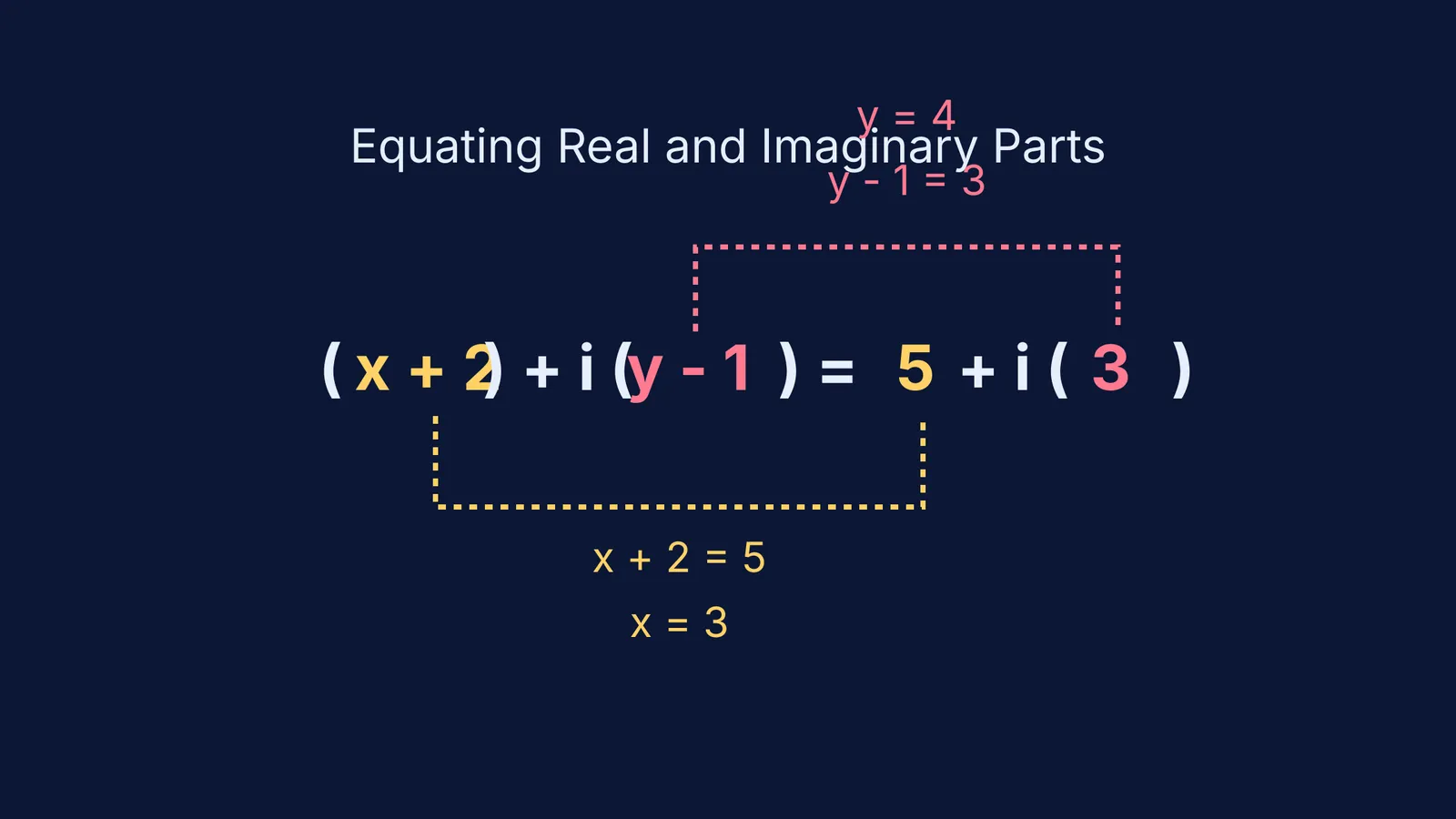
If you have two complex numbers in the standard form a + ib and c + id, setting them equal means:
a + ib = c + id
This is true only if:
a = c (the real parts match)
b = d (the imaginary parts match)
You cannot equate a real part to an imaginary part. They exist on different axes of the complex plane and do not mix. If you need a refresher on the basics of these numbers, the Fermi Concept Library explains the geometry of the real and imaginary axes.
When you equate the parts, you take a single statement in the complex plane and convert it into a system of two linear equations. This forms the foundation for solving many algebraic problems in complex analysis.
How do you find real x and y if complex numbers are equal?
When a problem asks you to find the real numbers x and y from a complex equation, you can rely on a consistent four-step framework:
Simplify both sides: Expand all brackets, collect terms, and clear any fractions that have i in the denominator.
Write in standard form: Rearrange the equation into (Real) + i(Imaginary) = (Real) + i(Imaginary).
Equate the parts: Create one equation by setting the real parts equal, and a second equation by setting the imaginary parts equal.
Solve the system: Solve the two simultaneous equations for x and y.
How do you simplify fractions with i?
Let's look at a common problem type where the unknowns are mixed with fractions.
Find real x and y if: (x - iy) / (1 + i) = 1 - 3i
Step 1: Simplify both sides We need to remove the fraction. The easiest way is to multiply both sides by (1 + i). x - iy = (1 - 3i)(1 + i)
Now, expand the brackets on the right: x - iy = 1 + i - 3i - 3i²
Since i² = -1, substitute it in: x - iy = 1 - 2i - 3(-1) x - iy = 1 - 2i + 3 x - iy = 4 - 2i
Step 2: Write in standard form The left side is x + i(-y), and the right side is 4 + i(-2). They are now matched up. (If you struggle to break down complex expressions, the step-by-step solver in the Fermi Problem Library will show you exactly how to group the real and imaginary terms.)
Step 3: Equate the parts
Real parts: x = 4
Imaginary parts: -y = -2
Step 4: Solve the system The equations are already isolated. x = 4 y = 2
What if there are fractions on both sides?
What if the variables themselves are part of the fraction?
Find real x and y if: x / (1 + i) + y / (1 - i) = 5 / 2
Here, we need a common denominator. The product of the denominators is (1 + i)(1 - i). This is a difference of squares: 1² - i² = 1 - (-1) = 2. Multiply the entire equation by 2 to clear the fraction on the right, and then multiply by the cross terms on the left:
x(1 - i) + y(1 + i) = 5
Expand the brackets: x - ix + y + iy = 5
Group the real terms and the imaginary terms: (x + y) + i(-x + y) = 5 + 0i
Equate the real parts: x + y = 5
Equate the imaginary parts: -x + y = 0 This means y = x.
Substitute y = x into the real equation: x + x = 5 2x = 5 x = 5/2
Since y = x, y = 5/2. Both variables are 5/2.
What happens if the equation involves the complex conjugate?
Sometimes, an equation asks you to find a complex number z, rather than explicitly naming x and y. If the equation includes both z and its complex conjugate z̄, you can solve it using this exact same method.
First, substitute z = x + iy and z̄ = x - iy into the equation. Then, group all the real terms together and all the imaginary terms together. Once you have the equation in standard form, you can equate the real and imaginary parts to find x and y. The resulting values give you the components of your unknown number z.
By pushing through the algebra to reach standard form, every complex equation breaks down into a familiar system of linear equations. You can see more techniques for handling these expressions in our guides on Solving equations in complex numbers by putting z = x + iy and Using z z̄ = |z|² to simplify complex number problems.


