

On this page
If you draw two chords of identical length anywhere in a circle, they will always sit at the exact same distance from the centre. This rule, listed as Theorem 9.6 in the rationalised NCERT Class 9 Mathematics textbook, connects the length of a chord to its perpendicular distance from the origin.
Understanding why this is true relies on basic triangle congruence, and it gives you a quick way to find missing lengths in geometry problems without having to measure anything manually.
What is the rule for equal chords and their distance?
The distance from the centre of a circle to a line is always measured along the shortest path, which is the perpendicular line. If you take any two equal chords in a circle, and draw a perpendicular line from the centre to each of those chords, those two perpendicular segments will be exactly equal in length.
This property is not just limited to a single circle. It also applies across congruent circles. If you have two identical circles with the same radius and draw a 10 cm chord in each, both of those chords will be at the exact same distance from their respective centres.
How do you prove equal chords are equidistant from the centre?
You can prove this theorem using the right angle-hypotenuse-side (RHS) congruence rule. Here is the step-by-step reasoning that shows why the distances must be identical:
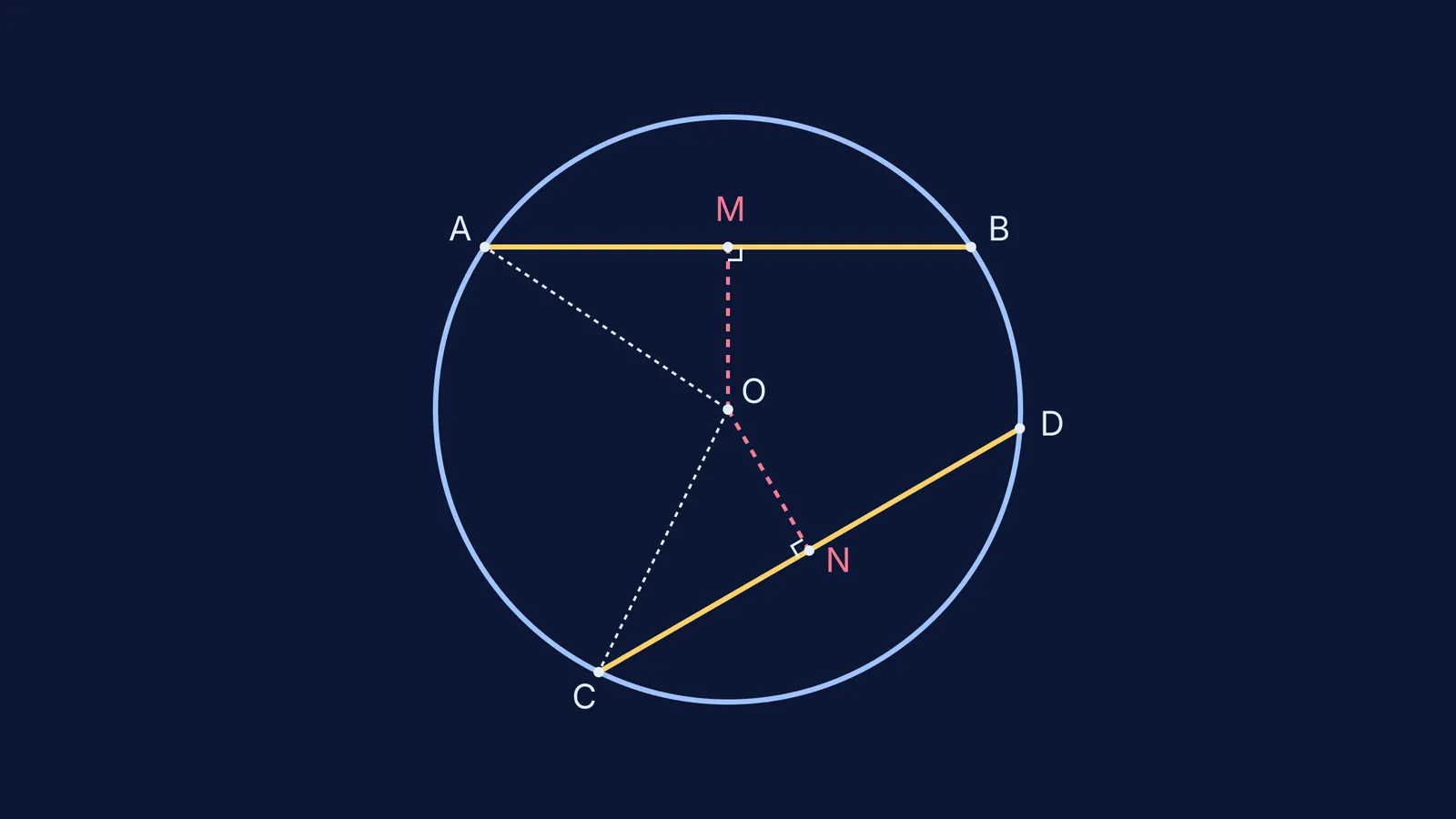
Draw a circle with centre O. Draw two equal chords, AB and CD, so that AB = CD.
Drop a perpendicular line from the centre O to chord AB (meeting at point M), and another from O to chord CD (meeting at point N).
A key circle property is that a perpendicular dropped from the centre bisects the chord. This means it cuts the chord exactly in half, so AM = MB and CN = ND. Since the full chords are equal (AB = CD), their halves must also be equal to each other (AM = CN).
Draw lines from the centre to the edge of the circle to form the radii OA and OC.
You now have two right-angled triangles: ΔOMA and ΔONC. Let us compare their parts:
Both have a right angle by construction: ∠OMA = ∠ONC = 90°.
Their hypotenuses are equal because they are radii of the exact same circle: OA = OC.
One side is equal because they are halves of equal chords: AM = CN.
Because a right angle, the hypotenuse, and one corresponding side match, the triangles are congruent by the RHS rule: ΔOMA ≅ ΔONC.
Since the triangles are exactly the same size and shape, all their corresponding parts are equal (this is known as CPCT). Therefore, OM = ON.
Because OM and ON are the perpendicular distances from the centre to the chords, the two distances are equal, completing the proof.
How do you find chord length from distance and radius?
You can use the perpendicular distance and the radius to calculate the length of any chord. Since the radius, the perpendicular distance, and half the chord form a right-angled triangle, you can simply use Pythagoras' theorem to find the missing side.
Suppose a circle has a radius of 5 cm, and its centre is 3 cm away from a given chord. How long is the chord?
Let the chord be AB, and the perpendicular distance from the centre be OM = 3 cm. The radius is OA = 5 cm. In the right-angled triangle ΔOMA, we know the hypotenuse and one side:
AM² + OM² = OA² AM² + 3² = 5² AM² + 9 = 25 AM² = 16
Taking the square root, you find that AM = 4 cm. Because the perpendicular from the centre bisects the chord, AM is only half the chord's length. The total length of the chord is double that distance: 2 × 4 = 8 cm.
When geometry problems ask for multiple steps—such as finding a missing distance first, then using it to calculate a chord length—it is easy to lose track of which side belongs to which triangle. The Fermi Problem Library has worked problems with a step-by-step solver that explains the reasoning rather than printing an answer. If you are still unsure how the right-angled triangles fit together, Fermi's AI tutor teaches rather than answers: it notices where you are stuck, decides whether to explain, ask or show, and draws the figure to check your understanding as it goes.
If you are revising for exams, it helps to connect this concept to other geometry rules. Read our guides on Circles in Class 9: chords, arcs and cyclic quadrilaterals and Congruent triangles in Class 9: SAS, ASA, SSS and RHS to see how these theorems build on each other.


