

On this page
When you mix a strong acid and a strong base, the reaction reliably releases -57.3 kJ/mol of heat. But swap the strong acid for a weak one, like hydrocyanic acid (HCN), and the thermometer tells a different story. The neutralisation of HCN with sodium hydroxide releases only -12.0 kJ/mol.
This shortfall is not an experimental error or a loss of heat to the surroundings. It is the energy required to force the weak acid to fully dissociate into its constituent ions. By carefully measuring how much heat is "missing" from the reaction, you can calculate exactly how strongly the weak acid holds onto its hydrogen ion, giving you a direct measure of its bond strength in solution.
What is the enthalpy of neutralisation?
The enthalpy of neutralisation is the heat energy released when one mole of hydrogen ions (H⁺) from an acid reacts with one mole of hydroxide ions (OH⁻) from a base to form water.
For a strong acid (like HCl) and a strong base (like NaOH), both compounds are completely ionised in solution. The only reaction taking place is:
H⁺(aq) + OH⁻(aq) → H₂O(l)
Because this same net reaction happens no matter which strong acid and strong base you use, the standard enthalpy of neutralisation is almost always a constant -57.3 kJ/mol. The negative sign is a thermodynamic convention indicating that the process is exothermic—it releases heat energy from the chemical system into the surrounding water, causing the temperature of the solution to rise.
Why does a weak acid release less heat?
Hydrocyanic acid (HCN) is a classic example of a very weak acid. In a typical aqueous solution, only a tiny fraction of its molecules dissociate naturally into cyanide ions (CN⁻) and hydrogen ions (H⁺). The vast majority of the acid remains completely intact as un-ionised HCN molecules floating in the water.
For neutralisation to complete, these intact molecules must be forced to ionise. Breaking the H-CN bond to release the hydrogen ion requires an input of energy. This process is endothermic.
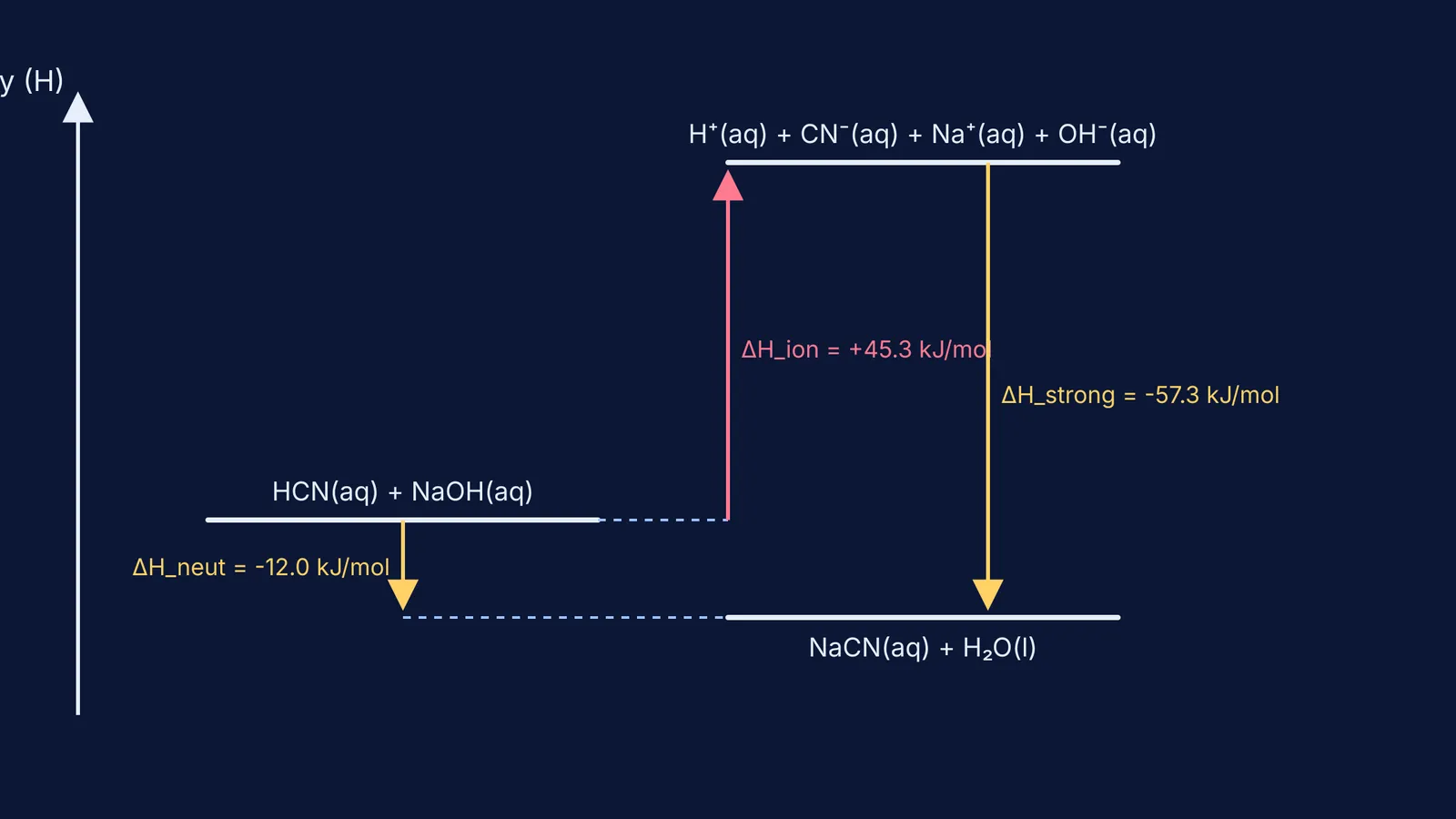
When you add NaOH, the hydroxide ions react with the available H⁺ ions, releasing -57.3 kJ/mol of heat. However, a large portion of this released heat is immediately absorbed to ionise the rest of the HCN. Because this heat is consumed internally, the net heat released to the surroundings is lower. For HCN, the net enthalpy of neutralisation drops to -12.0 kJ/mol.
How to find the enthalpy of ionisation from neutralisation data?
The energy consumed to dissociate the acid is called the enthalpy of ionisation (ΔH_ionisation). You can calculate it directly by taking the difference between the measured weak-acid neutralisation heat and the expected strong-acid neutralisation heat.
The relationship is essentially an application of Hess's Law, similar to how we add up enthalpies of atomisation and sublimation to find total energy changes:
ΔH_neutralisation = ΔH_ionisation + ΔH_strong
Rearranging for the enthalpy of ionisation:
ΔH_ionisation = ΔH_neutralisation − ΔH_strong
Worked example: Hydrocyanic acid (HCN)
Using the standard values for HCN:
Measured neutralisation: -12.0 kJ/mol
Strong acid baseline: -57.3 kJ/mol
ΔH_ionisation = (-12.0) − (-57.3)
ΔH_ionisation = +45.3 kJ/mol
Because HCN holds onto its hydrogen ion so tightly—a behaviour mathematically governed by its small acid dissociation constant and the relative strength of its conjugate acid-base pair—it requires a massive 45.3 kJ/mol of energy just to pull it apart. This large energy cost dominates the reaction, leaving very little net heat to actually escape into the surroundings and warm the solution.
If you are studying chemical thermodynamics for exams, the Fermi Concept Library breaks down Hess's law and enthalpy cycles so you can see exactly where the energy goes. When you are practising numericals on weak acids and buffers and keep dropping minus signs, Fermi's AI tutor can check your understanding as you go and help you spot the mistake step by step.


