

On this page
Directly synthesising most organic compounds from pure graphite, hydrogen gas, and oxygen is practically impossible in a laboratory. Carbon and hydrogen react under heat to form complex mixtures of hydrocarbons rather than a single pure substance. Instead, chemists measure heat released during complete combustion in a bomb calorimeter at constant volume, convert it to constant-pressure enthalpy, and reconstruct the formation pathway indirectly.
The foundation of this calculation is Hess's law of constant heat summation, formulated by chemist Germain Henri Hess in 1840 and explained in Chemistry LibreTexts/05%3A_Thermochemistry/5.06%3A_Hess's_Law). Hess established that because enthalpy is a thermodynamic state function, the net enthalpy change of a reaction depends solely on the initial and final states, remaining independent of the reaction pathway. If a direct synthesis cannot be carried out cleanly, you can build an indirect thermochemical cycle using known combustion reactions. The Fermi Concept Library connects thermodynamic definitions to full reaction pathways, mapping how individual state functions interact.
How do you write and manipulate thermochemical equations for Hess's law?
To assemble a valid thermochemical cycle, you manipulate individual stoichiometric equations so that adding them algebraically cancels every unwanted intermediate, leaving only the desired formation reaction. The four operational rules detailed in Chemistry LibreTexts thermochemistry guides/05%3A_Thermochemistry/5.07%3A_Enthalpies_of_Formation) include:
State the target formation reaction: Define the synthesis of exactly 1 mole of the substance from its constituent elements in their reference standard states at 298.15 K and 1 bar pressure.
Balance elemental combustion equations: Write the complete combustion reaction for each constituent element, producing carbon dioxide gas and liquid water.
Multiply by stoichiometric coefficients: If the target compound contains n atoms of carbon or m atoms of hydrogen, multiply the combustion equations for carbon and hydrogen by n and m/2 respectively, scaling their standard enthalpy of combustion (Δc H°) by the same factor.
Reverse the compound's combustion equation: Place the target compound on the product side by reversing its combustion reaction, which flips the algebraic sign of its enthalpy change from negative to positive.
When you add these modified equations, identical chemical species appearing on opposite sides of the reaction arrow cancel out completely.
How to calculate enthalpy of formation of ethanol from combustion data?
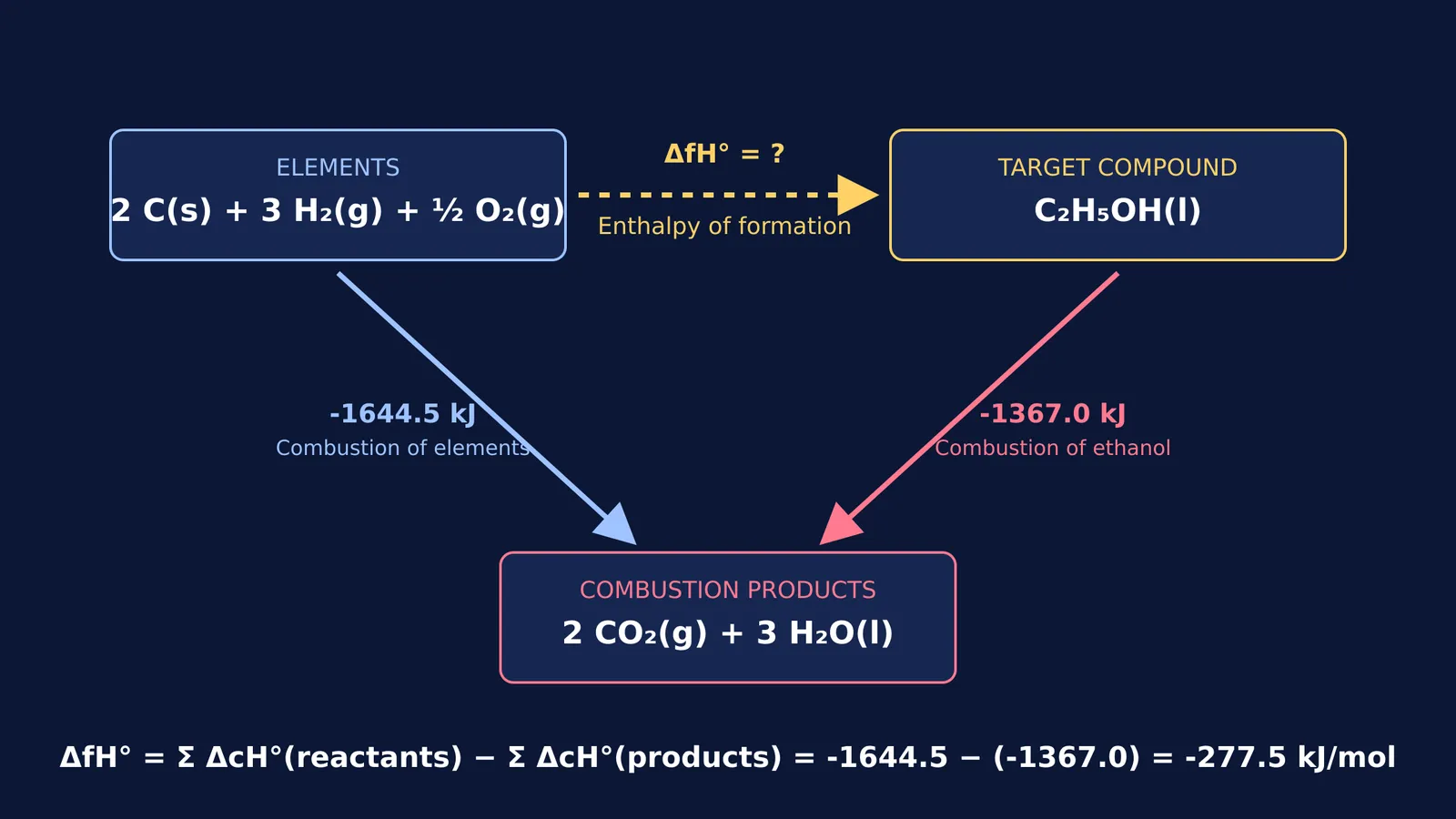
Consider determining the standard molar enthalpy of formation of liquid ethanol, C₂H₅OH(l). The target reaction forms 1 mole of liquid ethanol from graphite, hydrogen gas, and oxygen gas:
2 C(s, graphite) + 3 H₂(g) + ½ O₂(g) → C₂H₅OH(l)
According to the NIST Chemistry WebBook for carbon dioxide, the complete combustion of 1 mole of graphite releases 393.51 kJ:
C(s, graphite) + O₂(g) → CO₂(g), Δc H° = −393.51 kJ/mol
As reported in the NIST Chemistry WebBook for water, the combustion of 1 mole of dihydrogen gas to liquid water releases 285.83 kJ:
H₂(g) + ½ O₂(g) → H₂O(l), Δc H° = −285.83 kJ/mol
For liquid ethanol, benchmark calorimetric measurements by J. H. S. Green in 1960 catalogued in the NIST Chemistry WebBook for ethanol show a standard enthalpy of combustion of −1367.0 kJ/mol:
C₂H₅OH(l) + 3 O₂(g) → 2 CO₂(g) + 3 H₂O(l), Δc H° = −1367.0 kJ/mol
Now scale and reverse the reactions to align with the target:
Multiply the carbon combustion equation by 2:
2 C(s, graphite) + 2 O₂(g) → 2 CO₂(g), ΔH₁ = 2 × (−393.51 kJ) = −787.02 kJ
Multiply the hydrogen combustion equation by 3:
3 H₂(g) + 1.5 O₂(g) → 3 H₂O(l), ΔH₂ = 3 × (−285.83 kJ) = −857.49 kJ
Reverse the combustion equation of ethanol:
2 CO₂(g) + 3 H₂O(l) → C₂H₅OH(l) + 3 O₂(g), ΔH₃ = −(−1367.0 kJ) = +1367.0 kJ
Summing the three equations cancels 2 moles of CO₂(g), 3 moles of H₂O(l), and 3 moles of O₂(g) across reactants and products, leaving exactly ½ mole of O₂(g) on the reactant side. Summing the enthalpy changes produces:
Δf H° = ΔH₁ + ΔH₂ + ΔH₃ = −787.02 kJ + (−857.49 kJ) + 1367.0 kJ = −277.51 kJ/mol
This derived value matches the accepted standard molar enthalpy of formation of liquid ethanol within 0.1 kJ/mol of the NIST reference value of −277.6 kJ/mol.
Why do students make sign mistakes with combustion cycles?
A frequent stumbling block in competitive exams like JEE Main and NEET-UG is confusing the standard formation formula with the combustion formula. When calculating reaction enthalpies from enthalpies of formation, you compute products minus reactants:
Δr H° = Σ m Δf H°(products) − Σ n Δf H°(reactants)
However, when working with enthalpies of combustion, the relationship reverses:
Δr H° = Σ n Δc H°(reactants) − Σ m Δc H°(products)
In a combustion cycle, the reactants burn to form combustion oxides (carbon dioxide and water), while the chemical products must be assembled by reversing their own combustion reactions. Because combustion reactions are exothermic and carry negative values, subtracting the product's combustion enthalpy introduces a double negative that correctly reflects the energy required to rebuild the molecule from its combustion oxides.
Understanding how thermochemical quantities relate to enthalpies of atomisation and phase change and heat capacities in isobaric and isochoric processes prevents sign errors under timed test conditions. The Fermi Problem Library provides worked problems with a step-by-step solver that explains the reasoning rather than printing an answer.


