

On this page
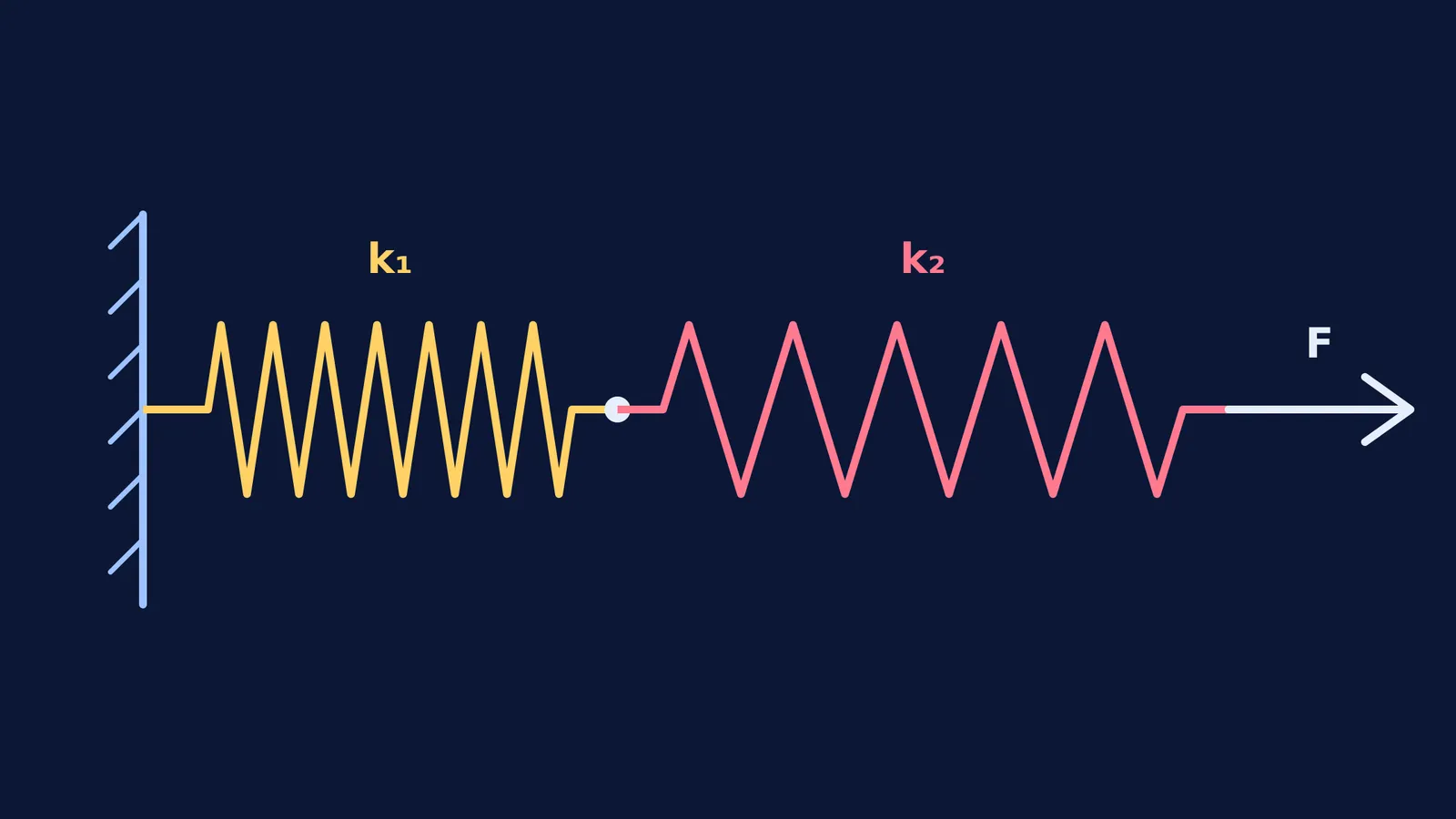
When you connect two springs end-to-end, their behaviour changes compared to a single spring or a parallel setup. If you pull on the end of the chain, both springs stretch, but they do not necessarily store the same amount of energy. To find the ratio of the energy they store, you need to look at what they share: the force passing through them.
What is the ratio of energy stored in two springs in series?
The first step is to establish what stays constant. Any external force applied to an arrangement of springs in series passes through each spring without a change in magnitude. According to Wikipedia's definitions, F_eq = F₁ = F₂, meaning both springs experience the exact same force F.
The standard formula for the elastic potential energy stored in a single spring is U = 1/2 kx², where k is the spring constant and x is the displacement from equilibrium, as derived in OpenStax University Physics. We also know from Hooke's Law that F = kx, which means we can rewrite the displacement as x = F/k.
If we substitute this into the energy formula, we get: U = 1/2 k (F/k)² = F² / 2k
Since the force F is identical for both springs, the energy stored in the first spring is U₁ = F² / 2k₁, and the energy stored in the second is U₂ = F² / 2k₂.
Dividing the two gives the energy ratio: U₁ / U₂ = k₂ / k₁
Why does the softer spring store more energy?
Because the ratio U₁/U₂ is equal to k₂/k₁, the energy stored in each spring is inversely proportional to its spring constant. This leads to an important counterintuitive result: the softer spring (the one with the smaller k) stores more energy than the stiffer spring.
You can understand this by thinking about work. Work is force multiplied by distance. Since both springs experience the identical force pulling on them, the amount of work done on each spring depends entirely on how far it stretches. A softer spring requires a much larger displacement x to push back with the same restoring force F. Because it stretches further under the same load, it absorbs more work and stores more potential energy.
How do you find the equivalent spring constant for springs in series?
When two springs are in series, they stretch by different amounts depending on their individual stiffness. The total stretch of the system is the sum of the individual displacements: x_total = x₁ + x₂.
Substituting the force equations (x₁ = F/k₁ and x₂ = F/k₂), we get x_total = F/k₁ + F/k₂ = F(1/k₁ + 1/k₂). Since the equivalent spring constant k_eq is defined by x_total = F/k_eq, we can match the terms to see that 1/k_eq = 1/k₁ + 1/k₂.
This means the equivalent spring is always softer than the softest individual spring in the chain. When you calculate the total energy stored in the combined system, you can verify your work by checking that:
The total displacement is x_total = x₁ + x₂
The total energy is U_total = U₁ + U₂
The equivalent spring constant satisfies 1/k_eq = 1/k₁ + 1/k₂
This consistency is a good way to verify your calculations when checking answers.
How does this compare to springs in parallel?
If you were to set the springs side-by-side (in parallel) and pull on a block attached to both, the situation flips. In a parallel arrangement, the block forces both springs to stretch by the exact same distance x.
Because displacement is constant, you should use the standard formula U = 1/2 kx². In this case, the ratio of the energy stored is directly proportional to the spring constants: U₁ / U₂ = k₁ / k₂. When displacement is fixed, the stiffer spring does more work and stores more energy. This principle also applies to other stretched materials, such as finding the elastic potential energy in a stretched wire.
How does an AI tutor help you solve spring systems?
Students often struggle with spring problems because they grab the first equation they remember—usually U = 1/2 kx²—without checking whether the system keeps the force or the displacement constant. You can see similar issues when tracking the accelerations at the instant a string is cut, where assumptions about tension can quickly derail a solution.
When you're practicing mechanics on the Fermi Problem Library, the AI tutor often notices where a student is stuck and decides whether to explain, ask, or show the next step. If you try to use the wrong formula for a series circuit, Fermi stops to ask you what physical quantity must be shared between the two springs, helping you build a reflex to check for constants before calculating. You can review these derivations visually in the Fermi Concept Library.


