

On this page
Why is electromotive force not a force?
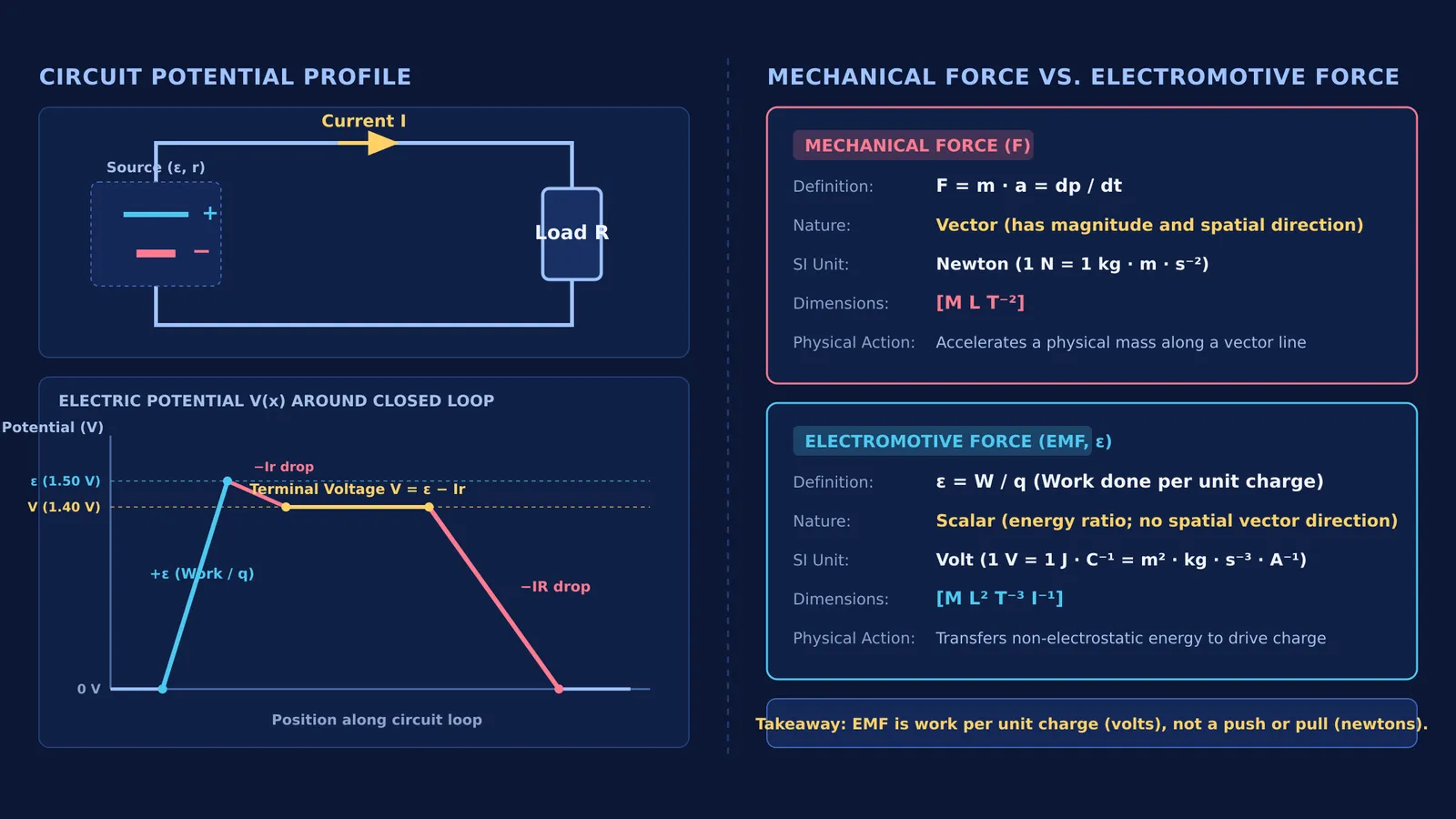
If you look at the name electromotive force, often abbreviated as EMF or written as the symbol ε, it sounds like a push or pull that can accelerate a mass. Yet its standard unit is the volt, not the newton. Under the International System of Units documented in NIST Special Publication 330, the volt is the derived unit of electric potential difference and electromotive force, defined as one joule per coulomb (1 V = 1 J/C) or m²·kg·s⁻³·A⁻¹ in SI base units. In contrast, mechanical force has dimensions [M L T⁻²] and is measured in newtons (1 N = 1 kg·m·s⁻²).
Electromotive force is a scalar quantity measuring the energy supplied per unit of electric charge by a source. When a source such as a chemical cell, generator, or solar panel drives current, it performs work to move charge carriers from lower to higher potential inside the device. The formal definition of EMF is the work done per unit charge in carrying that charge once around a closed circuit loop:
ε = W / q
Because work is measured in joules and charge in coulombs, EMF is an energy ratio. A mechanical force accelerates a mass along a vector direction. EMF has no spatial direction; it describes how many joules of non-electrostatic energy are converted into electrical potential energy for every coulomb that passes through the source.
Where did the name electromotive force come from?
The term is an enduring historical leftover. In 1800, Italian physicist Alessandro Volta reported his invention of the electric battery to the Royal Society of London in a landmark paper titled "On the electricity excited by the mere contact of conducting substances of different kinds". Volta observed that alternating discs of zinc and silver separated by brine-soaked cardboard produced a continuous flow of electricity. He called the driving agency "force motrice électrique," translated into English as electromotive force.
In Volta's era, the modern physical distinction between force, energy, and work had not yet solidified. As physicists Robert N. Varney and Leon H. Fisher noted in the American Journal of Physics, 19th-century natural philosophers routinely used "force" for any cause of change, including living force for kinetic energy. By the time James Prescott Joule clarified the mechanical equivalent of heat and the volt was officially adopted in 1881, the phrase was already entrenched. You can see how Volta's experiments challenged early electrostatic thinking in our story on Alessandro Volta's invention of the chemical battery.
How does EMF differ from potential difference in a circuit?
In high school physics and entrance exams like JEE Main and NEET-UG, students often confuse EMF with terminal potential difference. A study by Isabel Garzón and colleagues in the American Journal of Physics surveyed university physics students and found that conceptual errors happen when learners ignore the overall energy balance of the circuit.
The distinction between EMF and potential difference rests on where and how energy is transformed:
Source mechanism: Electrostatic potential difference arises from Coulomb fields between stationary charges, where the closed loop integral is zero (∮ E·dl = 0). EMF arises from non-electrostatic mechanisms, such as chemical reactions in a cell or changing magnetic flux in an induction loop.
Circuit condition: EMF is the potential difference across a source's terminals on open circuit, when no current flows.
Internal resistance: When current I flows, internal electrolyte resistance r creates a voltage drop. The terminal voltage V becomes V = ε − I × r.
Energy role: EMF quantifies energy supplied to the charges by the source, whereas terminal voltage measures energy delivered by the charges to the external circuit.
To trace how multiple cells interact, see our guides on combining cells with internal resistance and the node potential method for complex circuits. For students building intuition across electrostatics and current electricity, the Fermi Concept Library covers every concept in physics, chemistry, biology, mathematics and computing, each with its own lesson and its place in the map.
How do you calculate work and EMF in an exam problem?
A worked calculation based on the standard energy balance formulation referenced in NIST Special Publication 330 makes the energy-per-charge principle clear.
Problem: A cell with an open-circuit EMF of ε = 1.50 V and internal resistance r = 0.20 Ω is connected to a load resistor of R = 2.80 Ω for t = 4.0 seconds. Calculate the current, charge moved, chemical work done, and terminal voltage.
Step-by-step solution:
Find the circuit current:
Total resistance R_total = 2.80 Ω + 0.20 Ω = 3.00 Ω Current I = ε / R_total = 1.50 V / 3.00 Ω = 0.50 A
Find the charge transferred in 4.0 seconds:
q = I × t = 0.50 A × 4.0 s = 2.0 C
Calculate the work done by the cell:
Using ε = W / q, the work is: W = ε × q = 1.50 V × 2.0 C = 3.0 J The chemical source supplies 3.0 joules of electrical energy to the circuit. No force in newtons appears anywhere in this calculation.
Find the terminal voltage:
Internal drop = I × r = 0.50 A × 0.20 Ω = 0.10 V Terminal voltage V = ε − I × r = 1.50 V − 0.10 V = 1.40 V The external resistor receives V × q = 1.40 V × 2.0 C = 2.80 J, while 0.20 J is lost as heat inside the cell (I² × r × t = 0.20 J), satisfying energy conservation (2.80 J + 0.20 J = 3.0 J).
When tackling tricky circuit problems with internal resistance or back-EMF, the Fermi Problem Library provides worked problems with a step-by-step solver that explains the reasoning rather than printing an answer.


