

On this page
When an ellipse is centered at the origin, its equation is neatly packed into x²/a² + y²/b² = 1. But in exams like JEE Main and coordinate geometry problem sets, the centre is rarely sitting perfectly at (0, 0).
If the ellipse has moved across the Cartesian plane, you have to find its new centre, its foci, and its vertices from an expanded general quadratic equation. This requires understanding how shifting the centre changes the standard equation and mastering the algebraic technique of completing the square.
What is the equation of an ellipse with centre not at origin?
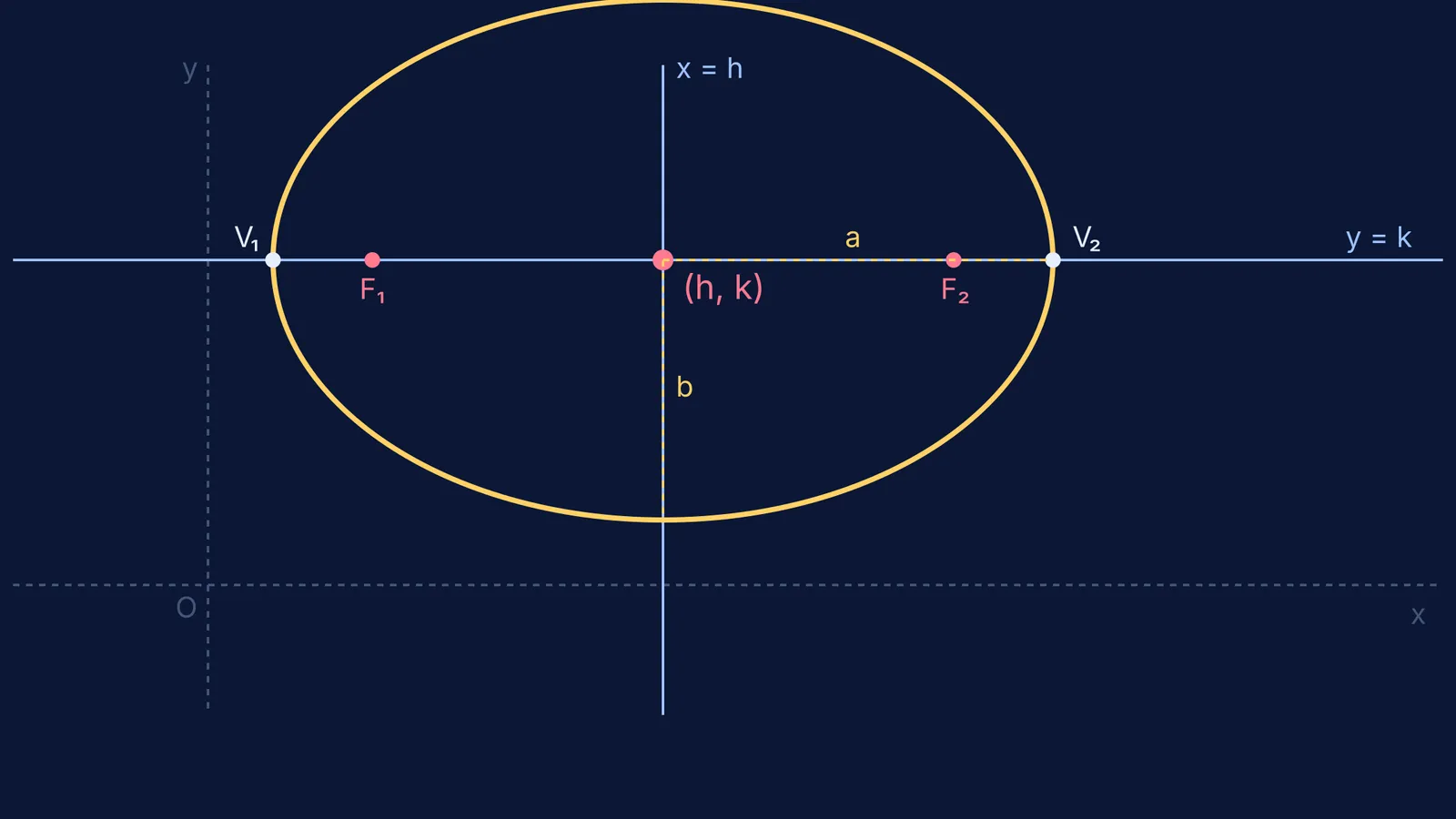
The standard form of the equation of an ellipse with its centre at (h, k) depends on the direction of its major axis. According to the Wikipedia article on the ellipse, for a horizontal major axis, the equation is:
(x − h)²/a² + (y − k)²/b² = 1
Here, a is the semi-major axis (the distance from the centre to a horizontal vertex), and b is the semi-minor axis. For a vertical major axis, where the ellipse is taller than it is wide, the a² and b² swap places beneath the y and x terms. The equation becomes:
(x − h)²/b² + (y − k)²/a² = 1
Everything about the ellipse shifts by h in the x-direction and k in the y-direction. If you already know how to calculate the focal distances on an ellipse when it is located at the origin, the underlying mathematics remains identical. You simply add h and k to the resulting coordinates to find the new positions on the graph. The relationships between the axes, such as c² = a² − b², do not change when the shape is shifted.
How do you find the centre, foci and vertices by completing the square?
Exam questions often disguise the properties of the ellipse by presenting it in a general quadratic form, which looks like this:
4x² + 9y² − 16x + 18y − 11 = 0
To find its properties, you must rewrite this polynomial into the standard form by completing the square.
1. Group the x and y terms together First, move the constant to the right side of the equals sign and group the variables: (4x² − 16x) + (9y² + 18y) = 11
2. Factor out the leading coefficients Take out the numbers in front of the squared terms for both x and y: 4(x² − 4x) + 9(y² + 2y) = 11
3. Complete the square for both variables Take half of the x coefficient (−4), square it to get 4, and add it inside the brackets. Do the exact same sequence for y: half of 2 is 1, and 1 squared is 1.
Crucially, you must balance the equation. Adding 4 inside the first bracket means you are actually adding 4 × 4 = 16 to the left side. Adding 1 inside the second bracket means you are adding 9 × 1 = 9. You must add both of these values to the right side:
4(x² − 4x + 4) + 9(y² + 2y + 1) = 11 + 16 + 9
4. Simplify and factor into perfect squares Rewrite the trinomials inside the brackets as perfect squares, and add up the constants on the right: 4(x − 2)² + 9(y + 1)² = 36
5. Divide to reach the final standard form The right side of the standard equation must always be 1. Divide everything in the equation by 36: (x − 2)²/9 + (y + 1)²/4 = 1
From this standard form, you can immediately read the ellipse's anatomy:
Centre (h, k): (2, −1)
Semi-major axis (a): √9 = 3
Semi-minor axis (b): √4 = 2
Foci distance (c): Found using c = √(a² − b²), which evaluates to √(9 − 4) = √5. Because the larger denominator is under the x term, the foci lie on the horizontal major axis at (2 + √5, −1) and (2 − √5, −1).
Vertices: Located at (2 + 3, −1) and (2 − 3, −1), which simplify to (5, −1) and (−1, −1).
Along with knowing the latus rectum lengths, finding the standard form unlocks every physical dimension of the ellipse.
How do you write the equation when given the centre and foci?
Sometimes a problem gives you the coordinates of the centre and the foci, and asks you to work backwards to construct the standard equation.
Imagine an ellipse with its centre at (3, 2), a focus at (7, 2), and a vertex at (8, 2). Because the y-coordinates are all the same, the major axis is horizontal.
The distance from the centre (3, 2) to the vertex (8, 2) is a = 5. The distance from the centre (3, 2) to the focus (7, 2) is c = 4.
Using the relationship b² = a² − c², you can calculate b² = 25 − 16 = 9. Plugging a², b², h, and k back into the standard form gives:
(x − 3)²/25 + (y − 2)²/9 = 1
This reversal tests your conceptual grasp of the variables rather than just your algebraic manipulation skills.
Why does active learning beat reading the formula?
Following a beautifully worked example makes completing the square look easy. However, trying it yourself on a blank sheet of paper is where students typically drop negative signs or forget to multiply the added constants by the leading coefficient.
This is exactly why active practice is non-negotiable for coordinate geometry. A landmark 2011 study in *Science* compared instructional methods in a large-enrollment university physics class. The researchers found that students who learned through active practice and immediate feedback scored 74% on a post-instruction test, while those taught via traditional passive lectures scored only 41%. Reading the textbook is passive; solving problems forces your brain to build the connections.
The Fermi Problem Library has worked problems with a step-by-step solver that explains the reasoning rather than printing an answer, letting you practise the steps of completing the square actively.
When you get stuck shifting an ellipse, Fermi's AI tutor notices where you are stuck and explains why the 16 was added to the right side, teaching rather than just printing an answer.


