

On this page
“If x = a cos θ and y = b sin θ, eliminate θ.” The task is to find one equation linking x and y that holds whatever θ is, and every method rests on identities. NCERT's Class 10 textbook defines a trigonometric identity as an equation involving trigonometric ratios of an angle that is true for all values of the angle(s) involved (NCERT Class 10 Mathematics, Chapter 8).
Which identities do you need to eliminate θ?
The workhorses are the three Pythagorean identities. NCERT's Class 11 chapter on trigonometric functions shows that sin²x + cos²x = 1 for all real x, and that 1 + tan²x = sec²x and 1 + cot²x = cosec²x follow from it (NCERT Class 11 Mathematics, Chapter 3).
sin θ pairs with cos θ: sin²θ + cos²θ = 1
sec θ pairs with tan θ: sec²θ − tan²θ = 1
cosec θ pairs with cot θ: cosec²θ − cot²θ = 1
For harder questions, add the multiple-angle formulas, such as cos 2θ = 2cos²θ − 1. If these feel shaky, revisit our introduction to trigonometric ratios and identities in Class 10 first.
How do you eliminate θ step by step?
Isolate a pair. Rearrange so that two matching ratios, such as sin θ and cos θ, each stand alone in terms of x and y.
Choose the identity that links that pair.
Substitute, squaring where needed. If the equations are a sum and a difference, squaring both and adding often clears the cross terms.
Simplify, then check your answer with one test angle.
What do board-level elimination questions look like?
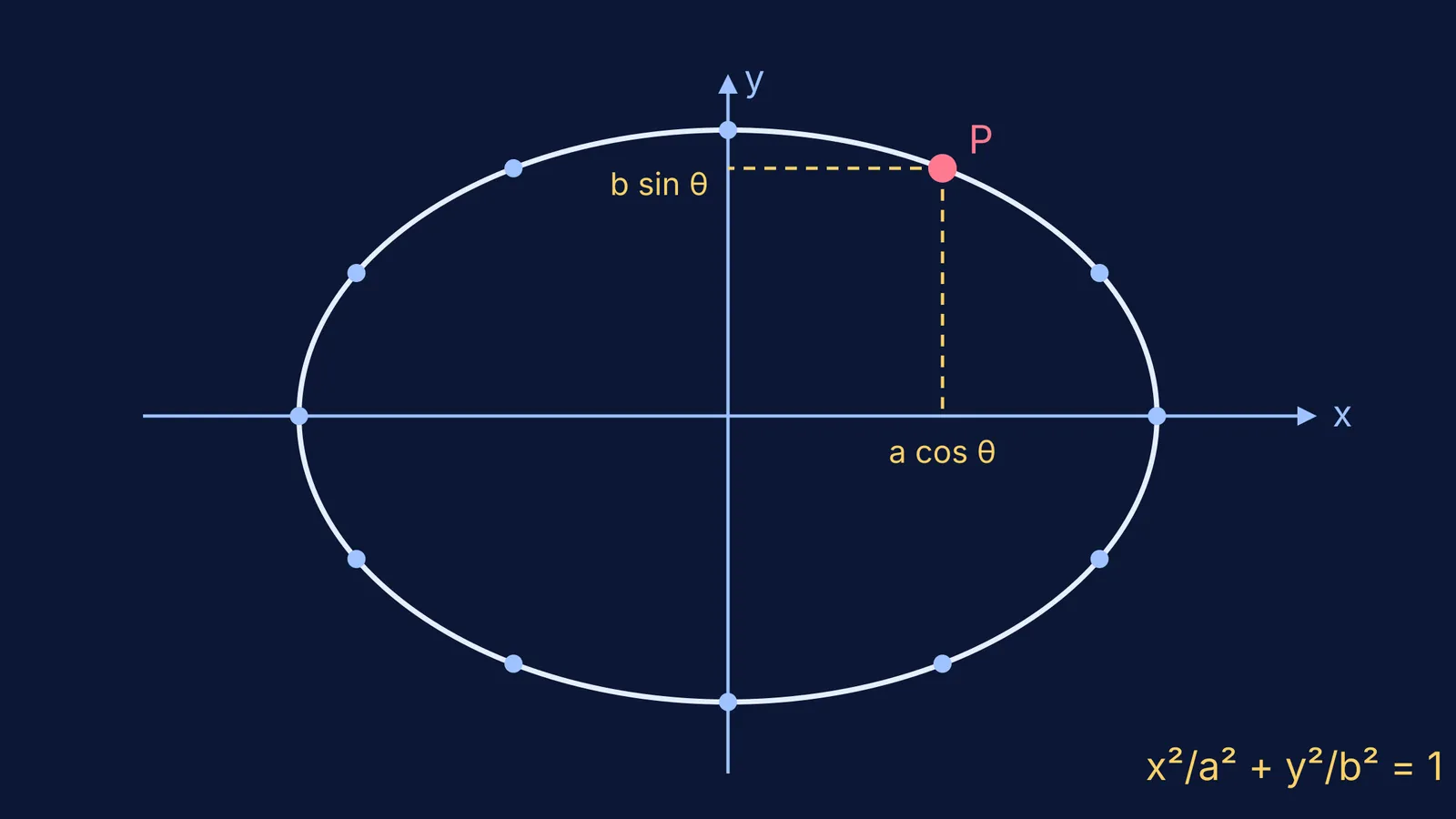
Example 1: x = a cos θ, y = b sin θ. Isolate: cos θ = x/a and sin θ = y/b. Use sin²θ + cos²θ = 1:
x²/a² + y²/b² = 1
That is an ellipse, which is why this substitution returns in coordinate geometry.
Example 2: x = a sec θ, y = b tan θ. Isolate: sec θ = x/a and tan θ = y/b. Use sec²θ − tan²θ = 1:
x²/a² − y²/b² = 1
This time the result is a hyperbola.
Example 3: sin θ + cos θ = p, sin θ − cos θ = q. Square both equations. The first gives p² = 1 + 2 sin θ cos θ, the second q² = 1 − 2 sin θ cos θ. Add them and the cross terms cancel:
p² + q² = 2
How does JEE make elimination harder?
JEE-style questions hide the pair: you often have to add, subtract or multiply the given equations before an identity becomes visible.
Example 4: tan θ + sin θ = m and tan θ − sin θ = n. Show that (m² − n²)² = 16mn.
Add and subtract: m + n = 2 tan θ and m − n = 2 sin θ.
So m² − n² = (m + n)(m − n) = 4 tan θ sin θ.
Multiply the given equations: mn = tan²θ − sin²θ = sin²θ (sec²θ − 1) = sin²θ tan²θ.
Square step 2: (m² − n²)² = 16 tan²θ sin²θ = 16mn.
Check at θ = 60°: m = 3√3/2 and n = √3/2, so m² − n² = 27/4 − 3/4 = 6 and the left side is 36. On the right, 16mn = 16 × 9/4 = 36. It matches.
Example 5: x = cos θ, y = cos 2θ. Here substitution does the work. Since cos 2θ = 2cos²θ − 1, you get y = 2x² − 1. But cos θ can only lie between −1 and 1, so the original pair traces only the part of this parabola where −1 ≤ x ≤ 1. Stating that range makes your answer complete.
If you keep picking the wrong pair or losing track midway, the Fermi Problem Library has worked problems with a step-by-step solver that explains the reasoning rather than printing an answer.
What mistakes cost marks in elimination questions?
Forgetting the cross term: (sin θ + cos θ)² is 1 + 2 sin θ cos θ, not 1.
Pairing ratios that no Pythagorean identity links directly, such as sin θ with tan θ. Convert one of them first, for example tan θ = sin θ/cos θ.
Leaving θ in disguise. If sin θ cos θ, tan θ or any function of θ is still in the answer, you have not finished.
Ignoring the range. The eliminated equation can describe more points than the original pair, as in Example 5, so add the range when it applies.
Elimination is the reverse of proving an identity, so practise both together with our practice plan for trigonometric identities and equations in JEE, and use the guide to sin 3x, cos 3x and tan 3x when θ sits inside a triple angle. If an identity itself is the gap, start with its lesson in the Fermi Concept Library.


