

On this page
Trigonometry problems involving heights and distances frequently require observing a tall structure, such as a tower or a cliff, from two distinct vantage points. In standard secondary mathematics curricula, a classic problem asks you to calculate the height of a tower by measuring the angles of elevation from both the top and the foot of an adjacent building.
While applying the tangent ratio is computationally straightforward, constructing the geometric model presents the real obstacle. A 2025 investigation into how secondary students solve word problems involving angles of elevation and depression found that while reading errors were very low, students committed high rates of comprehension, transformation, and process skills errors. In practice, students comprehend the vocabulary of the problem statement, yet they struggle to translate the written description into an accurate geometric diagram with appropriate right-angled triangles.
If you find yourself struggling to formulate geometric equations from written descriptions, the Fermi Problem Library provides worked problems with a step-by-step solver that explains the reasoning rather than printing an answer. This guided progression helps you master the transformation from text to spatial relationships at your own pace.
What is the geometry of the two-angle elevation problem?
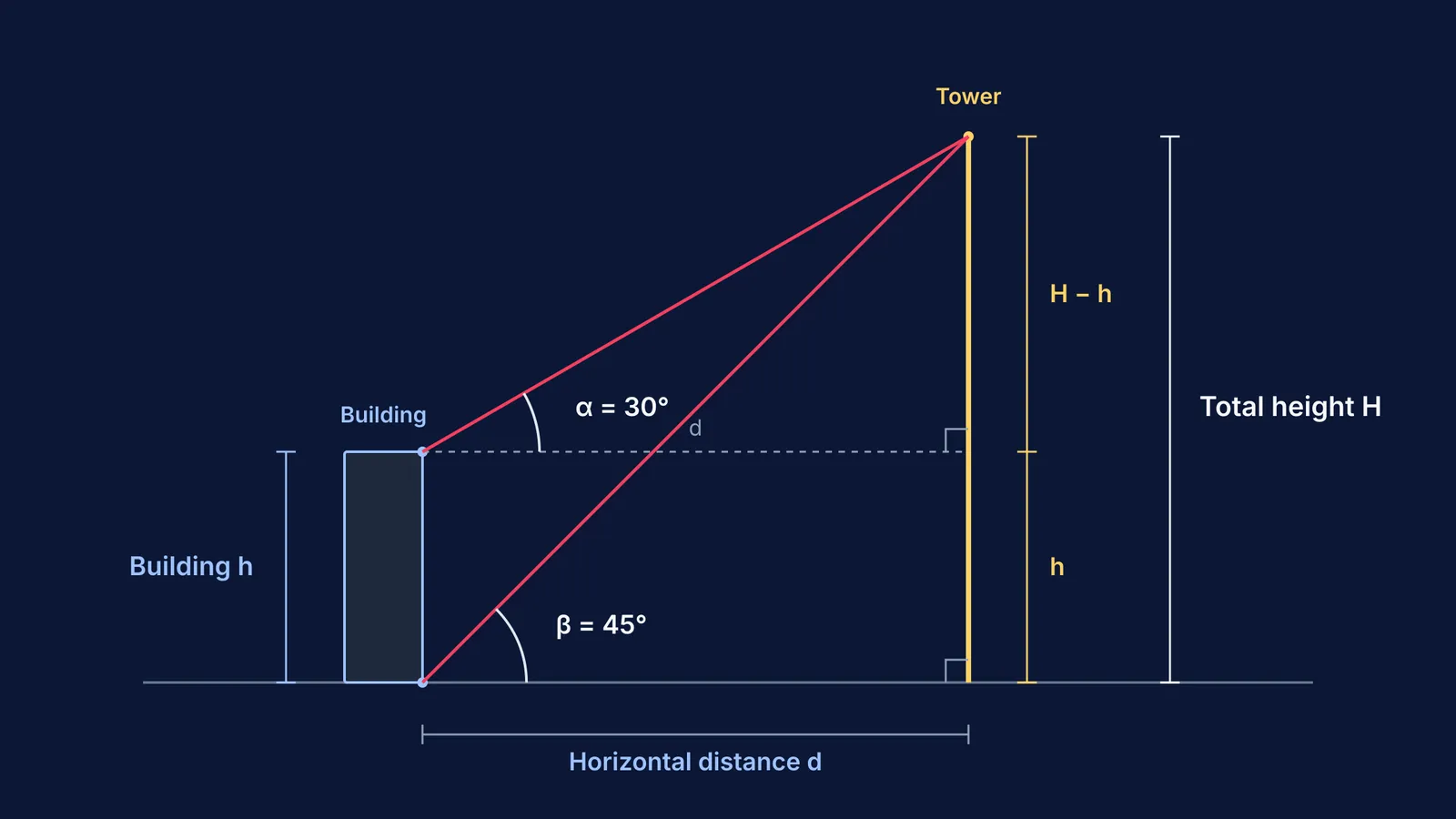
When observing a taller tower from an adjacent building, your lines of sight create two separate right-angled triangles that share a single common baseline.
The ground triangle: Your line of sight from the foot of the building to the peak of the tower forms a large right-angled triangle. Its vertical leg is the entire height of the tower, and its horizontal leg is the ground distance between the two structures.
The elevated triangle: Your line of sight from the roof of the building to the peak of the tower forms a smaller right-angled triangle. This triangle rests upon an imaginary horizontal line extending from the roof to the tower wall. Its vertical leg represents only the portion of the tower extending above the building.
The mathematical bridge connecting these two triangles is their shared horizontal separation. Because both structures stand vertically on level ground, the horizontal distance between them at the roof line is identical to the distance along the ground.
How do you calculate tower height from the top and foot of a building?
To determine the unknown tower height H when given the building height h, the elevation angle from the roof α, and the elevation angle from the foot β, you can follow a systematic three-step algebraic framework.
Let d represent the horizontal distance separating the building and the tower.
Step 1: Express distance from the ground triangle. Looking from the foot of the building, the opposite side equals the total tower height H, while the adjacent side equals d: tan β = H / d Rearranging this relationship for d yields: d = H / tan β
Step 2: Express distance from the elevated triangle. Looking from the roof at height h, the horizontal reference line intersects the tower at height h. The vertical height remaining above this line is H − h. The adjacent side remains d: tan α = (H − h) / d Rearranging this relationship for d yields: d = (H − h) / tan α
Step 3: Equate the two distance expressions. Because both equations describe the exact same physical distance d, equate them directly: H / tan β = (H − h) / tan α
Cross-multiplying gives: H tan α = (H − h) tan β H tan α = H tan β − h tan β h tan β = H (tan β − tan α) H = (h tan β) / (tan β − tan α)
This closed-form expression delivers the tower height directly. Mastering simultaneous geometric setups also builds the spatial foundations needed for circle through three given points proofs and tracking the equation of trajectory of a projectile.
How do you solve a worked example step by step?
Under the NCERT Class 10 Mathematics syllabus, heights and distances problems restrict setups to at most two right-angled triangles using standard angles of 30°, 45°, or 60°.
Consider a typical examination question: The angles of elevation of the top of a tower from the top and foot of a 20 m high building are 30° and 45° respectively. Find the height of the tower.
Here, building height h = 20 m, angle from the roof α = 30°, and angle from the foot β = 45°.
Calculate using the ground triangle:
tan 45° = H / d Because tan 45° = 1: 1 = H / d, which establishes that d = H.
Calculate using the elevated triangle:
tan 30° = (H − 20) / d Because tan 30° = 1 / √3: 1 / √3 = (H − 20) / d d = (H − 20)√3
Substitute and solve for H:
Because d = H, substitute H into the elevated equation: H = (H − 20)√3 H = H√3 − 20√3 20√3 = H√3 − H 20√3 = H(√3 − 1)
Isolating H and rationalising the denominator: H = 20√3 / (√3 − 1) H = [20√3(√3 + 1)] / [(√3 − 1)(√3 + 1)] H = [20(3 + √3)] / (3 − 1) H = [20(3 + √3)] / 2 H = 10(3 + √3) metres.
Evaluating with √3 ≈ 1.732 yields a tower height of approximately 47.32 metres, with the shared horizontal distance d also measuring 47.32 metres.
By isolating the shared horizontal base before substituting numerical values, you prevent arithmetic confusion between partial and total vertical heights. For broader review of right-triangle trigonometry and spatial reasoning, the Fermi Concept Library covers every concept in physics, chemistry, biology, mathematics and computing, each with its own lesson and its place in the map.


