

On this page
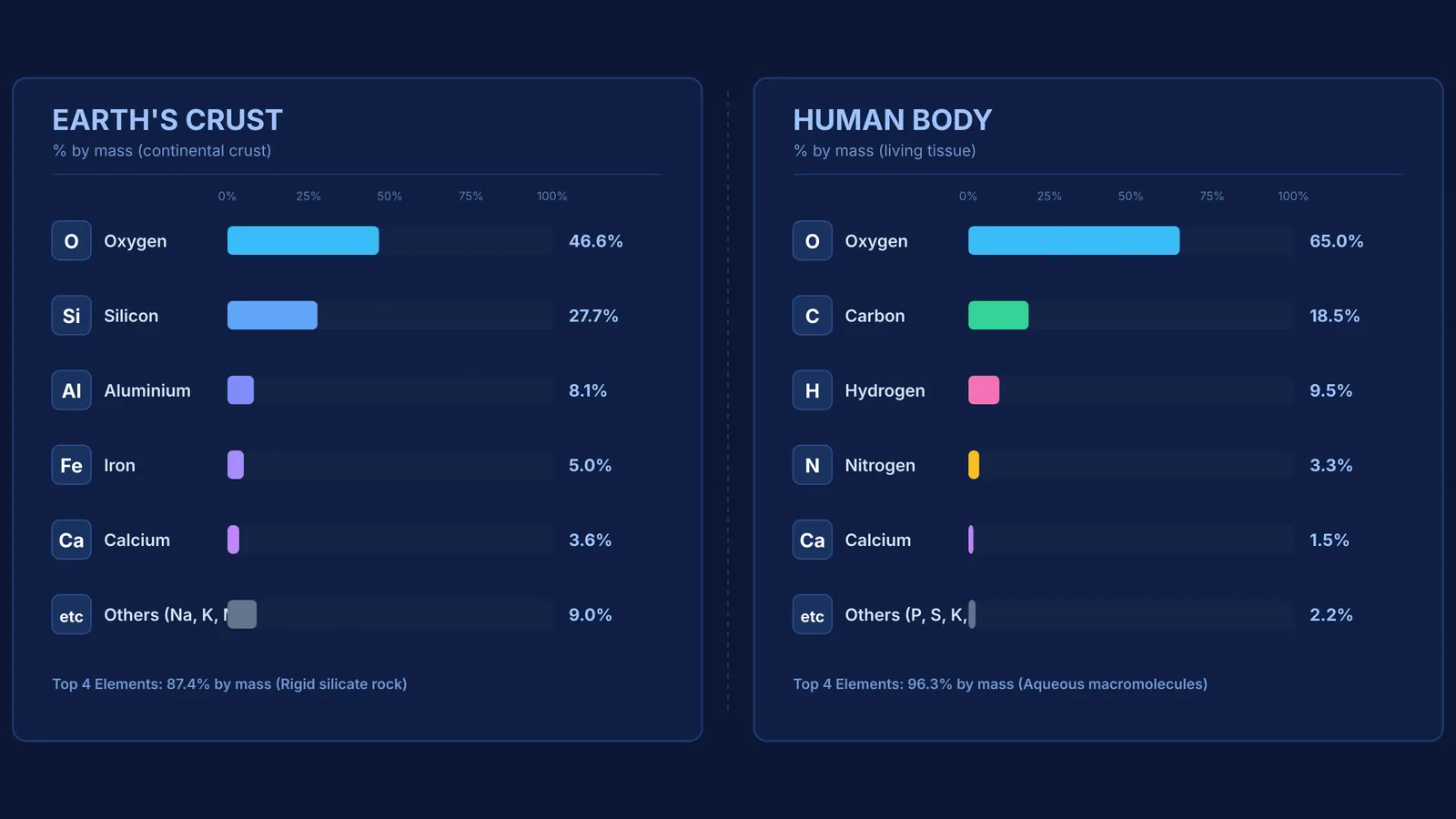
If you break down granite and human tissue into their chemical elements, you find nearly identical ingredients from the periodic table. Yet their proportions tell two different stories. In the Earth's crust, geology builds rigid minerals from oxygen, silicon, aluminium, and iron. In living organisms, biology selects oxygen, carbon, hydrogen, and nitrogen to construct flexible, water-soluble macromolecules.
Understanding why these elements dominate their respective realms clarifies key concepts for CBSE and NEET exams while illustrating the physical principles that separate geology from life.
Which elements are most abundant in the Earth's crust?
The continental crust is dominated by four elements, which together account for roughly 87.4% of its mass, according to geochemical data in Geochimica et Cosmochimica Acta00038-2):
Oxygen (O): 46.6% by mass
Silicon (Si): 27.7% by mass
Aluminium (Al): 8.1% by mass
Iron (Fe): 5.0% by mass
The remaining crustal mass consists of calcium (3.6%), sodium (2.8%), potassium (2.6%), and magnesium (2.1%), which complete the eight major rock-forming elements identified in USGS Fact Sheet 087-02 and classic geochemistry compilations. All other elements, including carbon and precious metals, make up less than 1.5% combined.
Geology favours this quartet because of how minerals crystallise from molten magma. Oxygen is highly electronegative and readily binds electropositive silicon and aluminium. Over 90% of crustal rocks are silicates—including quartz and feldspar—where oxygen surrounds silicon in tetrahedral [SiO₄]⁴⁻ frameworks, as detailed in Treatise on Geochemistry. Aluminium substitutes into these lattices to form aluminosilicates, while iron balances charge in dense minerals. Separating these metals from oxygen requires significant energy, as explained in our guide to the extraction of metals in Class 10.
Which elements make up most of the human body?
Living tissue inverts this geochemical order. According to physiological data from ICRP Publication 8900002-2) and Table 9.1 of NCERT Class 11 Biology, four non-metallic elements constitute approximately 96.0% of human body mass:
Oxygen (O): 65.0% by mass
Carbon (C): 18.5% by mass
Hydrogen (H): 9.5% by mass
Nitrogen (N): 3.3% by mass
The next tier provides structural support and electrolyte balance: calcium (1.5%), sulfur (0.3%), sodium (0.2%), and magnesium (0.1%), as tabulated in NCERT Class 11 Biology Table 9.1, alongside phosphorus (1.0%) and potassium (0.4%) from standard physiological reference data.
The dominance of oxygen and hydrogen stems from water (H₂O), which makes up roughly 60% of adult body weight according to ICRP Publication 8900002-2). Because oxygen has an atomic mass of 16 compared to hydrogen's 1, oxygen provides 88.8% of water's molecular weight. Carbon forms the backbone of all biomacromolecules, while nitrogen links amino acids and nucleic bases, as explored in our guides to peptide bonds and dipeptide structures and nucleosides and nucleotides chemistry.
Why is silicon dominant in rocks but carbon dominant in life?
Carbon and silicon are Group 14 neighbours with four valence electrons, but life relies on carbon while largely excluding silicon, as detailed in Treatise on Geochemistry. Three chemical factors explain this:
Bond stability and catenation: Carbon has a compact covalent radius of 77 pm, allowing stable C–C single, double, and triple bonds in ambient water. Silicon's larger radius of 117 pm weakens Si–Si bonds, making long silane chains prone to rapid hydrolysis.
Oxide solubility: Cellular respiration oxidises carbon to carbon dioxide (CO₂), a water-soluble gas easily expelled across cell membranes and lungs. Oxidising silicon yields silicon dioxide (SiO₂)—an insoluble covalent network (quartz). A silicon-respiring organism would precipitate solid rock inside its cells.
Metal exclusion: Aluminium (8.1% of the crust) forms insoluble hydroxides at neutral pH (7.0–7.4), offering no biological utility while inhibiting enzymes. Iron (5.0% of the crust) is essential in haemoglobin, but unshielded Fe²⁺ ions catalytically generate damaging hydroxyl radicals; as noted in ICRP Publication 8900002-2), the body therefore limits iron to roughly 0.006% of total mass.
How do you solve elemental abundance problems in exams?
Competitive exams like NEET and JEE frequently test elemental abundance through comparative traps based on NCERT Class 11 Biology Table 9.1 and planetary models in Treatise on Geochemistry. Use this 3-step check:
Distinguish mass percentage from atom count: Oxygen leads human body mass (65.0%), but hydrogen leads atom count (~62% of atoms), because every water molecule contains two hydrogen atoms per oxygen atom.
Check the boundary (crust vs whole Earth): In the crust, oxygen (46.6%) leads iron (5.0%). For the entire Earth, iron ranks #1 (~32.1%) due to the metallic core.
Remember the Dual-Quad rule:
Crust: O-Si-Al-Fe (Oxygen > Silicon > Aluminium > Iron)
Body: O-C-H-N (Oxygen > Carbon > Hydrogen > Nitrogen)
When solving problems linking mineral formulas with stoichiometry, the Fermi Problem Library provides worked problems with a step-by-step solver that explains the reasoning rather than printing an answer. To see how atomic radii and valence configurations dictate both geology and biochemistry, explore the Fermi Concept Library, which covers every concept in physics, chemistry, biology, mathematics and computing.


