

On this page
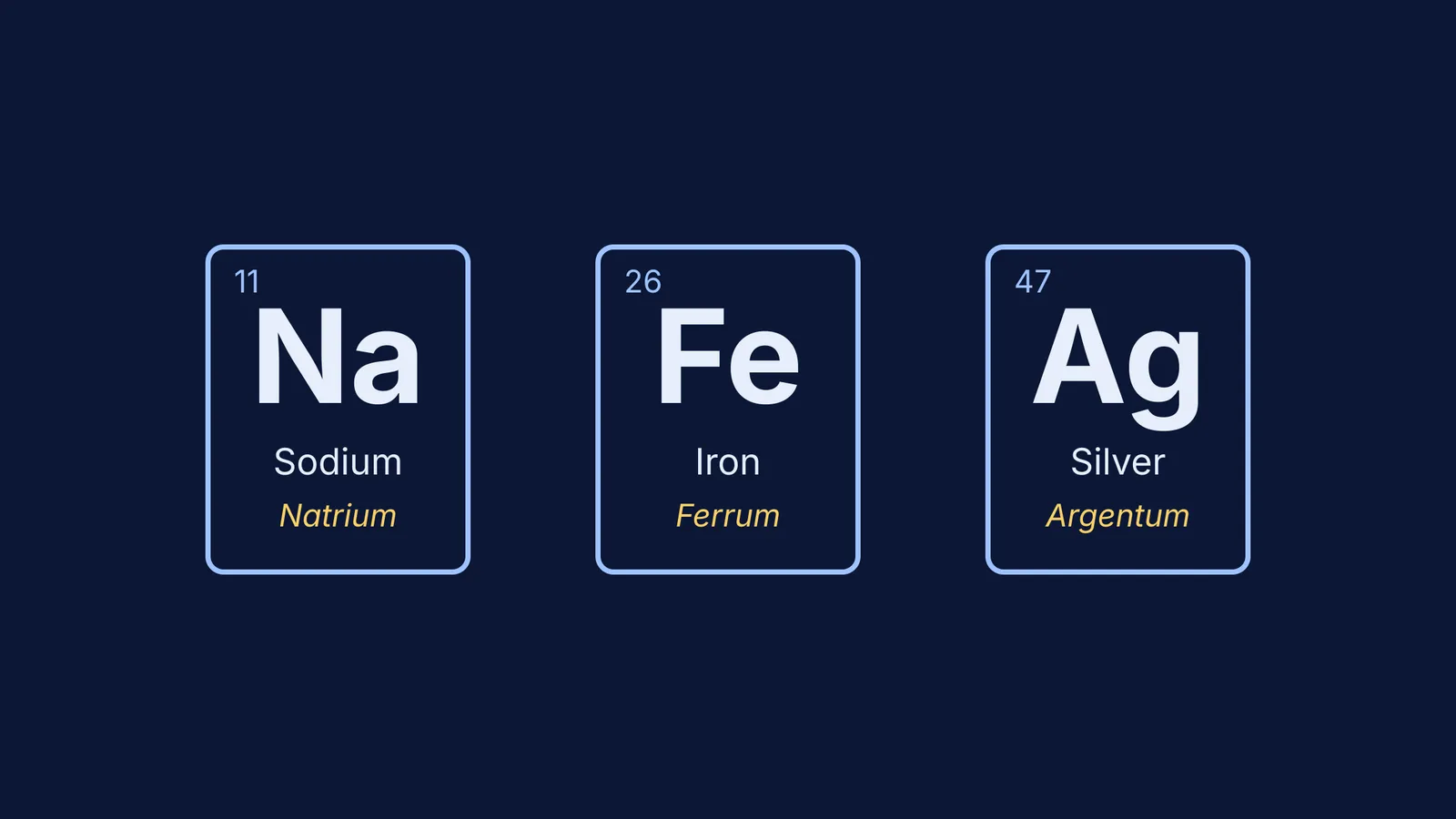
When you first learn chemistry, most element symbols make immediate sense: H for hydrogen, C for carbon, Li for lithium. But then you meet sodium, which is Na, and iron, which is Fe.
These symbols look like mistakes until you look at the history of how chemists agreed to write formulas. The answer lies in Latin.
Why do some elements have Latin symbols?
Before the 19th century, chemistry was difficult to read. Alchemists used secretive astrological signs for metals, and later chemists like John Dalton used circles with dots and lines inside them to represent atoms. These pictorial symbols were hard to draw and impossible to print in standard books.
In 1813, the Swedish chemist J. J. Berzelius proposed a simpler system: use the letters of an element's name instead of a picture. To ensure chemists from different countries could understand each other without translating, Berzelius based his symbols on Latin, which was the international language of science at the time.
Because elements like iron, copper and lead had been known since antiquity, they already had well-established Latin names. When Berzelius assigned them symbols, he used those Latin roots.
The 11 historical element symbols
According to the official IUPAC element list, there are 11 elements whose symbols do not match their English names. Ten come from Latin, and one comes from German. If you are studying for chemistry exams, you will use these constantly.
Sodium (Na) comes from *natrium*. It refers to natron, a naturally occurring mineral salt.
Potassium (K) comes from *kalium*, which shares a root with the word alkali.
Iron (Fe) comes from *ferrum*, the classical Latin word for iron.
Copper (Cu) comes from *cuprum*. This means "metal of Cyprus", the island where the Romans mined much of their copper.
Silver (Ag) comes from *argentum*, which means shiny or white.
Gold (Au) comes from *aurum*, meaning shining dawn.
Mercury (Hg) comes from *hydrargyrum*, which translates to liquid silver. (Mercury is unusual because it is liquid at room temperature and is not classified as a transition element).
Lead (Pb) comes from *plumbum*, the Latin word for lead.
Tin (Sn) comes from *stannum*.
Antimony (Sb) comes from *stibium*.
Tungsten (W) comes from *wolfram*, a German name.
What are the IUPAC rules for writing symbols?
Today, the International Union of Pure and Applied Chemistry (IUPAC) governs how we write these symbols. According to Section IR-3.1 of the 2005 IUPAC Red Book, the rules are strict about capitalisation.
An element's symbol consists of one or two letters.
The first letter is always a capital letter.
The second letter (if present) is always a lowercase letter.
The capitalisation rule is critical because it tells you where one element ends and another begins. For example, Co is the symbol for the metal cobalt. But CO is carbon monoxide, a molecule made of one carbon atom and one oxygen atom. Writing this incorrectly will cost you marks in exams and can change the entire meaning of a chemical equation. Getting these symbols right is the absolute first step before drawing electron dot structures of covalent molecules or calculating molar masses.
How do you remember the Latin names for exams?
Learning the Latin symbols is a matter of exposure, but word associations can speed up the process.
If you want to understand how these metals fit into the periodic table's s-block and d-block, you can explore the Fermi Concept Library, where every concept in physics, chemistry, biology, mathematics and computing has its own lesson and its place in the map.
When you need to practise using these symbols in real calculations, the Fermi Problem Library provides worked problems with a step-by-step solver that explains the reasoning rather than printing an answer. It will help you check that you have balanced your equations and applied the IUPAC rules correctly.


