

On this page
In chemistry, you do not write out "sodium chloride" every time you balance an equation. You write NaCl. These letters are the universal shorthand of science, letting researchers everywhere read the same reaction regardless of their spoken language.
For students beginning chemistry, memorising the symbols of the first 30 elements and how to remember them is one of the first major hurdles. This block—from hydrogen (1) to zinc (30)—covers almost all the chemistry you will do in school.
Why do element symbols have capital and small letters?
Before the modern letter system, alchemists used pictures like moons and stars for metals, and early chemist John Dalton used circles with marks inside them. In 1814, the Swedish chemist Jöns Jakob Berzelius introduced the alphabetic system we use today, choosing Latin letters) so scientists across Europe could share a common standard.
Today, the International Union of Pure and Applied Chemistry (IUPAC) sets the rules for naming elements. Their rule for symbols is absolute: the first letter is always capitalised, and the second letter (if there is one) is always lowercase.
This rule exists to stop dangerous confusion in chemical formulas. For example, Co is the symbol for the metal cobalt. CO, with a capital O, is carbon monoxide, a deadly gas made of carbon and oxygen. Sticking to the capital and small letter rule makes every formula clear at a glance.
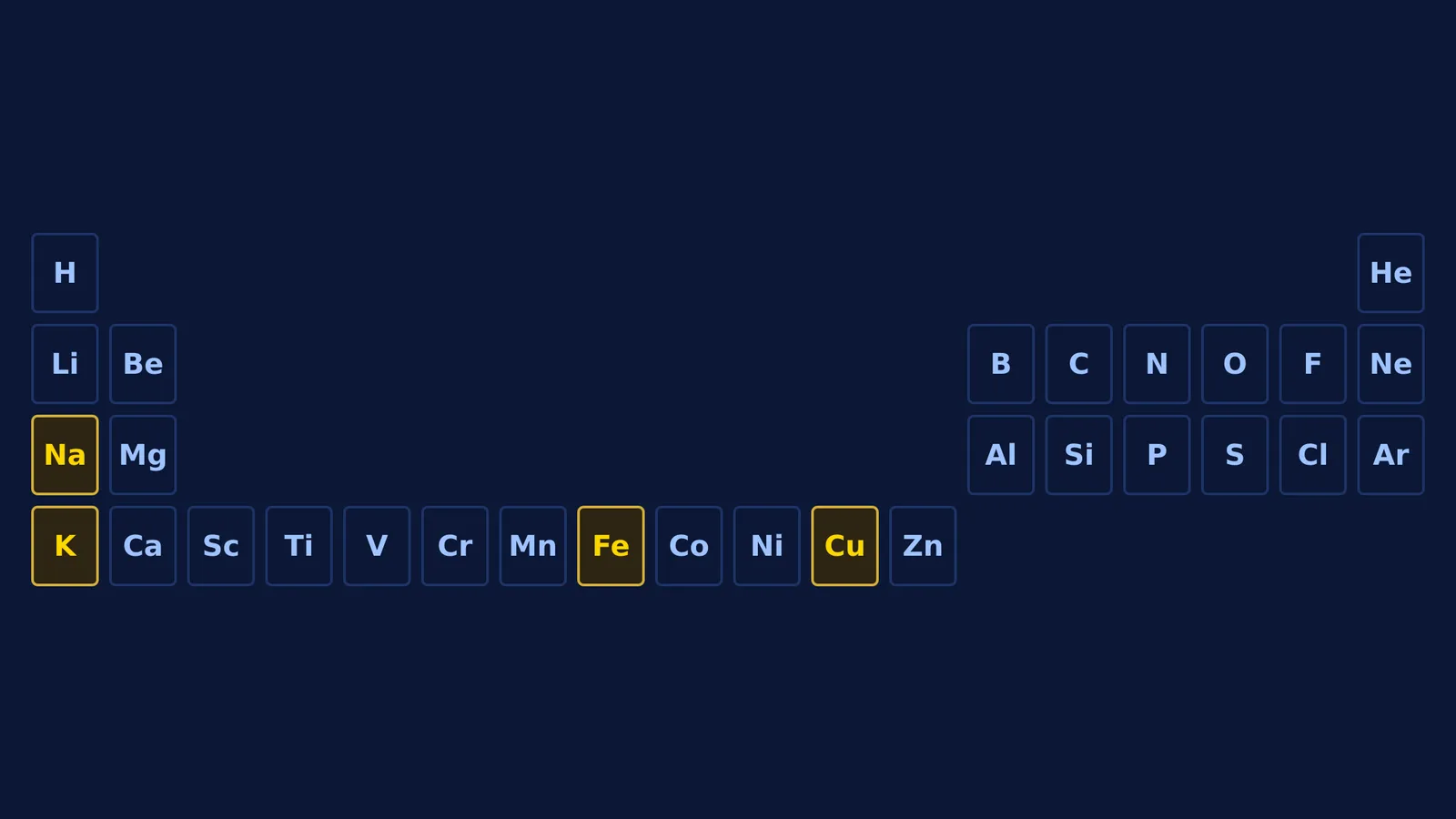
Where do Latin symbols like Na, K, Fe and Cu come from?
Most of the first 30 elements take their symbols from their English names: H for hydrogen, O for oxygen, and Ca for calcium. But four common elements in this group look completely wrong. If you are ever unsure why a symbol does not match its name, it is usually because the element was known to ancient civilisations or isolated by early European chemists who named it in Latin).
Sodium is Na: The symbol comes from *natrium*, a Neo-Latin name for a natural mineral salt.
Potassium is K: This comes from *kalium*, derived from the Arabic word *al-qalyah* (plant ashes) before being Latinised. When it was isolated in 1807, the name potassium stuck in English, but the symbol K honours its original alkaline source.
Iron is Fe: The symbol comes from the ancient Latin word for iron, *ferrum*.
Copper is Cu: This comes from *cuprum*, named after the island of Cyprus where the Romans mined most of their copper.
What are the symbols of the first 30 elements?
Here are the first 30 elements, grouped by tens. You can find every concept in chemistry, including the electron configuration and atomic mass of these elements, in the Fermi Concept Library.
Elements 1 to 10
Hydrogen (H)
Helium (He)
Lithium (Li)
Beryllium (Be)
Boron (B)
Carbon (C)
Nitrogen (N)
Oxygen (O)
Fluorine (F)
Neon (Ne)
Elements 11 to 20
Sodium (Na)
Magnesium (Mg)
Aluminium (Al)
Silicon (Si)
Phosphorus (P)
Sulphur (S)
Chlorine (Cl)
Argon (Ar)
Potassium (K)
Calcium (Ca)
Elements 21 to 30 (The transition metals)
Scandium (Sc)
Titanium (Ti)
Vanadium (V)
Chromium (Cr)
Manganese (Mn)
Iron (Fe)
Cobalt (Co)
Nickel (Ni)
Copper (Cu)
Zinc (Zn)
How can you remember the first 30 elements?
Rote memorisation works for some, but your brain holds onto information much better when it is connected to a pattern or a story. Here is a step-by-step framework to lock all 30 elements into your long-term memory over three days.
Day 1: Use an acrostic for the first 10 Create a sentence where the first letter of each word matches the symbol. For elements 1 to 10, a common sentence is: "Hi Hello Little Berries, Brown Cats Never Open Full Nets." It does not need to make perfect sense; a silly sentence is often easier to recall.
Day 2: Group by sounds for the next 10 Elements 11 to 20 can be chunked into rhythmic clusters. Try saying them aloud to a beat, almost like a short song:
Na-Mg-Al (Sodium, Magnesium, Aluminium)
Si-P-S (Silicon, Phosphorus, Sulphur)
Cl-Ar-K-Ca (Chlorine, Argon, Potassium, Calcium)
Day 3: The 21-30 story The transition metals are notorious for tripping students up. To keep them in order, use this classic memory hook: "Science Time! Very Crazy Man Feeds Cold Night Cubs Zinc." Once you can write out the symbols (Sc, Ti, V, Cr, Mn, Fe, Co, Ni, Cu, Zn), filling in the names becomes much easier.
If you find yourself stuck on later chemistry topics like naming carbon compounds in Class 10 or working out the oxidation numbers from structure, not knowing your symbols will slow you down. The earlier you lock these in, the smoother your chemistry classes will be. If you keep getting them mixed up, Fermi's AI tutor can work out what you already know and build a plan for the session, getting you past the blank page and onto the next step.


