

On this page
In short To find the time needed to electroplate a given thickness, you calculate the metal's volume and mass, then use Faraday's law of electrolysis. For example, plating a 50 μm layer of silver on a 100 cm² surface at 3 amps takes about 26 minutes, as the mass deposited is proportional to the total charge passed.
Electroplating is a standard way to protect metals from corrosion or give them a decorative finish. In chemistry exams like JEE and NEET, you will often face questions that ask for the time required to achieve a specific plating thickness.
Because the electrical current drives the chemical reaction, the time needed depends on the metal's density, its molar mass, the surface area being plated, and the current applied. By breaking the problem into geometry, density, and electrolysis and Faraday's laws, you can solve it in clear steps.
How does Faraday's law connect time and mass?
Michael Faraday's first law of electrolysis states that the mass of a substance deposited at an electrode is directly proportional to the total electric charge passed through the solution. This means m ∝ Q, where m is the mass and Q is the charge in coulombs.
Since electric current (I) is the rate of flow of charge, we know that Q = I × t, where t is the time in seconds.
The complete Faraday equation for the mass deposited is: m = (M × I × t) / (n × F)
Here, M is the molar mass of the metal, n is its valency (the number of electrons needed to reduce one ion), and F is the Faraday constant (approximately 96,485 C/mol). If you know the mass you need to deposit, you can rearrange this formula to solve for time.
How do you find mass from thickness and area?
Before you can use Faraday's law, you need to know how much metal you are trying to plate. Exams usually give you the target thickness and the surface area of the object.
Find the volume: Multiply the surface area (A) by the desired thickness (d) to get the volume of the metal layer (V = A × d). Ensure both measurements are in the same units, typically centimetres.
Find the mass: Multiply the volume by the metal's density (ρ). The formula is m = ρ × V.
Once you have the mass in grams, you are ready to find the time.
How long does it take to electroplate a given thickness of silver?
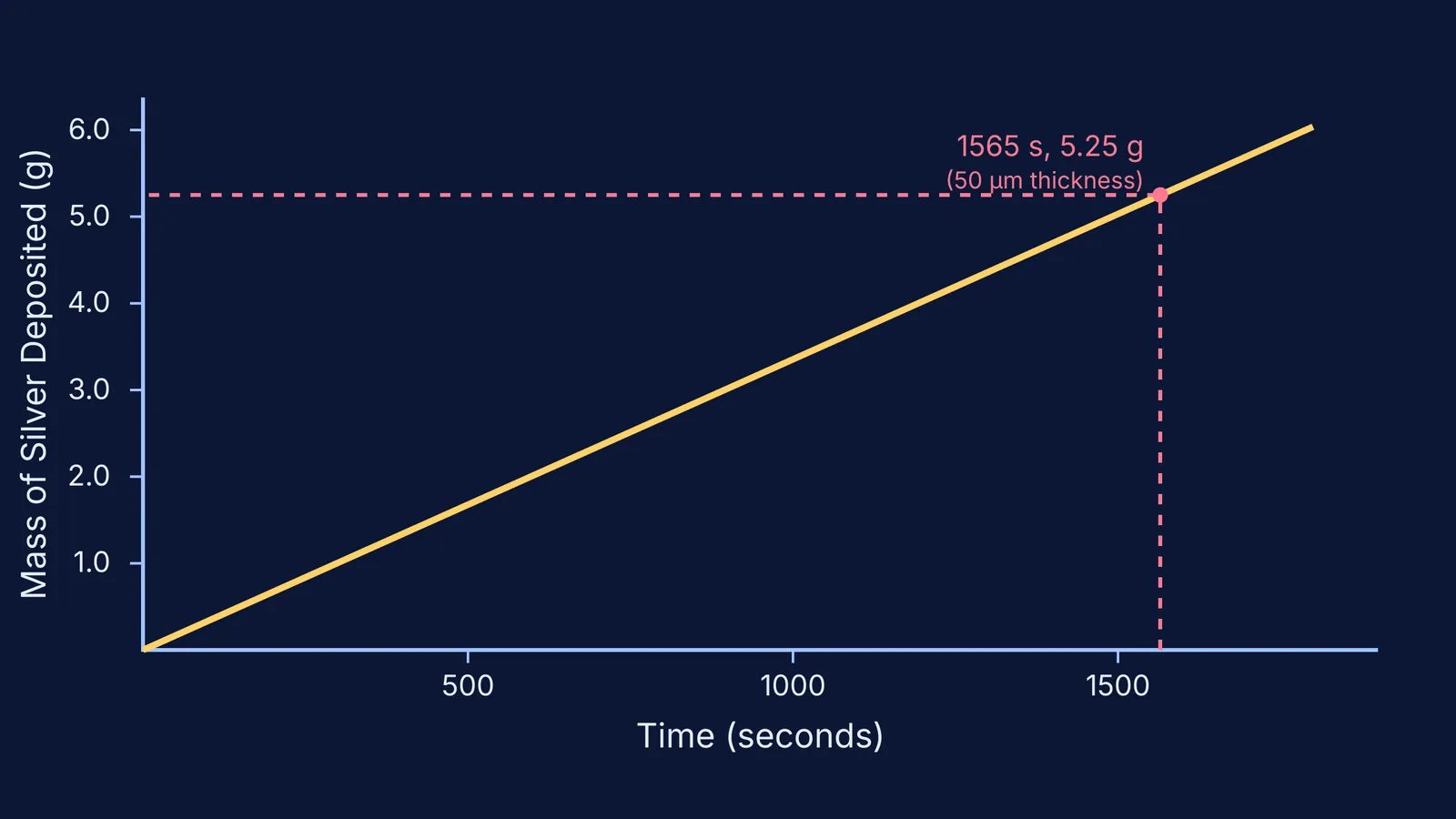
Let's calculate the time needed to plate a 0.005 cm (50 µm) layer of silver onto a rectangular tray with a surface area of 100 cm², using a steady current of 3 amperes.
Silver has a density of 10.50 g/cm³ and a standard molar mass of 107.87 g/mol. Silver ions in solution (Ag⁺) have a valency of n = 1.
Step 1: Calculate the mass of silver needed. The volume of the silver layer is the area multiplied by the thickness: V = 100 cm² × 0.005 cm = 0.5 cm³
The mass is the volume multiplied by the density: m = 0.5 cm³ × 10.50 g/cm³ = 5.25 g
Step 2: Use Faraday's law to find the time. Rearrange the Faraday equation to solve for t: t = (m × n × F) / (M × I)
Plug in the values: t = (5.25 × 1 × 96485) / (107.87 × 3)
t = 506546.25 / 323.61 ≈ 1565 seconds
Divide by 60 to convert seconds to minutes, which gives roughly 26.1 minutes. It will take just over 26 minutes to reach the desired thickness.
What if efficiency is not 100%?
In the real world, and in harder exam problems, current efficiency is rarely perfect. Some of the electrical energy might go into side reactions, like generating hydrogen gas at the cathode.
If a problem states that the current efficiency is 90%, it means only 90% of your 3-ampere current is actually plating the silver. You can handle this by multiplying the total current by the efficiency fraction (0.90) before putting it into the formula, or by dividing your final theoretical time by the efficiency fraction. A lower efficiency always means the process will take longer.
If you frequently lose track of units or conversions in multi-step chemistry problems, the Fermi Problem Library has worked problems with a step-by-step solver that explains the reasoning rather than printing an answer, making it easier to see where a standard cell EMF to Gibbs energy or Faraday's law calculation went wrong.


