

On this page
We wait for the electric kettle to boil every day, but the physics behind this everyday task gives us a clear window into how energy transfers from an appliance into a liquid. The speed at which a kettle heats water is not random; it is entirely governed by its power rating, how much water it holds, and fundamental thermodynamic constants. By understanding the math, you can predict precisely when your water will reach a rolling boil.
Students exploring thermal physics often practice applying these variables using the Fermi Concept Library to fill gaps in their understanding of thermodynamics.
How to calculate the time taken by an electric kettle to heat water?
The time it takes to heat a given amount of water is found by equating the electrical energy supplied to the thermal energy absorbed by the water, while accounting for the kettle's efficiency. The fundamental formula is:
P × t × η = m × c × ΔT
Here is what each term means:
P is the power rating of the kettle in Watts (W), usually found on its base label. A higher power rating means the appliance can supply more energy per second.
t is the time taken in seconds.
η (eta) is the efficiency of the kettle.
m is the mass of the water in kilograms (kg). Because the density of water is 1 kg/L, one litre of water has a mass of 1 kg.
c is the specific heat capacity of water, which is 4182 J/(kg·°C) (Engineering ToolBox). Water has an exceptionally high specific heat compared to most other substances, which is why it requires a significant amount of energy to heat up. This constant represents the energy required to raise 1 kg of water by 1°C.
ΔT is the change in temperature in degrees Celsius (from the initial tap temperature to the final boiling point).
What is the efficiency of an electric kettle?
Electric kettles are highly efficient appliances, typically converting 80% to 90% of the electrical energy they draw from the wall directly into heat within the water (Inside Energy).
This high heating efficiency is achieved because the kettle's internal heating element is fully submerged in or directly touching the water. As a result, almost all the generated heat transfers directly into the liquid, meaning very little energy escapes into the surrounding room air during the process. In contrast, heating water on a stovetop, especially with a gas burner, is often less than 40% efficient because a substantial amount of heat bypasses the pot and warms the air instead.
However, the electric kettle system is not perfect. Some energy is inevitably absorbed by the plastic or metal body of the kettle itself, or lost as heat radiating from the exterior while the water warms up. Interestingly, while the appliance is highly efficient, human habits—such as overfilling the kettle and boiling twice as much water as needed—are often the biggest source of wasted energy in the kitchen, as noted in a 2016 study on usage patterns in the journal *Applied Energy* (Murray et al., 2016).
How much extra time does boiling off water take?
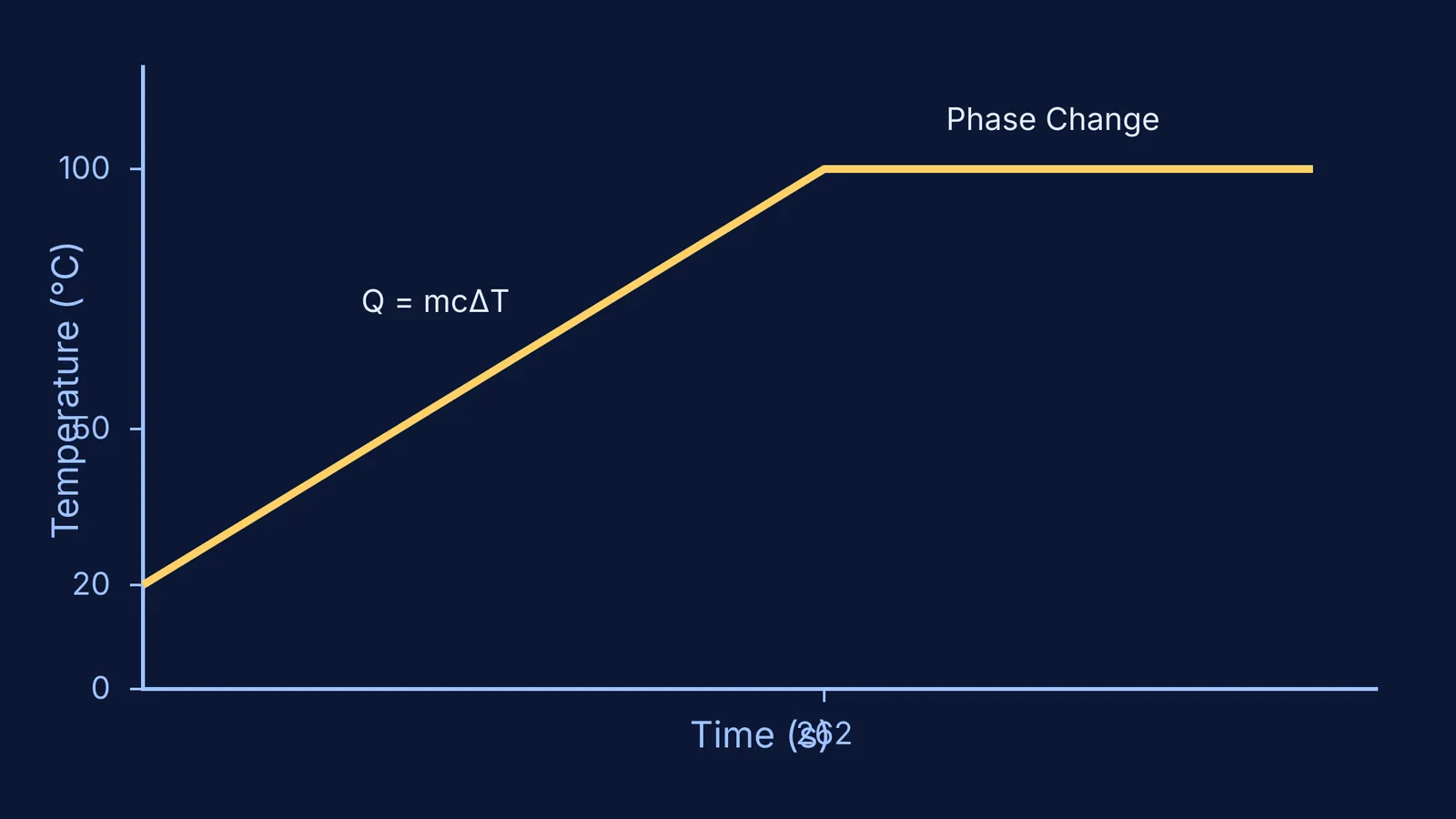
Once the water reaches 100°C, its temperature stops rising, but the kettle may continue to supply power for a short time before its automatic thermostat clicks off. During this period, the energy being pumped into the water goes entirely into changing its phase from a liquid to a gas.
The energy required to turn water into steam is governed by its latent heat of vaporization, which is approximately 2.26 × 10⁶ J/kg (Engineering ToolBox). Because this value is extremely large—more than five hundred times the energy needed to raise the water's temperature by a single degree—boiling away even a tiny fraction of the water takes considerable time. This phase change requires far more energy per gram than simply heating the liquid. This explains why a kettle left boiling vigorously consumes a lot of extra electrical power without making the water any hotter, and why boiling a pot dry takes so long.
Worked example: How long does it take to boil one litre of water?
Let us calculate the time needed to heat 1 litre of water from a room temperature of 20°C to its boiling point of 100°C, using a standard 1500 W kettle with an 85% efficiency.
First, calculate the thermal energy required (Q): Q = m × c × ΔT Q = 1 kg × 4182 J/(kg·°C) × (100 - 20)°C Q = 1 × 4182 × 80 = 334,560 Joules
Second, account for efficiency to find total electrical energy needed (E). Since the kettle is only 85% efficient (η = 0.85), the total energy drawn from the wall is: E = Q / η E = 334,560 / 0.85 = 393,600 Joules
Third, calculate the time (t). Time is energy divided by power. Just as studying motion at constant power reveals how distance accumulates, constant power applied to water reveals how thermal energy accumulates over time: t = E / P t = 393,600 J / 1500 W = 262.4 seconds
The kettle will take approximately 4 minutes and 22 seconds to boil. This energy balance principle is exactly the same as that used in a bomb calorimeter to precisely measure heat transfers during chemical reactions.


