

On this page
When two stationary charges sit separated by a fixed distance, they create an electrostatic field throughout space. Finding the point where electric field is zero between two charges—or outside them—is a foundational physics problem. At this null point, the net electrostatic force on any test charge vanishes.
Yet locating it consistently trips up students. In a diagnostic study in the American Journal of Physics, David P. Maloney and colleagues tested conceptual understanding across 5,000 students. Even after instruction, students averaged posttest scores of only 44% to 47% on foundational electricity concepts, frequently confusing vector cancellation with scalar addition.
Why can the electric field never be zero between unlike charges?
An isolated charge's electric field points radially outward from positive charges and inward toward negative charges, as detailed in OpenStax University Physics. By superposition, the net field is the vector sum E_net = E₁ + E₂. For E_net to vanish, individual field vectors must be equal in magnitude and opposite in direction.
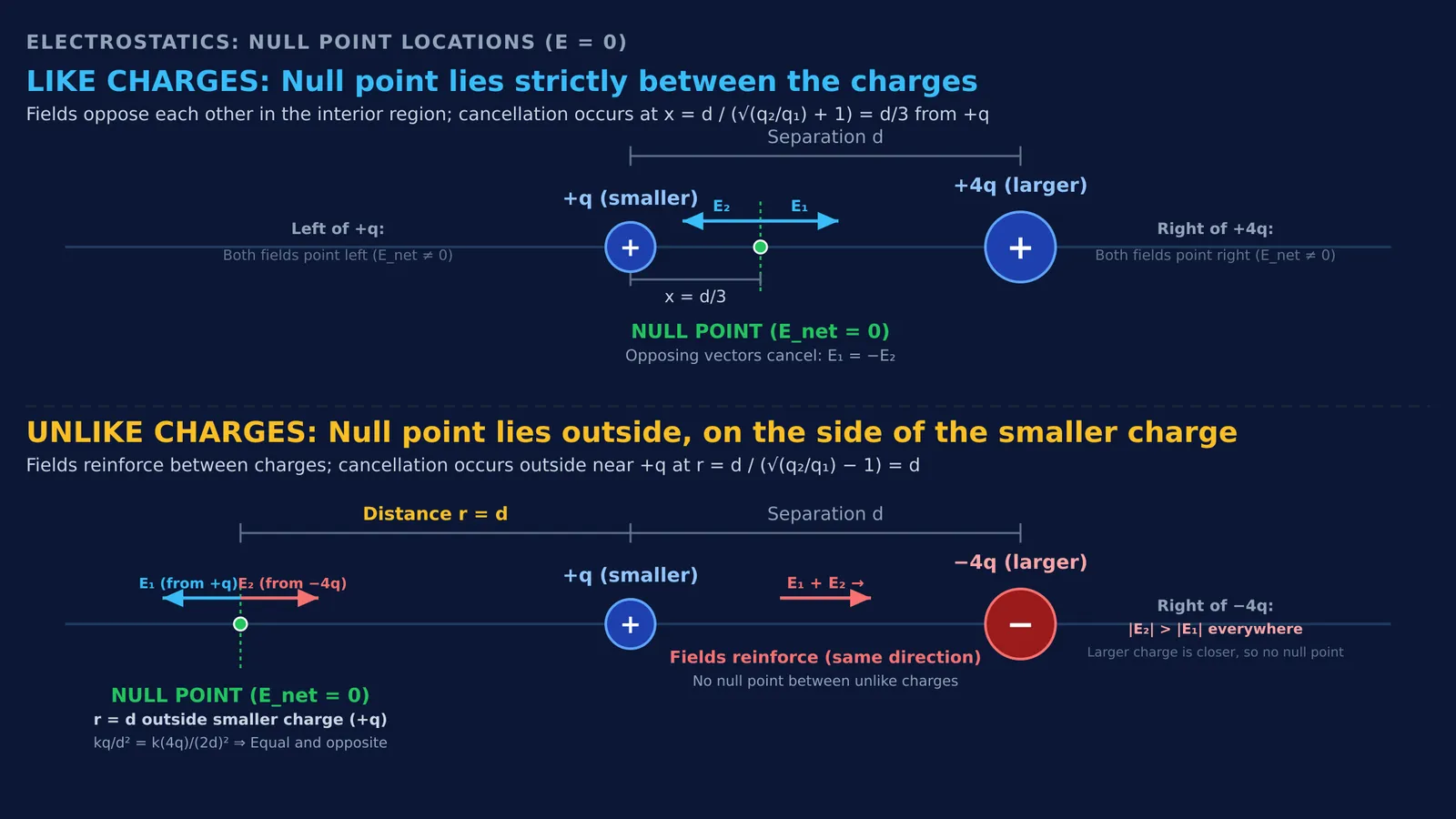
Between unlike charges (+q₁ and −q₂), this cancellation never occurs:
The positive charge pushes a positive test charge toward the negative charge.
The negative charge attracts that test charge toward itself.
Both field vectors point in the identical direction, reinforcing rather than cancelling.
Because both vectors point along the axis from positive to negative, the net field between unlike charges is strictly non-zero everywhere between them.
Where does the null point lie for unlike charges?
Because fields reinforce between unlike charges, any null point must lie along the axis outside them. Under Coulomb's inverse-square law, E = k|q| / r², its position depends on charge magnitude:
Side of the larger charge: Points here are closer to the larger charge and farther from the smaller one. Because the larger charge has greater magnitude and smaller distance, its field dominates everywhere. No cancellation can occur here.
Side of the smaller charge: Points here are closer to the weaker charge. Shorter distance compensates for smaller charge. At one exact point, the inverse-square ratio balances the charge ratio, and the opposing vectors cancel.
Equal-magnitude unlike charges (+q and −q) form an electric dipole, which has no finite null point anywhere in space. Off-axis points also cannot produce zero field because perpendicular components never cancel simultaneously with axial components.
How do you calculate the exact position of the null point?
To find the null point, equate the magnitudes of the opposing fields using the superposition principles in OpenStax University Physics.
For like charges separated by distance d, the null point lies between them at distance x from q₁:
k|q₁| / x² = k|q₂| / (d − x)² ⇒ x = d / (√( |q₂| / |q₁| ) + 1)
For unlike charges with |q₁| < |q₂|, the null point lies outside at distance r from the smaller charge q₁:
k|q₁| / r² = k|q₂| / (d + r)² ⇒ r = d / (√( |q₂| / |q₁| ) − 1)
For example, take q₁ = +2 μC and q₂ = −8 μC separated by d = 30 cm:
Charge ratio: |q₂| / |q₁| = 8 / 2 = 4, so √( |q₂| / |q₁| ) = 2.
Distance outside smaller charge: r = 30 / (2 − 1) = 30 cm.
The null point sits 30 cm outside +2 μC (60 cm from −8 μC). Field magnitudes match: E₁ = k(2)/30² = k/450, and E₂ = k(8)/60² = k/450, with opposing vectors.
When working through multi-charge problems, sign errors and vector setup are common tripwires. The Fermi Problem Library has worked problems with a step-by-step solver that explains the reasoning rather than printing an answer.
How does an electric field null point differ from a zero-potential point?
A frequent confusion in the NCERT Class 12 Physics curriculum is equating zero electric field with zero potential. Electric field is a vector, while electric potential is a scalar:
For like charges, the field cancels at an interior point, but potential is non-zero everywhere because like-sign terms cannot sum to zero.
For unlike charges, the field vanishes at one external point, whereas potential vanishes across an entire sphere (the sphere of Apollonius), cutting the axis at two points. See our guide to zero-potential points near two point charges.
At the null point, potential is non-zero; at zero-potential points, the field is non-zero. Their link through potential gradient is detailed in our guide on finding electric fields from potential gradients.
Furthermore, an electrostatic null point is never in stable equilibrium. Samuel Earnshaw proved in 1842 that no static charge arrangement can trap a charged particle in stable equilibrium in empty space. By Gauss's law, field lines cannot point inward from all directions toward a charge-free point. Energy and work in such arrangements are explored in our guide on calculating the work to assemble point charges.
Seeing how electric field lines bend around charges helps make vector mechanics intuitive. The Fermi Simulation Lab offers interactive simulations for ideas that are easier to see than to read.


