

On this page
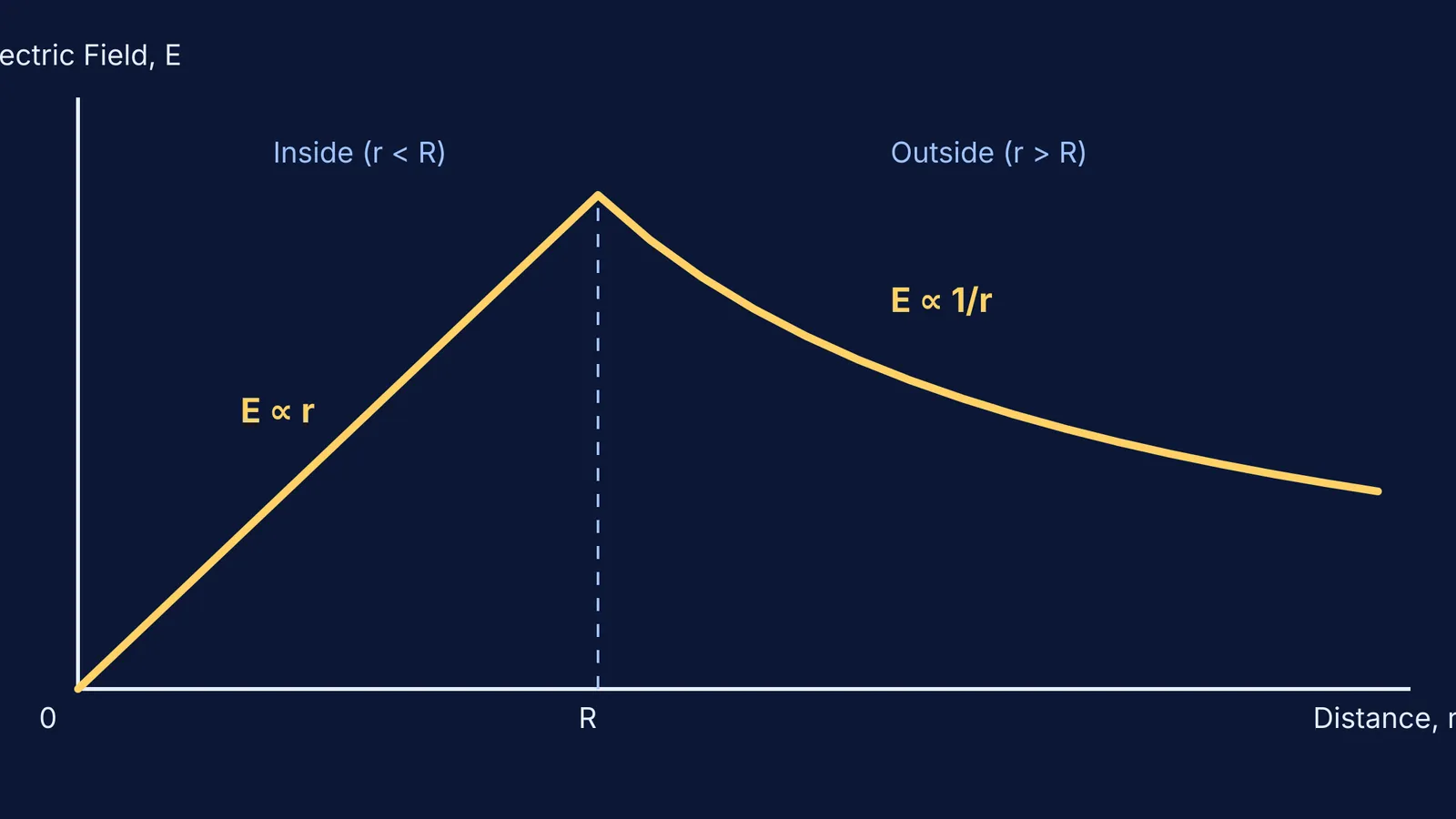
When you apply Gauss's law to a long, uniformly charged solid cylinder, the resulting electric field changes depending on whether you are inside or outside the material. Inside, the field grows steadily. Outside, it fades away.
Finding the field requires you to match the symmetry of the shape to your mathematical surface. This is a common stumbling block: a 2006 study in the *American Journal of Physics* found that university students frequently struggle to choose a Gaussian surface that exploits the symmetry of the charge distribution, or to distinguish between the net flux through that surface and the electric field at a specific point on it.
To prove this, you need Gauss's law and a coaxial Gaussian cylinder.
How to set up the Gaussian surface?
Imagine a very long (effectively infinite) solid cylinder of radius R. It has a uniform volume charge density ρ (charge per unit volume). You want to find the electric field E at a distance r from the central axis.
Because the cylinder is symmetric, the electric field must point radially outward (if the charge is positive) or inward (if negative). It cannot point along the length of the cylinder, because the cylinder stretches endlessly in both directions, and there is no reason for the field to lean one way or the other.
Gauss's law states that the net electric flux through a closed surface is equal to the enclosed charge divided by the permittivity of free space, ε₀: ∮ E · dA = q_enc / ε₀
To capture this radial field, you draw a Gaussian surface shaped like a smaller or larger cylinder—coaxial with the charged one—with radius r and length L.
This closed surface has three parts: the curved side, the top flat cap, and the bottom flat cap.
The caps: The electric field is radial, but the area vector dA for the flat caps points along the cylinder's axis. Because they are perpendicular, the dot product E · dA is zero. No flux passes through the ends.
The curved side: The field points in exactly the same direction as the area vector at every point on the curved surface. The field magnitude is also constant everywhere at distance r. The flux through the curved side is simply E × (2πrL).
So, for any radius r, the left side of Gauss's law simplifies to E(2πrL).
If you find yourself memorising these symmetries without seeing why they work, the Fermi Concept Library can help. Its AI tutor breaks down the geometry of electromagnetic fields, drawing the shapes and vectors on a shared board so you can see exactly why the flux through the end caps vanishes.
What is the electric field inside the cylinder?
When you are inside the solid cylinder (r < R), your Gaussian surface only encloses a fraction of the total charge.
The enclosed charge q_enc is the volume of your Gaussian cylinder multiplied by the charge density ρ: q_enc = ρ(πr²L)
Plug this into Gauss's law: E(2πrL) = ρ(πr²L) / ε₀
Cancel the π, the L, and one r from both sides to get the field: E = ρr / 2ε₀
Because ρ and ε₀ are constants, the electric field is directly proportional to r. It is zero at the very centre of the axis and grows in a straight line until it reaches its maximum strength precisely at the surface (r = R). This is mathematically similar to how gravity behaves inside the Earth, or how you find Gauss's law for a sphere with non-uniform charge density.
What is the electric field outside the cylinder?
When you step outside the charged cylinder (r > R), your Gaussian surface now encloses the entire cross-section of the charged material over the length L.
The volume of charge trapped inside your surface stops growing once your radius r exceeds R. The enclosed charge is fixed at: q_enc = ρ(πR²L)
Put this back into Gauss's law: E(2πrL) = ρ(πR²L) / ε₀
Divide by 2πrL: E = ρR² / (2ε₀r)
Here, the numerator is a constant. The electric field outside the cylinder falls off as 1/r.
If you prefer to write this in terms of linear charge density λ (the charge per unit length, where λ = ρπR²), the outside field becomes E = λ / (2πε₀r). This is the exact same field you would get from an infinitely thin line of charge. From the outside, the thickness of the cylinder no longer matters.
A checklist for cylinder problems
When you face a Gauss's law problem involving cylindrical symmetry on an exam, use this checklist to avoid common mistakes:
Identify the source: Is it a solid cylinder, a hollow shell, or a simple line of charge? This tells you where the charge actually lives.
Define the Gaussian surface: Always use a coaxial cylinder of radius r and length L. State clearly that the flux through the flat caps is zero.
Check your boundaries: If r < R (inside), you must calculate the fraction of charge enclosed. If r > R (outside), you enclose the total charge of the cross-section.
Solve for E: Evaluate the integral as E(2πrL) and divide the enclosed charge by ε₀. Ensure your final answer has the correct units and dependencies (linear inside, inverse outside).
Mastering this inside-versus-outside jump is key to electromagnetism. The same logic lets you solve charges and potentials for concentric spherical shells, or find the circulating electric field inside a solenoid. You build a boundary, count what is inside, and let symmetry do the rest of the heavy lifting.


