

On this page
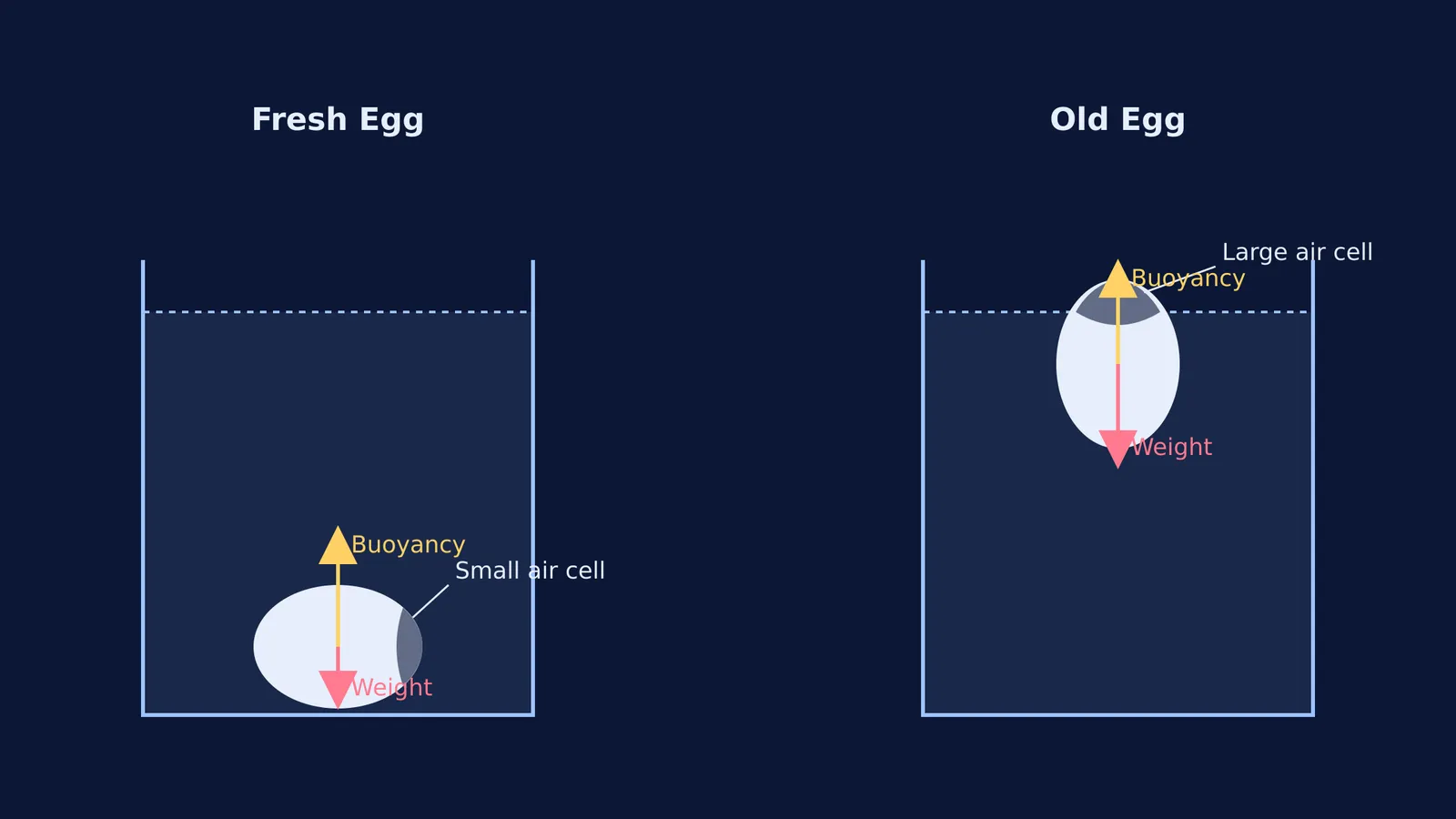
Imagine dropping a raw egg into a bowl of water to check if it is still good. A fresh one sinks and rests flat on its side, while an older egg stands on its end or bobs to the surface. It is a kitchen trick passed down for generations, but the reason it works comes down to the physics of buoyancy and the microscopic anatomy of the shell.
The anatomy of an eggshell
An eggshell might look completely solid, but it is actually a breathable membrane. A typical chicken eggshell contains between 7,000 and 17,000 microscopic pores. These pores act as a life-support system for a developing embryo, allowing it to take in oxygen and release carbon dioxide.
Even unfertilised eggs sold in grocery stores constantly exchange gases with the outside air. Because an egg is mostly water, it slowly loses moisture through these pores from the moment it is laid.
Why does an old egg float in water?
As the egg loses water, its physical properties change. To replace the lost volume of moisture, air is drawn through the shell. As an egg cools after being laid, its contents contract, separating the inner and outer membranes to form an air cell, usually at the blunt end of the egg (USDA).
As the egg ages, moisture and carbon dioxide evaporate through the pores of the shell, allowing more air to penetrate and expand this air cell. Because the hard shell cannot shrink, the egg's total volume remains constant, but its mass decreases as water escapes.
According to Archimedes' principle, an object will float if its overall density—its mass divided by its volume—is lower than the density of the fluid displacing it. Fresh eggs have a density greater than water, so they sink. As the air cell grows, the egg’s average density drops. (If you are studying these forces for an exam, our guide to fluid mechanics: pressure, buoyancy and Bernoulli mistakes to avoid breaks down the common pitfalls.)
Once it becomes less dense than the water around it, it begins to stand upright and eventually floats—a principle that applies whether you are identifying two immiscible liquids in a manometer or checking your breakfast.
Visualising how volume, mass, and buoyant force interact can be difficult to grasp from a textbook alone. If you want to see these forces in action, the Fermi Simulation Lab has interactive simulations for the ideas that are easier to see than to read.
What else changes as an egg ages?
Beyond buoyancy, the moisture loss triggers several chemical and physical shifts inside the shell.
The egg white thins: A fresh egg has a thick, cloudy albumen (the egg white) because it contains a high level of dissolved carbon dioxide. As this gas escapes through the pores, the white becomes clearer and much more watery.
The yolk flattens: The yolk naturally tries to absorb the remaining water from the thinning egg white. This causes the yolk to swell slightly, stretching the membrane that holds it together. When you crack an older egg into a pan, the yolk sits flatter and breaks more easily than the tall, firm yolk of a fresh egg.
The pH rises: The loss of carbon dioxide also alters the egg's chemistry. A fresh egg is nearly neutral, but as carbon dioxide leaves, the pH of the egg white increases, making it more alkaline. This higher pH weakens the bond between the cooked egg white and the inner shell membrane, which is exactly why older eggs are much easier to peel when hard-boiled.
The USDA grades and the air cell
Commercial grading systems rely heavily on this physical aging process. The United States Department of Agriculture (USDA) uses air cell depth to determine egg quality grades. A very fresh Grade AA egg has an air cell depth of 1/8 inch (3.2 mm) or less. As moisture is lost and the air cell expands up to 3/16 inch (4.8 mm), the egg drops to Grade A.
Does a floating egg mean it is rotten?
A floating egg is definitely old, but it is not automatically unsafe to eat. Spoilage is caused by bacteria entering the egg, not simply by the evaporation of water.
While a large air cell indicates a loss of quality, the USDA advises that a floating egg can still be used if it is safe. To check for spoilage, crack the egg into a separate bowl. A spoiled egg will have a distinct, unpleasant odour when opened. If it looks and smells normal, it is perfectly fine for baking or boiling. So the next time your egg floats, remember that you are seeing the result of thousands of microscopic pores and a textbook demonstration of density at work.


