

On this page
When a heat engine runs through a complete thermodynamic cycle, the gas returns to its exact starting pressure, volume, and temperature. Because of this, it is easy to assume that everything cancels out. In a 2015 study published in *Physical Review Physics Education Research* (Smith et al., 2015), researchers found that students often fail to differentiate between a cycle's net state changes (which are zero) and the process quantities (such as heat and work) for that cycle.
To find the efficiency of a cycle, you cannot just add up all the heat transfers. If you do, you will get the net work, not the heat input. Efficiency (η) is defined as what you get out divided by what you put in:
η = W_net / Q_in
Here is how to calculate both parts from a standard PV diagram.
How do you find the net work from a PV diagram area?
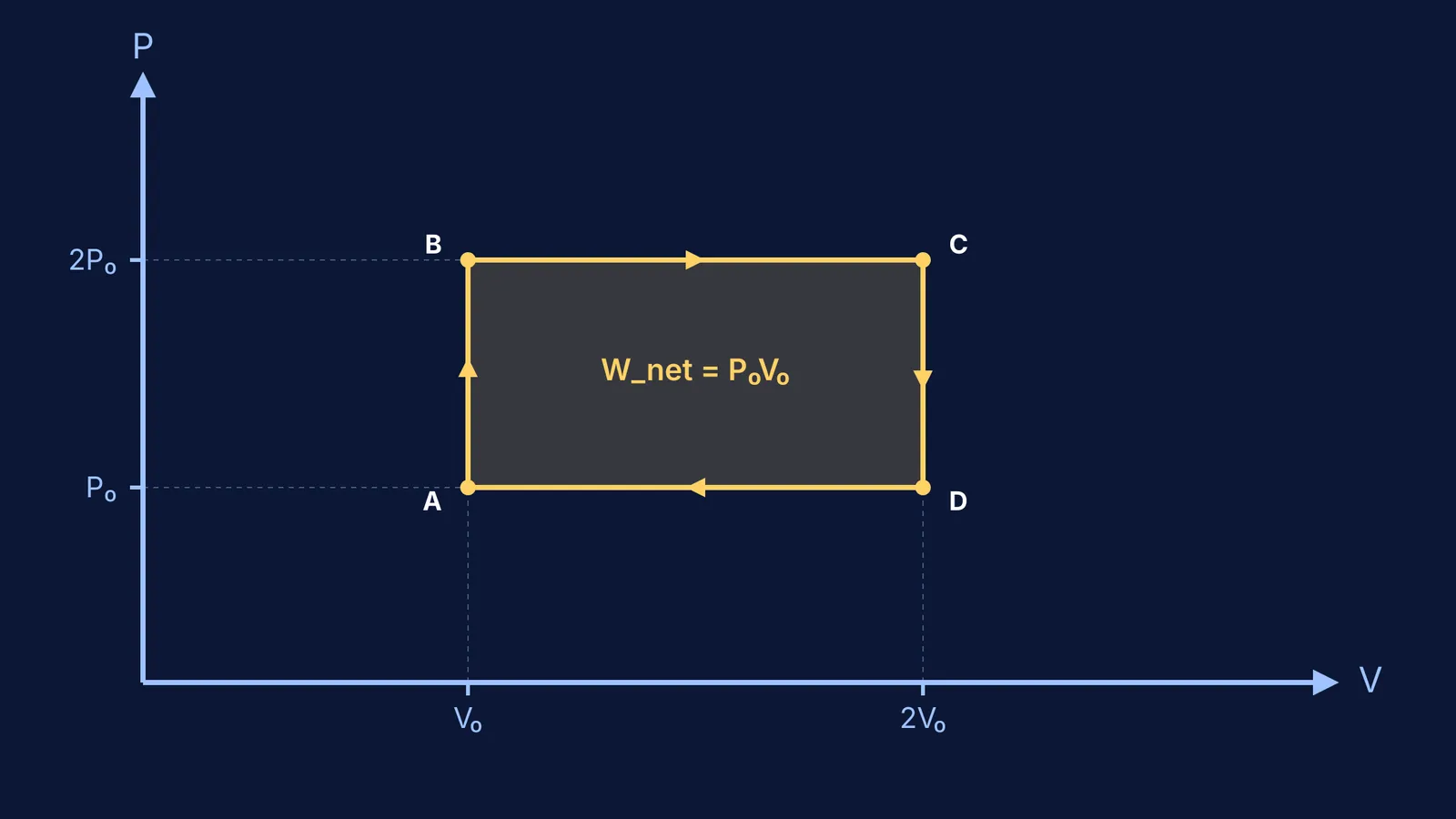
The net work (W_net) done by the gas is the total area enclosed by the cycle on the PV diagram.
You do not need to integrate the entire cycle if the shape is a simple geometric figure. For a clockwise cycle, the gas expands at a higher pressure than it compresses, meaning it does net positive work on its surroundings. If the cycle is a rectangle, triangle, or circle, simply calculate the area of the shape. Net work in a cycle: reading the loop on an indicator diagram
Where is heat absorbed in a thermodynamic cycle?
The most common mistake is dividing the net work by the net heat (Q_net). By the first law of thermodynamics (ΔU = Q − W), because the internal energy change for a full cycle is zero, Q_net exactly equals W_net. Dividing them gives an efficiency of 1, meaning complete conversion of heat to work, which is impossible under the second law of thermodynamics.
You must divide by Q_in, which is the sum of heat absorbed *only* during the parts of the cycle where Q > 0. You have to check each leg using Q = ΔU + W to see if heat is entering or leaving the system. Heat in isobaric and isochoric processes: using nCpΔT and nCvΔT
How do you calculate the efficiency of a rectangular cycle?
Consider a rectangular cycle for a monoatomic ideal gas moving clockwise from state A (V₀, P₀) to B (V₀, 2P₀) to C (2V₀, 2P₀) to D (2V₀, P₀) and back to A.
First, find the net work. The width of the rectangle is V₀ and the height is P₀, so the area is P₀V₀. Therefore, W_net = P₀V₀.
Next, calculate Q for each leg. For a monoatomic ideal gas, the molar heat capacity at constant volume is Cv = 3/2 R, and at constant pressure is Cp = 5/2 R.
A to B (Isochoric heating): Volume is constant, so work W = 0. Pressure doubles, meaning temperature increases. Q_AB = ΔU = nCvΔT = (3/2) × V₀ × (2P₀ − P₀) = 1.5 P₀V₀. Since this is positive, heat is absorbed.
B to C (Isobaric expansion): Pressure is constant at 2P₀. Volume doubles, doing work, and temperature increases. Q_BC = nCpΔT = (5/2) × (2P₀) × (2V₀ − V₀) = 5 P₀V₀. This is also positive, so heat is absorbed.
C to D (Isochoric cooling): Pressure drops, so temperature drops. ΔU is negative and W = 0, making Q negative. Heat is rejected here, so we ignore it for Q_in.
D to A (Isobaric compression): Volume drops, meaning work is done on the gas (negative). Temperature drops, so ΔU is negative. Q is negative, so we ignore it.
The total heat put into the engine is Q_in = 1.5 P₀V₀ + 5 P₀V₀ = 6.5 P₀V₀.
Now, calculate the thermal efficiency by dividing the net work by the heat input:
η = P₀V₀ / (6.5 P₀V₀) = 1 / 6.5 ≈ 0.154.
If you find yourself stuck distinguishing between the net heat over a cycle and the heat added in a specific process, the Fermi Problem Library has worked problems with a step-by-step solver that explains the reasoning rather than printing an answer. Drawing the cycle clearly and explicitly checking the sign of Q for every single line is the most reliable way to avoid missing a heat input.


