

On this page
Calculating the Earth's orbital speed is a classic physics exercise that connects simple geometry to Newton's law of universal gravitation. You can find the speed using two entirely different starting points, and they both lead to the same answer.
How do you calculate Earth's orbital speed with distance and time?
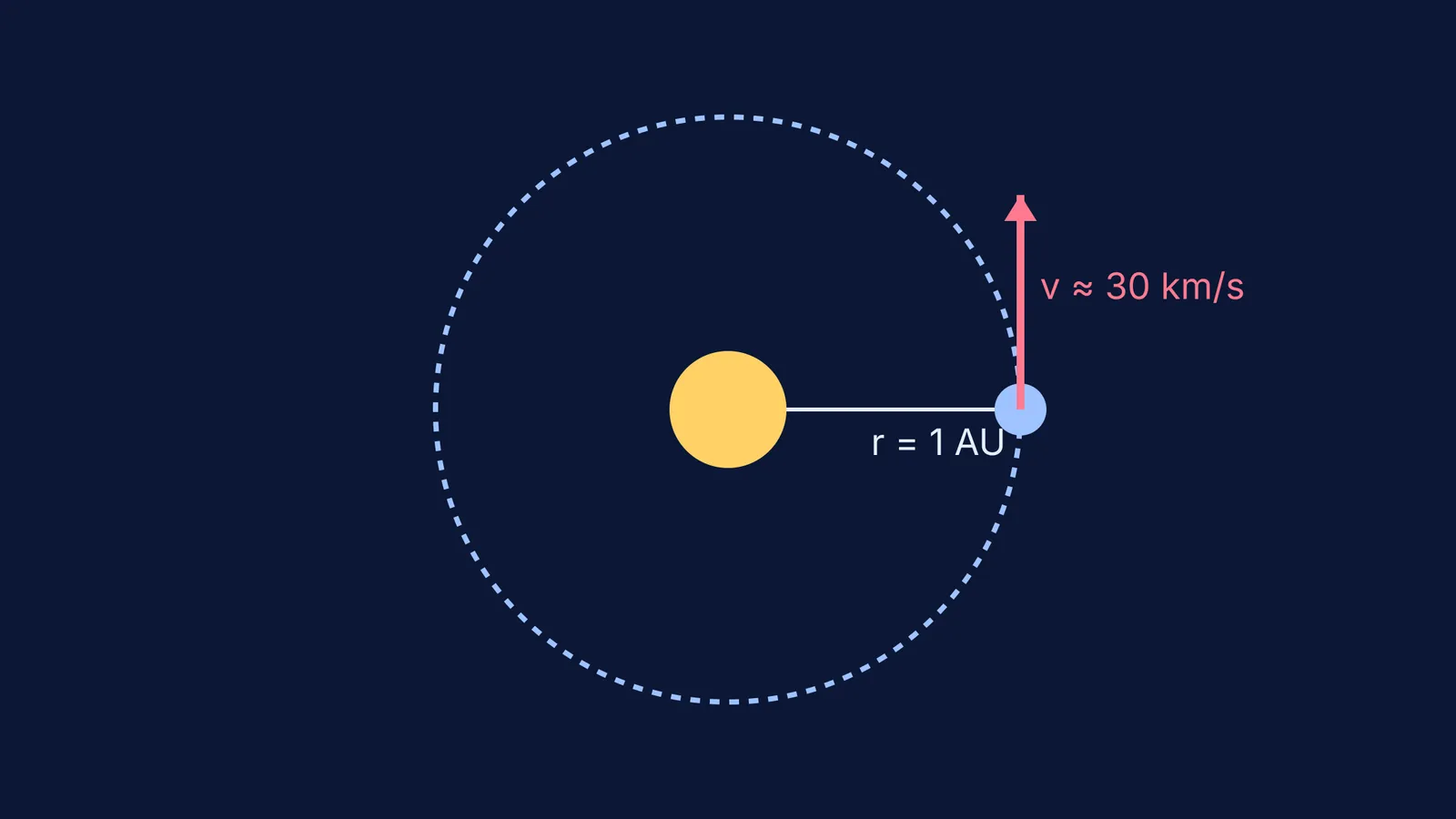
The most direct way to find the Earth's speed is to measure the physical distance it travels in one year and divide that by the time taken. The Earth travels at a mean orbital velocity of 29.78 km/s (NASA Earth Fact Sheet). This speed is not perfectly constant because the Earth's orbit is slightly elliptical, but treating it as a circle gives a very close approximation of the mean speed.
First, we need the radius of the orbit. According to the same NASA data, the Earth's semimajor axis (its average distance from the Sun) is about 149.598 million kilometres. This average distance is also known as one Astronomical Unit (1 AU).
Assuming the orbit is roughly circular, the total distance travelled in one year is the circumference of that circle, calculated using the formula 2πr.
Distance = 2 × π × 149.598 × 10⁶ km ≈ 939.95 million km.
Next, we need the precise time it takes to complete one full orbit. The Earth's sidereal orbit period—the time it takes to return to the same position relative to the fixed background stars—is 365.256 days (NASA Earth Fact Sheet). To find the speed in standard units of seconds, we convert this time from days to seconds:
Time = 365.256 days × 24 hours × 3600 seconds ≈ 31,558,118 seconds.
Dividing the total distance by the total time gives the mean speed:
Speed = 939.95 × 10⁶ km / 31,558,118 s ≈ 29.78 km/s.
This means the Earth is moving at nearly 30 kilometres every second just to maintain its orbit.
How does gravity determine orbital speed?
We do not have to rely on measuring the year. We can also find the Earth's speed by looking at the force of gravity that holds it in place. Newton's law of universal gravitation states that the gravitational pull of the Sun provides the exact centripetal force required to keep the Earth moving in a circle.
By setting Newton's law of gravitation equal to the centripetal force formula (GMm/r² = mv²/r), we can see that the mass of the orbiting object (m, the Earth) cancels out. This leaves us with a simplified equation for orbital speed that depends only on the central body: v = √(GM/r).
Here is how the numbers work out using the Sun's mass:
The Sun's standard gravitational parameter (GM) is 132,712 × 10⁶ km³/s² (NASA Sun Fact Sheet).
The Earth's orbital radius (r) is 149.598 × 10⁶ km.
Plugging these into the formula:
v = √(132,712 × 10⁶ / 149.598 × 10⁶)
v = √(887.12) ≈ 29.78 km/s.
If you are stuck on mechanics questions like this, the Fermi Problem Library has worked problems with a step-by-step solver that explains the reasoning rather than printing an answer.
How do you choose a method for orbital problems?
When you encounter gravitation and satellites: orbital speed, energy and escape speed problems in an exam, use this checklist to decide which method to apply:
Are you given time? If a question gives you the time period (T) and the radius (r), use the kinematics approach: v = 2πr / T. You do not need to know the mass of the central star or planet.
Are you given mass? If you are given the mass of the central body (M) or its gravitational parameter (GM), use the dynamics approach: v = √(GM/r). This is independent of the orbiting object's mass.
Do you need to find an unknown? You can equate the two formulas: 2πr / T = √(GM/r). This allows you to find the mass of a distant star just by observing a planet's orbit, which is the basis for exploring ideas like Kepler's second law from angular momentum: areal velocity worked.


