

On this page
What is the difference between delta y by delta x and dy by dx?
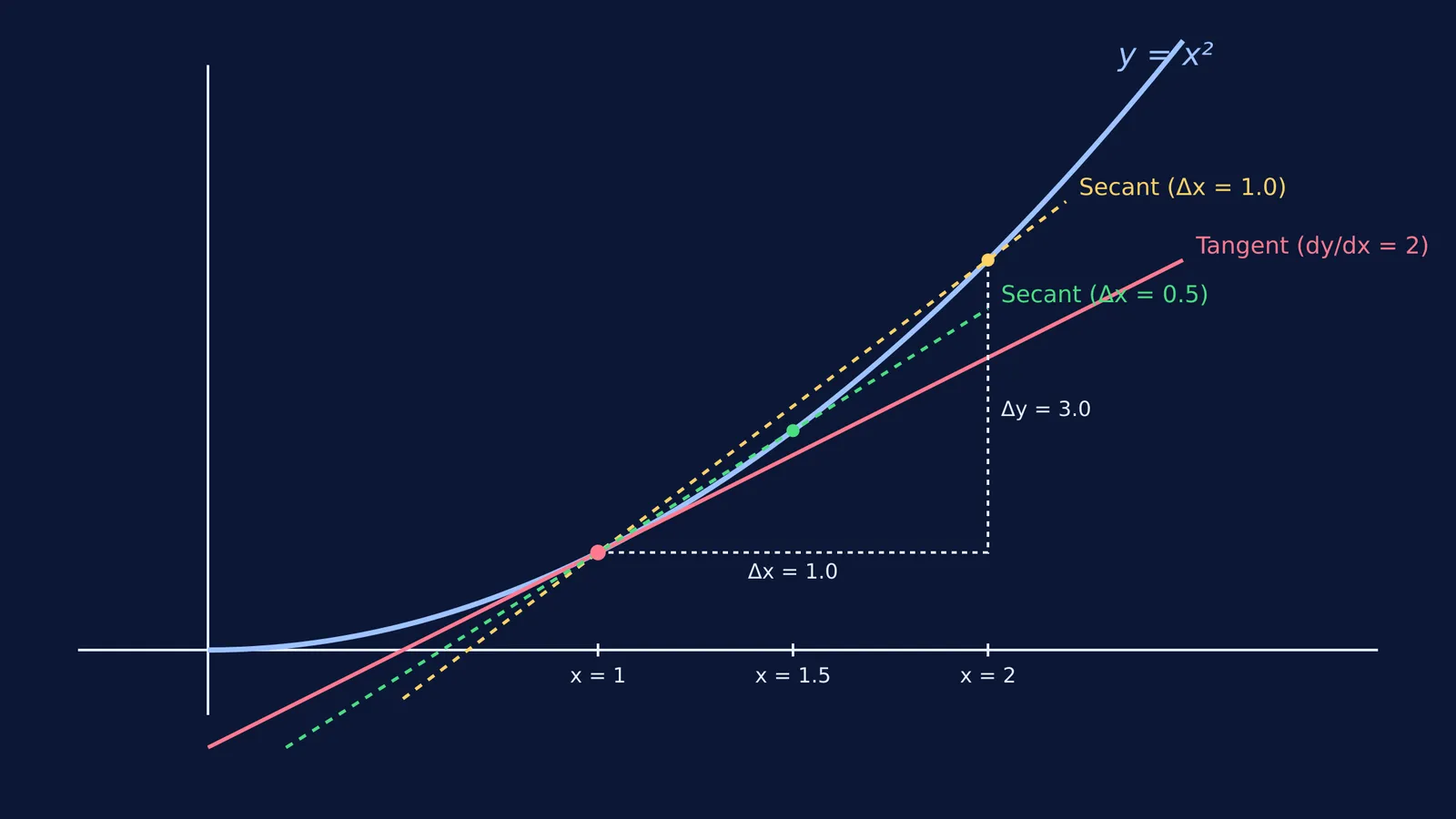
Start with the fundamental definition. The fraction Δy/Δx represents the average rate of change, measuring how much an output changes over a specific interval of an input (OpenStax). The Greek letter delta (Δ) is traditionally used in mathematics to denote a finite, measurable change in a variable. If you travel 100 kilometres in exactly 2 hours, your average rate of change (average speed) is simply 50 km/h. On a geometrical graph, this average rate is the slope of the secant line—a straight line cutting through two distinct points on a curve.
On the other hand, dy/dx is the derivative, representing the instantaneous rate of change or the slope of the tangent line touching just one specific point on the curve (Wikipedia). If you look down at your car's speedometer at precisely 1 hour and 15 minutes into your journey, the dial's reading is your instantaneous speed.
When the relationship between variables is perfectly linear (a straight line), the average rate and the instantaneous rate are completely identical. However, when the graph curves (a non-linear function), the two rates differ wildly. A 2012 study found that while advanced students successfully calculate the rate of change of linear functions, they struggle to calculate, model on a graph, or interpret the rate of change for non-linear functions (School Science and Mathematics).
How does the limit connect average and instantaneous rates?
The mathematical bridge that connects these two distinct ideas is the concept of the limit. To find the instantaneous rate dy/dx at a specific point x, you must first calculate the average rate Δy/Δx over an interval, and then mathematically make that interval (Δx) smaller and smaller.
Karl Weierstrass and the epsilon-delta definition of a limit formalized exactly how this shrinking process works. As Δx approaches zero, the secant line smoothly pivots to become the tangent line, and the average rate converges to a single limiting value. You can also see this limit logic applied in other complex mathematical rules, such as Guillaume de l'Hôpital, the 0/0 rule and the first calculus textbook.
Consider the function f(x) = x². We want to find the instantaneous rate of change exactly at x = 1. Using the standard power rule of differentiation, the derivative is 2x, so exactly at x = 1, the instantaneous rate dy/dx is exactly 2.
But let us prove this by calculating the average rate Δy/Δx from x = 1 to a second point x = 1 + Δx, letting Δx shrink:
Interval [1, 2]: Here Δx = 1.0. The change in y is 2² − 1² = 3. The average rate is 3 / 1.0 = 3.0.
Interval [1, 1.5]: Here Δx = 0.5. The change in y is 1.5² − 1² = 1.25. The average rate is 1.25 / 0.5 = 2.5.
Interval [1, 1.1]: Here Δx = 0.1. The change in y is 1.1² − 1² = 0.21. The average rate is 0.21 / 0.1 = 2.1.
Interval [1, 1.01]: Here Δx = 0.01. The change in y is 1.01² − 1² = 0.0201. The average rate is 0.0201 / 0.01 = 2.01.
As the interval Δx shrinks towards 0, the average rate neatly and predictably arrives at 2. This sequence demonstrates the formal definition of the derivative: dy/dx = lim (Δx → 0) (Δy/Δx).
How to master rates of change for exams?
Calculus sections in major competitive exams heavily feature rate of change word problems. Translating physical situations (like a leaking water tank or an expanding spherical balloon) into differential equations requires distinguishing the static value of a function from its active rate of change. For example, topics like Differentiating parametric functions: dy/dx and d²y/dx² rely entirely on treating varying rates as distinct algebraic variables.
Here is a practical checklist to help you avoid common conceptual errors:
Identify the Given Timing: Are you given a duration (between t = 2 and t = 5) or an exact instant (at t = 3)? A duration means you need Δy/Δx; an instant means you need dy/dx.
Watch the Directional Signs: If a quantity is decreasing, its rate of change must be explicitly negative. Forgetting this negative sign is a very common way to lose marks on long-answer questions.
Use the Chain Rule Correctly: When rates depend on multiple changing variables at once, you must apply the chain rule correctly to link them together without losing the inner function's derivative.
Practise Interactively: Reading about limits is not enough to truly grasp them; you must calculate them yourself. The Fermi Concept Library has a lesson for every concept in mathematics and its place in the map, helping you visualise exactly how secant lines collapse into precise tangents.
Calculus becomes much less intimidating when you stop seeing dy/dx as just an abstract, disconnected symbol, and start seeing it as the natural, mathematical destination of Δy/Δx.


