

On this page
When studying differential calculus in Class 12 or preparing for JEE Main, you quickly learn the reciprocal rule for first derivatives: dy/dx = 1 / (dx/dy). It feels natural and intuitive. The notation looks like a simple numerical fraction, inviting you to cancel and flip differentials like ordinary variables.
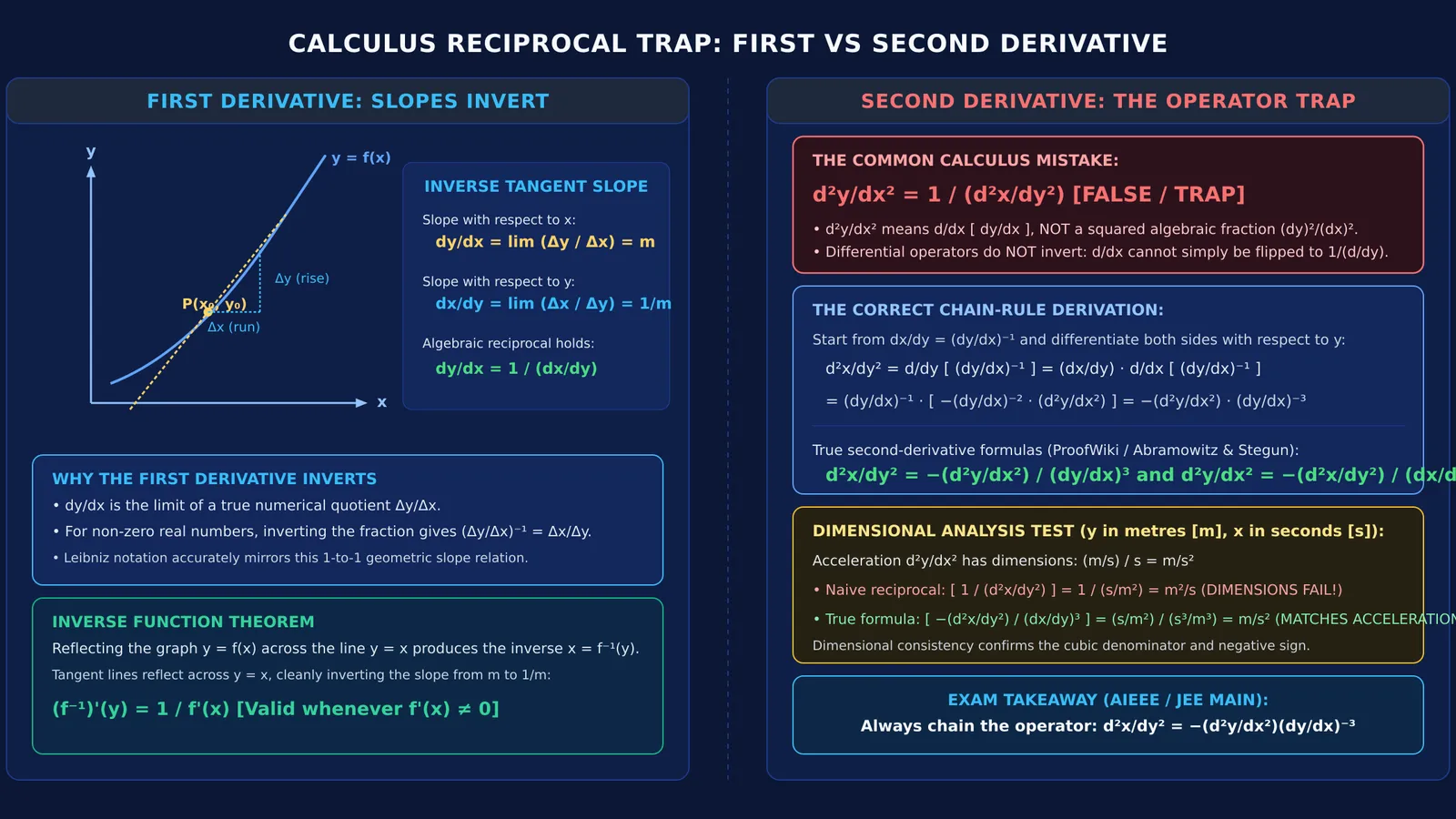
That notation creates a seductive trap. When asked for the second derivative of an inverse function, many students assume that d²y/dx² must equal 1 / (d²x/dy²). But that intuitive guess is completely wrong. In fact, d²y/dx² and 1 / (d²x/dy²) do not even share the same physical dimensions or algebraic signs.
Understanding why this reciprocal fails—and how to derive the correct relationship—protects you from a costly exam pitfall.
Why is dy/dx equal to 1/(dx/dy) in the first place?
To see why higher derivatives fail to invert, first examine why the first derivative succeeds.
Geometrically, dy/dx represents the slope of the tangent line to y = f(x) on Cartesian axes. For a small step Δx, the output changes by Δy. The ratio Δy/Δx is a genuine quotient of real numbers. Inverting the axes swaps rise and run, giving Δx/Δy = 1 / (Δy/Δx). As Δx approaches zero, this quotient converges to dy/dx = 1 / (dx/dy).
As shown in the Inverse Function Theorem in OpenStax Calculus, the graph of an inverse function reflects across the line y = x, cleanly inverting the tangent slope from m to 1/m. Because Leibniz notation dy/dx mirrors this slope ratio, students often mistake dy and dx for separable algebraic variables.
Why does d²y/dx² not equal 1/(d²x/dy²)?
The illusion breaks for higher-order derivatives. In a calculus study examining 110 students in *Educational Studies in Mathematics*, researcher Anthony Orton (1983) observed that learners frequently master procedural routines while treating derivative symbols as simple fractions rather than operational limits.
The symbol d²y/dx² does not mean "(dy)² divided by (dx)²". It represents applying the differential operator d/dx twice: d/dx [ dy/dx ]. Here, d/dx is an operation: "take the rate of change with respect to x."
When you compute d²x/dy², you apply the operator d/dy to dx/dy. You cannot invert the operator into 1 / (d/dy) because differentiation operators do not invert like fractions.
In AIEEE 2011 (now JEE Main), examiners specifically tested this misconception by asking for d²x/dy². The trap option (d²y/dx²)⁻¹ lured candidates who relied on algebraic intuition rather than the chain rule.
How do you derive the correct second derivative formula?
To find the true formula, differentiate the reciprocal identity dx/dy = (dy/dx)⁻¹ with respect to y:
d²x/dy² = d/dy [ (dy/dx)⁻¹ ]
Because dy/dx is an expression in x, use the chain rule d/dy = (dx/dy) · d/dx:
d²x/dy² = (dx/dy) · d/dx [ (dy/dx)⁻¹ ]
Applying the power rule yields:
d/dx [ (dy/dx)⁻¹ ] = −(dy/dx)⁻² · (d²y/dx²)
Substituting dx/dy = (dy/dx)⁻¹ gives:
d²x/dy² = (dy/dx)⁻¹ · [ −(dy/dx)⁻² · (d²y/dx²) ] = −(d²y/dx²) · (dy/dx)⁻³
Expressed in standard fractional form:
d²x/dy² = −(d²y/dx²) / (dy/dx)³
Or solved for d²y/dx²:
d²y/dx² = −(d²x/dy²) / (dx/dy)³
This result—catalogued on ProofWiki's second derivative of inverse function theorem from Abramowitz and Stegun's *Handbook of Mathematical Functions*—features a minus sign and a cubic denominator. Mastering this chain-rule step directly supports related problems like differentiating parametric functions and differentiating one expression with respect to another.
How does a dimensional analysis test catch the mistake?
A quick units check immediately exposes why 1 / (d²x/dy²) is impossible.
Let y have units of metres (m).
Let x have units of seconds (s).
Trace the units of each derivative:
dy/dx has units m/s (velocity).
d²y/dx² = d/dx [ dy/dx ] has units (m/s) / s = m/s² (acceleration).
dx/dy has units s/m (slowness).
d²x/dy² = d/dy [ dx/dy ] has units (s/m) / m = s/m².
Now invert d²x/dy²:
1 / (d²x/dy²) has units 1 / (s/m²) = m²/s.
Because m²/s cannot equal m/s², the naive reciprocal fails on physical grounds.
Now check the true identity −(d²x/dy²) / (dx/dy)³:
(s/m²) / (s/m)³ = (s/m²) / (s³/m³) = (s/m²) · (m³/s³) = m/s²
The units match acceleration perfectly.
How does testing y = x³ verify the formula?
Test the identity on y = x³ for x > 0.
Direct differentiation gives:
dy/dx = 3x²
d²y/dx² = 6x
Invert the function to find x = y^(1/3), then differentiate with respect to y:
dx/dy = (1/3) y^(−2/3) = 1 / (3x²)
d²x/dy² = d/dy [ (1/3) y^(−2/3) ] = −(2/9) y^(−5/3) = −(2/9) x^(−5)
Compare both formulas:
Naive reciprocal: 1 / (d²x/dy²) = −(9/2) x⁵ ≠ 6x (wrong degree and sign).
True formula: −(d²x/dy²) / (dx/dy)³ = [ (2/9) x^(−5) ] / [ 1 / (27 x⁶) ] = (2/9 × 27) · x = 6x
The true formula reproduces 6x exactly.
When working through advanced calculus problems where operator reasoning matters, the Fermi Problem Library provides worked problems with a step-by-step solver that explains the reasoning rather than printing an answer. To review curvature and rates of change across STEM subjects, explore the Fermi Concept Library, or work directly with Fermi's AI tutor to build a clear session plan. For more practice with differential equations, review our guide on second-order derivative relations.


