

On this page
Titrate a mixture of sodium hydroxide and sodium carbonate against standard hydrochloric acid with two indicators, and you see two colour changes. Each marks a different stage of the reaction, and the two burette readings are all you need to find how much of each base is present.
What does each indicator detect in a NaOH and Na2CO3 mixture?
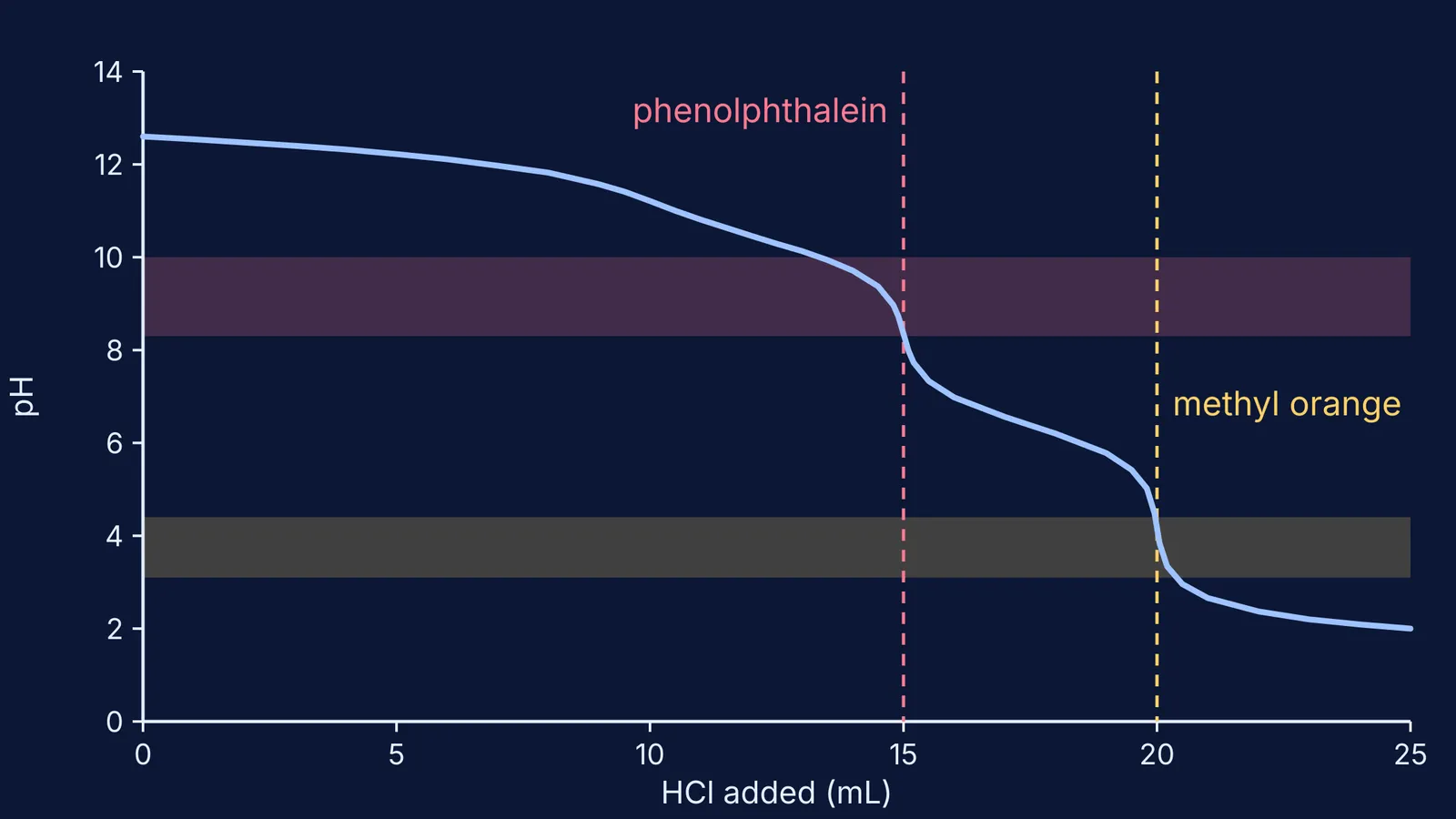
Carbonate picks up two protons, one at a time. A LibreTexts analytical chemistry lab on soda ash by Oliver Seely gives the two steps. First, CO₃²⁻ + H⁺ → HCO₃⁻, with an equivalence point at about pH 8.3. Second, HCO₃⁻ + H⁺ → H₂CO₃, with an equivalence point at roughly pH 4.0.
Phenolphthalein changes colour between pH 8.3 and 10.0, and methyl orange between pH 3.1 and 4.4, according to the LibreTexts module on acid-base indicators/Equilibria/Acid-Base_Equilibria/6._Acid-Base_Indicators). So each indicator lands on one of the two steps:
Phenolphthalein end point (pink to colourless): all the OH⁻ has become water, and all the CO₃²⁻ has become HCO₃⁻.
Methyl orange end point (yellow to orange-red): all the HCO₃⁻ has become H₂CO₃, that is, dissolved CO₂ and water.
An NPTEL chemistry experiments module puts it in one line. The phenolphthalein titre corresponds to sodium hydroxide plus half the carbonate, and the methyl orange titre corresponds to the total alkali. Our guide to acid-base titration curves and choosing indicators shows why the pH drops in two steps.
How do you calculate the composition from the two readings?
The cleanest method uses one flask. Titrate with phenolphthalein and note the volume, x mL. Then add methyl orange to the same flask, keep titrating, and note the extra volume, y mL. With acid of molarity M:
Phenolphthalein stage: n(OH⁻) + n(CO₃²⁻) = M × x
Methyl orange stage: n(HCO₃⁻) = n(CO₃²⁻) = M × y
So the carbonate is M × y mmol and the hydroxide is M × (x − y) mmol. Carbonate uses 2y mL of acid in total, and NaOH uses the remaining x − y mL.
What does a worked example look like?
You titrate 25.0 mL of the mixture with 0.100 M HCl. Phenolphthalein loses its colour at x = 15.0 mL. You add methyl orange, and it changes after a further y = 5.0 mL.
Carbonate: 0.100 × 5.0 = 0.50 mmol of Na2CO3.
Hydroxide: 0.100 × (15.0 − 5.0) = 1.00 mmol of NaOH.
Concentrations: 0.50 ÷ 25.0 = 0.020 M Na2CO3, and 1.00 ÷ 25.0 = 0.040 M NaOH.
Check: total acid = 1.00 + 2 × 0.50 = 2.00 mmol, which is 20.0 mL of 0.100 M HCl, exactly x + y.
Some textbooks titrate two separate portions instead. In the NPTEL module's notation, V1 is the methyl orange titre and V2 the phenolphthalein titre; carbonate corresponds to 2(V1 − V2) and NaOH to 2V2 − V1. Here V1 = 20.0 and V2 = 15.0, so carbonate takes 10.0 mL and NaOH 10.0 mL: the same answer. If you work in equivalents, carbonate counts once to phenolphthalein and twice to methyl orange; our post on n-factor and the equivalent concept shows how to handle a changing n-factor.
What do the two readings tell you before you calculate?
Compare x and y first; it tells you which bases are present:
y = 0: only NaOH.
x = y: only Na2CO3.
x greater than y: NaOH and Na2CO3 (this post's case).
x less than y: Na2CO3 and NaHCO3; the bicarbonate is M × (y − x).
x = 0: only NaHCO3.
NaOH and NaHCO3 never appear together, because hydroxide turns bicarbonate into carbonate.
Why is the phenolphthalein end point harder to read?
The curve is gentle at the first end point. In the soda-ash procedure, near pH 8.3 adding 1.0 mL of acid moves the pH by only about 0.3 units, and about 10 mL is needed for a change of one pH unit; near the second end point, about 4 mL does the same. The indicators module/Equilibria/Acid-Base_Equilibria/6._Acid-Base_Indicators) adds that phenolphthalein's half-way colour is just a paler pink, which is hard to spot. A few habits help:
Use a white tile and add acid drop by drop, swirling, as the pink fades.
Write down x before you add methyl orange.
For precise work, the soda-ash procedure (which uses bromocresol green for the second end point) boils the solution just before the final end point to drive off dissolved CO₂.
If you understand the chemistry but the arithmetic keeps slipping, the Fermi Problem Library has worked problems with a step-by-step solver that explains the reasoning rather than printing an answer. When a sample will not titrate directly, see our guide to back titration calculations.
Next time you meet a two-indicator question, write down x and y, compare them, and only then calculate.


