

On this page
A system of two blocks on a double inclined plane connected by a string over a pulley is a classic physics problem used to teach Newton's second law. The problem asks you to predict which way the blocks will move, how fast they will accelerate, and what the tension in the string will be.
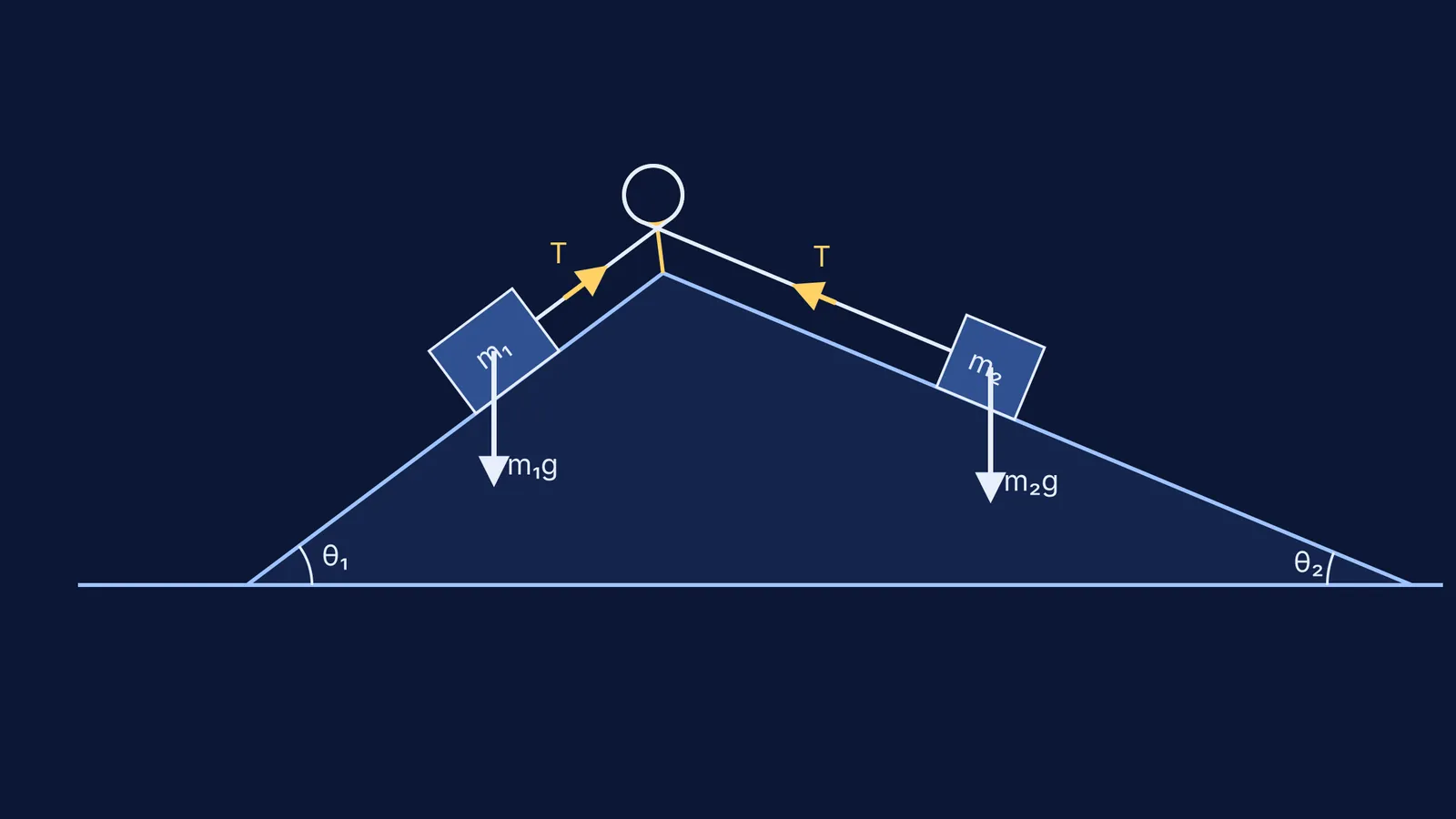
A record 14,76,557 unique candidates registered for JEE Main 2024 according to the National Testing Agency (source), meaning students cannot afford to skip fundamental mechanics topics like this one. In this setup, we have two blocks of mass m₁ and m₂ resting on inclines with angles θ₁ and θ₂ to the horizontal. They are connected by a massless, inextensible string running over a frictionless pulley at the peak.
Which way will the blocks move?
Before writing out any equations of motion, you must decide the direction the system will move. Gravity pulls each block down its respective incline. The driving force for the first block is m₁g sin θ₁, and the driving force for the second block is m₂g sin θ₂.
Because the string connects them, these two forces pull against each other.
If m₁g sin θ₁ > m₂g sin θ₂, the first block accelerates down the left slope and pulls the second block up the right slope.
If m₁g sin θ₁ < m₂g sin θ₂, the second block accelerates down its slope and pulls the first block up.
If they are equal, the system remains at rest (or moves at a constant velocity if already in motion).
If you are unsure how to set up the free-body diagram for each block, the Fermi Concept Library maps out every core idea in mechanics, breaking down vectors into their parallel and perpendicular components.
A checklist for double incline problems
When faced with a double inclined plane on an exam, follow these steps to avoid common sign errors:
Draw the free-body diagram: Sketch both blocks, the inclines, and all forces. Label the normal force perpendicular to the surface and gravity pointing straight down.
Resolve the gravity vectors: Break the weight of each block into a component parallel to the incline (mg sin θ) and a component perpendicular to the incline (mg cos θ).
Compare the driving forces: Calculate m₁ sin θ₁ and m₂ sin θ₂. The larger value dictates the assumed direction of acceleration.
Assign friction: Draw kinetic friction vectors (μmg cos θ) on both blocks pointing opposite to the assumed direction of motion.
Write Newton's second law: Create an equation for each block (Net Force = ma), ensuring forces in the direction of motion are positive.
Solve the system: Add the two equations to eliminate the tension T and find the acceleration.
How do you calculate the acceleration?
Assume that the left block m₁ is heavier or on a steeper slope, so m₁g sin θ₁ > m₂g sin θ₂. The left block will move down the slope with acceleration a, and the right block will move up with the same acceleration.
Write Newton's second law for both blocks:
For m₁ (moving down): m₁g sin θ₁ − T = m₁a
For m₂ (moving up): T − m₂g sin θ₂ = m₂a
Adding the two equations eliminates the tension T: m₁g sin θ₁ − m₂g sin θ₂ = (m₁ + m₂)a
Rearranging gives the acceleration of the system: a = g(m₁ sin θ₁ − m₂ sin θ₂) / (m₁ + m₂)
For step-by-step guidance on setting up these equations for different masses and angles, the Fermi Problem Library explains the reasoning behind each substitution rather than just printing the final answer.
What happens when you add friction?
When the inclines are rough, friction always acts opposite to the direction of motion (source). You must first check the driving forces to assume a direction of motion.
If we again assume m₁ moves down the slope, kinetic friction on both blocks will oppose this movement. The normal force on each block is mg cos θ.
Kinetic friction on m₁ points up the slope: f₁ = μ₁m₁g cos θ₁
Kinetic friction on m₂ points down the slope: f₂ = μ₂m₂g cos θ₂
The new equations of motion become: m₁g sin θ₁ − T − μ₁m₁g cos θ₁ = m₁a T − m₂g sin θ₂ − μ₂m₂g cos θ₂ = m₂a
Adding them together yields the new acceleration: a = g(m₁ sin θ₁ − m₂ sin θ₂ − μ₁m₁ cos θ₁ − μ₂m₂ cos θ₂) / (m₁ + m₂)
If your resulting a is negative, your assumption about the direction of motion was wrong, and you must start over with friction pointing the other way. If both assumptions give a negative result, the system is held in place by static friction. This principle is closely related to finding the time for a block to slide down a rough incline or the minimum force to drag a block on a rough floor.
How to find the tension in the string?
Once you have calculated the acceleration a—with or without friction—you can find the tension T by substituting a back into the equation of motion for either block.
Using the first block's equation for a frictionless surface: T = m₁(g sin θ₁ − a)
If you substitute the expression for a and simplify, you get: T = m₁m₂g(sin θ₁ + sin θ₂) / (m₁ + m₂)
This shows that the tension is identical throughout the string, but its value depends on the parameters of both blocks. It works similarly to the tension found when a monkey is climbing a rope.


