

On this page
There is a famous piece of trivia that says water drains counterclockwise in the Northern Hemisphere and clockwise in the Southern Hemisphere. It is a compelling idea, rooted in a real physics concept called the Coriolis effect.
But if you fly to Australia and watch a bathroom sink empty, you might be disappointed. The direction water swirls down a household drain has nothing to do with which side of the equator you are on.
Here is why the Earth’s rotation loses out to the shape of your sink, and the extreme lengths scientists had to go to in order to prove the Coriolis effect works on water at all.
Does water swirl the other way down the drain in Australia?
In a household sink or bathtub, no. Water in Australia is just as likely to drain counterclockwise as it is to drain clockwise.
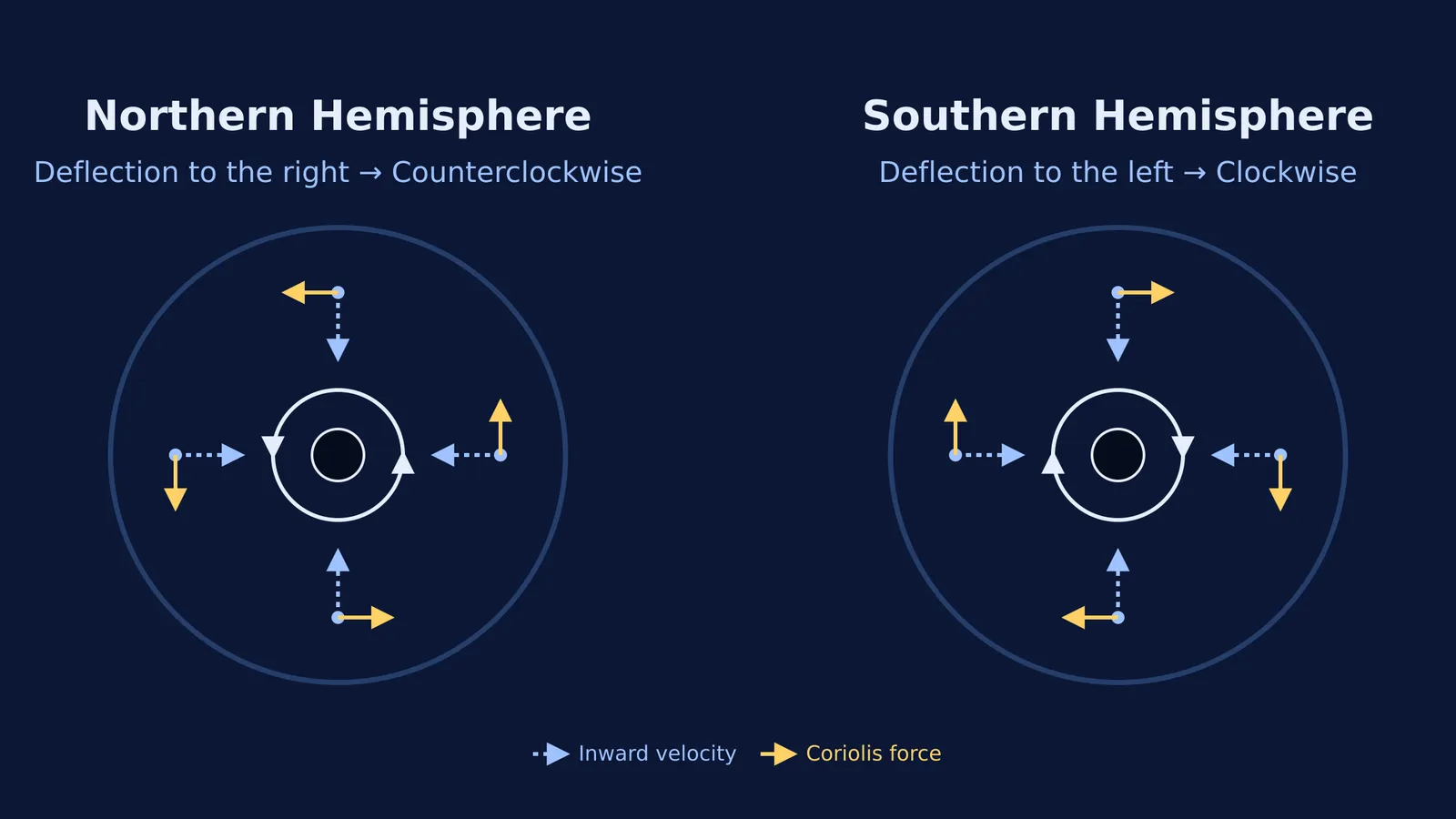
The Coriolis effect is a pseudo-force that acts on objects moving within a rotating frame of reference, such as the Earth. As the Earth spins, it completes one full rotation every 24 hours. Because of this rotation, moving objects are deflected to the right of their path in the Northern Hemisphere, and to the left in the Southern Hemisphere.
This deflection governs the large-scale circulation of winds and the rotation of cyclones. However, the magnitude of the Coriolis force depends on the speed of the Earth's rotation, which is incredibly slow—roughly 7.29 × 10⁻⁵ radians per second.
For typical water speeds in a draining basin, the acceleration caused by the Coriolis effect can be as small as 3 × 10⁻⁷ times that of gravity (Wikipedia).
What really controls the swirl in your sink?
In everyday life, the Coriolis effect is completely overwhelmed by local factors. The shape of the basin, the angle at which the water is introduced, and the exact placement of the drain pipe all create their own minute currents.
Even slight air currents in your bathroom or temperature differences across the water can generate forces thousands of times stronger than the rotation of the Earth. When you fill a sink, the water sloshes around, and that momentum takes hours to completely dissipate. As long as any of that residual motion remains, it will dictate the direction the water swirls when it drains.
The 24-hour bathtub experiment
Because the Coriolis force is so weak at the scale of a sink, demonstrating it requires a perfect setup. In 1962, Ascher H. Shapiro, a professor at MIT, published a definitive experiment in the journal Nature showing that the Coriolis effect can determine the drain direction—but only if you eliminate every other variable.
Shapiro used a perfectly symmetrical, flat-bottomed tank measuring 2 metres across (Wikipedia). To ensure that the water had absolutely no residual motion from being poured in, he filled the tank and let it sit undisturbed under a cover for 24 hours.
When he carefully pulled the plug from below, the water initially drained straight down. To detect the Coriolis effect, he placed a small wooden cross above the plug hole to visualize the rotation. The tank took 20 minutes to drain, and the wooden cross only began to turn after about 15 minutes. By the end of the drain, the cross rotated at a leisurely rate of 1 rotation every 3 to 4 seconds. It was a subtle, slow turn, not a violent whirlpool—but it proved the Northern Hemisphere's counterclockwise influence.
Three years later, in 1965, Lloyd M. Trefethen and a team at the University of Sydney replicated Shapiro's precise experiment in Australia, publishing their results in Nature. After letting their tank settle for 18 hours, they pulled the plug and observed a consistent clockwise rotation, confirming the effect for the Southern Hemisphere.
How do you find the dominant force in a system?
The bathtub myth persists because it is easy to assume that a law of physics applies equally at all scales. When studying physics, a useful framework is to write down all the competing forces and compare their magnitudes before deciding what will happen. This process of dimensional analysis is exactly how meteorologists decide whether to include rotation in their models.
Identify the forces: In a draining sink, the forces include gravity pulling the water down, the centripetal force of the swirling water, fluid friction slowing it down, and the Coriolis force pushing it sideways.
Estimate the scale: Calculate the acceleration for each. Gravity accelerates objects at 9.8 m/s². The Coriolis acceleration for water moving at half a metre per second is near 0.00005 m/s² (Wikipedia).
Find the dominant term: Since gravity and inertial forces are hundreds of thousands of times larger, you can safely ignore the Coriolis term when predicting the outcome.
When a concept is governed by invisible forces, relying on intuition can lead you to the wrong conclusion. If you are struggling to picture how fields and forces interact, the Simulation Lab lets you run interactive experiments, changing the variables to see which force takes over.
For example, understanding how a car over a hump lifts off requires balancing gravity against centripetal force. Similarly, calculating the time lost by a pendulum clock in summer means balancing thermal expansion against the restoring force of gravity. And if you drop a mass in SHM through a tunnel across the Earth, you have to map how gravity changes with depth. In all these cases, comparing the scale of the forces is the first step to the solution.
The next time you pull the plug in your bathtub, watch the swirl. You aren't seeing the rotation of the planet; you are seeing the unique geometry of your own plumbing.


