

On this page
Does adding salt make water boil faster?
Technically, yes, but the difference is just a few seconds. When you dissolve salt in water, you trigger two competing effects. First, saltwater has a slightly lower specific heat capacity than pure water. This means it requires less thermal energy to increase in temperature by one degree, giving it a head start.
However, there is a second phenomenon known as boiling point elevation. The salt ions interact with the water molecules, making it harder for them to escape into the air as a gas. According to Live Science, this means you must heat the water to a higher temperature than the standard 100 °C to make it boil. The speed gained from the lower heat capacity slightly outweighs the delay from the higher finish line, leaving the boiling time practically unchanged.
How much salt changes the boiling point?
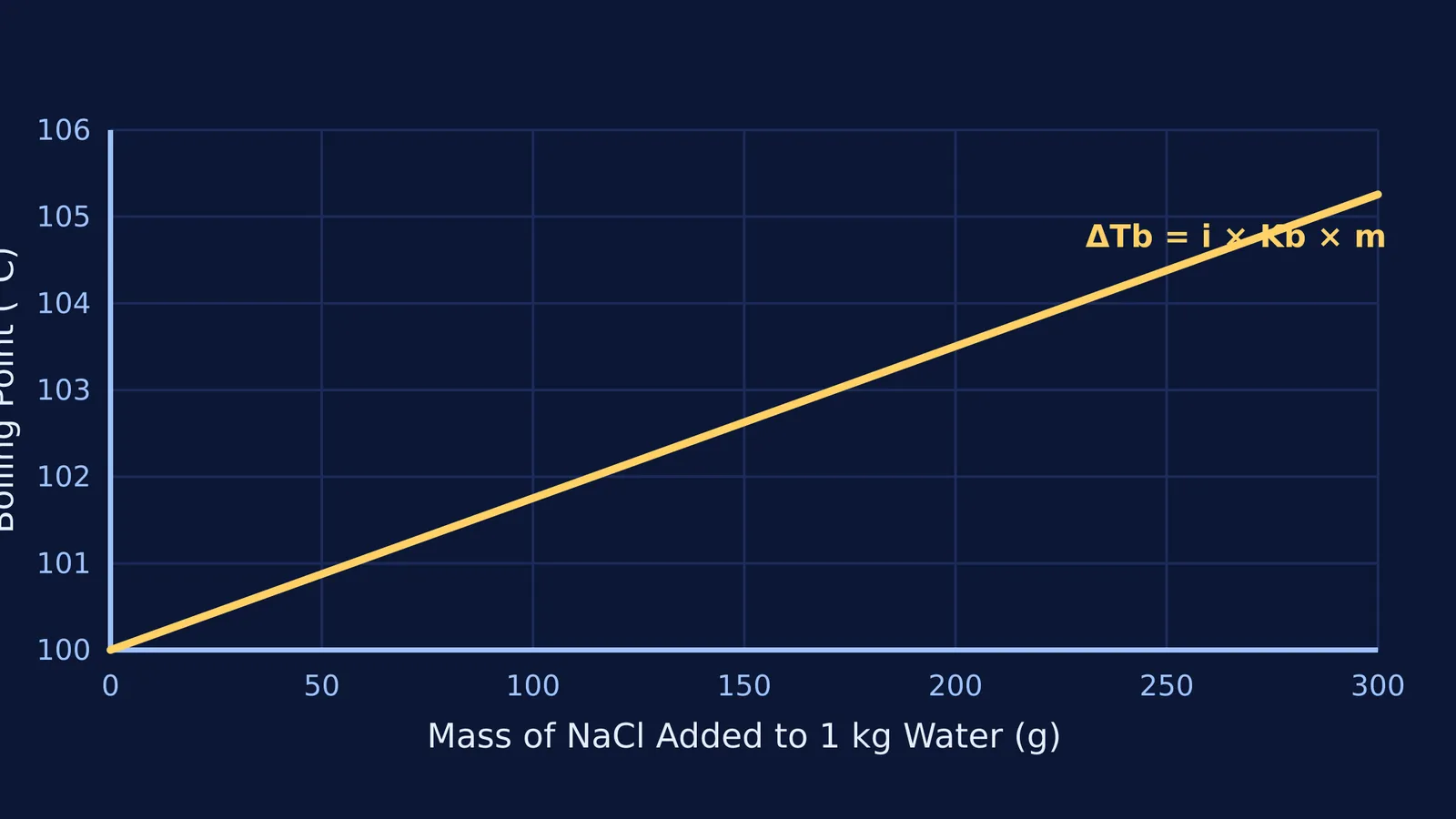
The rise in temperature depends strictly on how many particles you dissolve, not what those particles are. The ebullioscopic constant (Kb) for water is 0.512 °C/molal. This means one mole of particles dissolved in one kilogram of water raises the boiling point by exactly 0.512 °C.
Table salt (NaCl) splits into two separate ions (Na⁺ and Cl⁻) when it dissolves, giving it a van 't Hoff factor of i = 2. Therefore, one mole of NaCl (about 58.44 grams) in one kilogram of water raises the boiling point by approximately 1.024 °C. To see how these ionic interactions play out visually or to test different solutes, you can experiment in the Fermi Simulation Lab.
If you add a typical kitchen amount—say, 10 grams of salt—to a litre of water, the math looks like this:
Find the moles: 10 grams / 58.44 g/mol = 0.171 moles.
Find the molality: 0.171 moles / 1 kg = 0.171 m.
Calculate the elevation: ΔTb = i × Kb × m = 2 × 0.512 × 0.171 = 0.175 °C.
Your pasta water boils at 100.175 °C instead of 100 °C. The difference is too small to notice without a highly sensitive laboratory thermometer.
Does adding sugar have the same effect?
Yes, adding sugar also raises the boiling point, because this effect is a colligative property. Colligative properties depend only on the ratio of solute particles to solvent molecules, not on the identity of the solute.
However, sugar (sucrose) does not break apart into ions when it dissolves. Its van 't Hoff factor is i = 1. Because it does not dissociate, one mole of sugar (which is a massive 342.3 grams) dissolved in one kilogram of water will only raise the boiling point by 0.512 °C. You would need nearly twelve times the mass of sugar to match the boiling point elevation caused by salt.
How does altitude affect boiling time?
While salt barely moves the needle, atmospheric pressure changes the boiling point drastically. Water boils when its vapour pressure equals the surrounding atmospheric pressure.
At higher elevations, the air pressure is lower, so it is easier for water molecules to escape as vapour. In a city like Denver, which is 1,600 metres above sea level, water boils at roughly 95 °C. Because the boiling water is cooler, food takes much longer to cook. A chef working at a high altitude might actually add salt to try to drag the boiling point back up, ensuring their pasta cooks at the correct speed.
How do you calculate boiling point elevation in Class 12?
Boiling point elevation (ΔTb) is a core concept in the Class 12 Chemistry chapter on solutions, appearing alongside osmotic pressure. The standard formula required for the board exams and competitive tests is ΔTb = i × Kb × m.
Here is a worked example to practice the steps: *Question:* What is the boiling point of a solution made by dissolving 29.22 g of NaCl in 500 g of water?
*Answer:*
Calculate moles of NaCl: 29.22 g / 58.44 g/mol = 0.5 moles.
Calculate molality (m): 0.5 moles / 0.5 kg = 1.0 m.
Identify the van 't Hoff factor (i): NaCl dissociates completely into 2 ions, so i = 2.
Apply the formula: ΔTb = 2 × 0.512 × 1.0 = 1.024 °C.
Add to the pure solvent's boiling point: 100 + 1.024 = 101.024 °C.
If you struggle with setting up these equations or mixing and diluting solutions, Fermi's AI tutor can hold a line of reasoning across a session and check your understanding as you go.
Whether you are trying to perfect a recipe in the kitchen or preparing for your chemistry finals, the physical chemistry remains exactly the same.


