

On this page
For decades, we have been told that adding a spider plant or a peace lily to a study room can purify the air. The idea is that these plants absorb harmful volatile organic compounds (VOCs) from paint, furniture and electronics, creating a healthier environment for students to focus and learn. But does a potted plant actually clean the air in a real room?
The short answer is no. While plants do absorb toxins, the rate at which they do so is mathematically insignificant compared to normal air circulation.
Where did the idea come from?
The popular belief that plants are highly effective air purifiers stems from a 1989 NASA study led by Bill Wolverton. NASA was looking for ways to clean the air inside sealed space stations. In their experiments, researchers placed plants in small, hermetically sealed chambers and injected VOCs like benzene and formaldehyde. Under these airtight conditions, the plants and their soil microbes successfully reduced the pollutant levels over 24 hours.
However, a typical home or office is not a sealed space capsule. A real room has constant air exchange. Air leaks under doors, around window frames, and through ventilation systems. The conditions that allowed plants to clean the air in the NASA experiment simply do not exist in a normal study environment.
How many plants do you need to clean a room?
In 2019, environmental engineers Bryan Cummings and Michael Waring published a comprehensive review of 30 years of research in the *Journal of Exposure Science & Environmental Epidemiology*. They analysed 196 experimental results and converted the data into a standard metric called the Clean Air Delivery Rate (CADR).
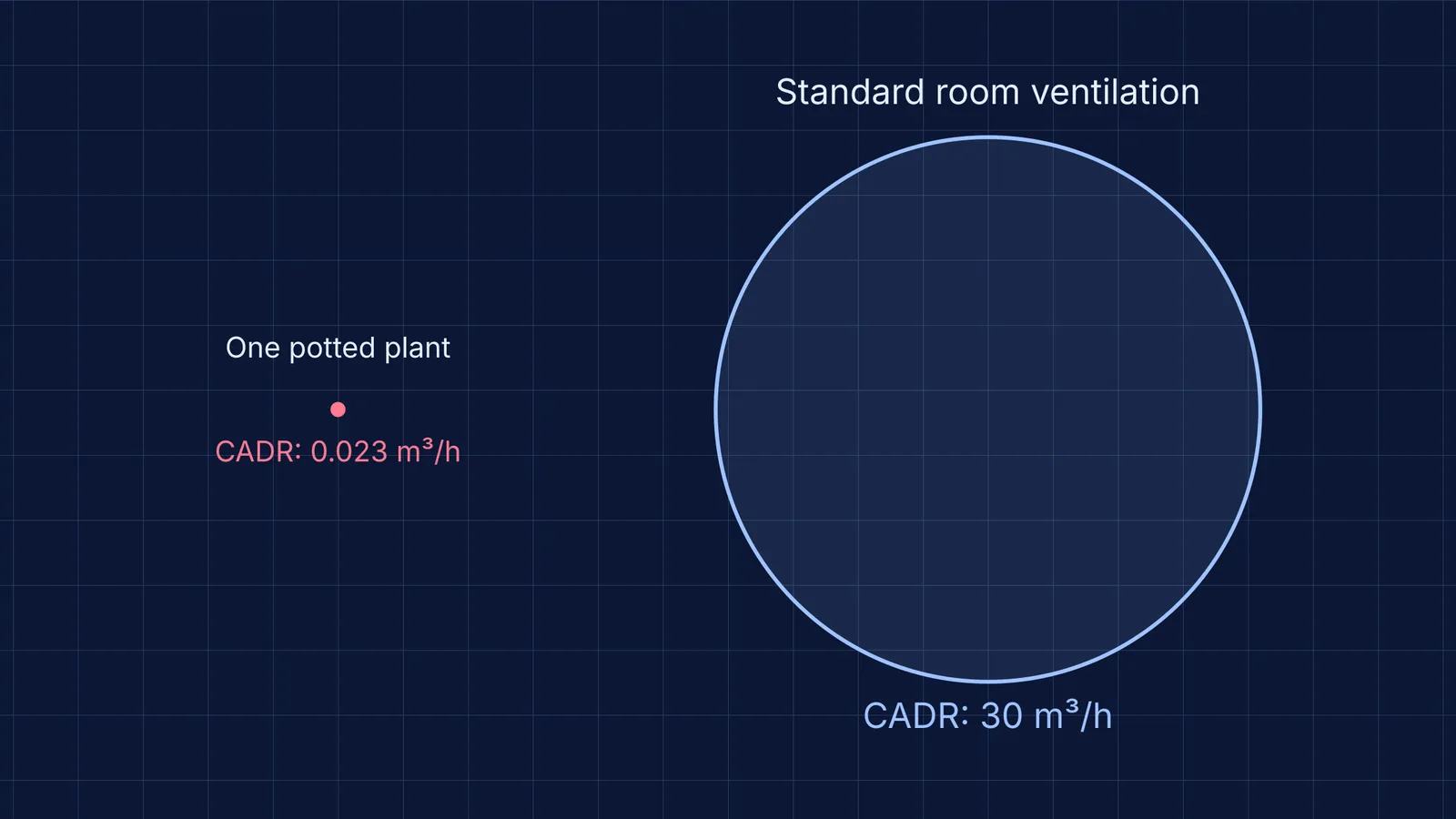
They found that the CADR of a single houseplant is roughly 0.023 cubic metres per hour. By comparison, simply having standard building ventilation provides an air exchange that equates to a CADR of around 30 cubic metres per hour for a small room.
To match the air-cleaning power of a typical building's passive ventilation system, you would need between 10 and 1,000 plants per square metre of floor space. In other words, you would have to pack the room so full of foliage that there would be no space left for a desk.
Why do plants fail in real rooms?
To understand why plants fail as air purifiers, we have to look at how they interact with their environment. A plant's primary interaction with the air is driven by photosynthesis and photorespiration. During these processes, leaves do take in trace gases through their stomata, but at a rate tailored strictly to the plant's own metabolic needs, not the vast volume of a human-sized room.
In a sealed lab chamber, a plant and its soil microbes have hours to slowly absorb VOCs because the gases have nowhere else to go. In an open system like your study room, natural ventilation dilutes and removes pollutants far faster than a plant's leaves can absorb them.
This difference is an excellent example of why students must carefully evaluate experimental conditions—a key skill whether you are tackling a biology paper or running experiments in the Fermi Simulation Lab. A result that is true in a closed system does not automatically apply to an open one.
What should you do for better air?
If you want to keep your study space fresh to maintain focus, the solution requires a practical plan rather than a jungle of indoor plants. Follow this simple routine:
Ventilate daily: Open a window and a door every morning. This creates a cross-breeze that completely exchanges the indoor air.
Filter when needed: If outdoor particulate matter or smog is high, close the windows and run a HEPA air purifier with an activated carbon filter.
Control the source: Minimise the use of aerosol sprays and ensure your room is dusted regularly.
This does not mean you should throw away your houseplants. If you place a potted plant on your desk, it will naturally bend toward the window—a classic example of phototropism and other tropic movements. Observing this growth is a fascinating daily connection to biology. Just let them be plants, and rely on your windows to clean the air.


