

On this page
When you check if a number is a multiple of 2, 5 or 10, you only need to look at its final digit. The test for 13 is slightly more involved, but it relies on a similar mathematical idea of breaking the number apart into smaller, manageable pieces.
The divisibility rule for 13 test is a process of truncating the number, multiplying the last digit by a factor, and adding it back. By repeating this cycle, you can shrink a very large number to a simple two-digit result that you can evaluate by heart. Understanding how this rule works is an excellent exercise in basic number theory, bridging simple arithmetic with modular mathematics.
What is the divisibility rule for 13 test?
To determine if a number is divisible by 13, you must first separate its last digit from the rest of the number. The Brilliant Math & Science Wiki states the standard rule as: take the last digit of the number, multiply that digit by four, and add the result to the remaining digits.
If the resulting number is divisible by 13, then the original number is as well. Often, one pass of the rule leaves a number that is still too large to verify instantly. In that case, you treat the new number as your starting point and repeat the test until the result is small enough to recognise as a multiple of 13, such as 13, 26, 39 or 52.
How to check a number: worked examples
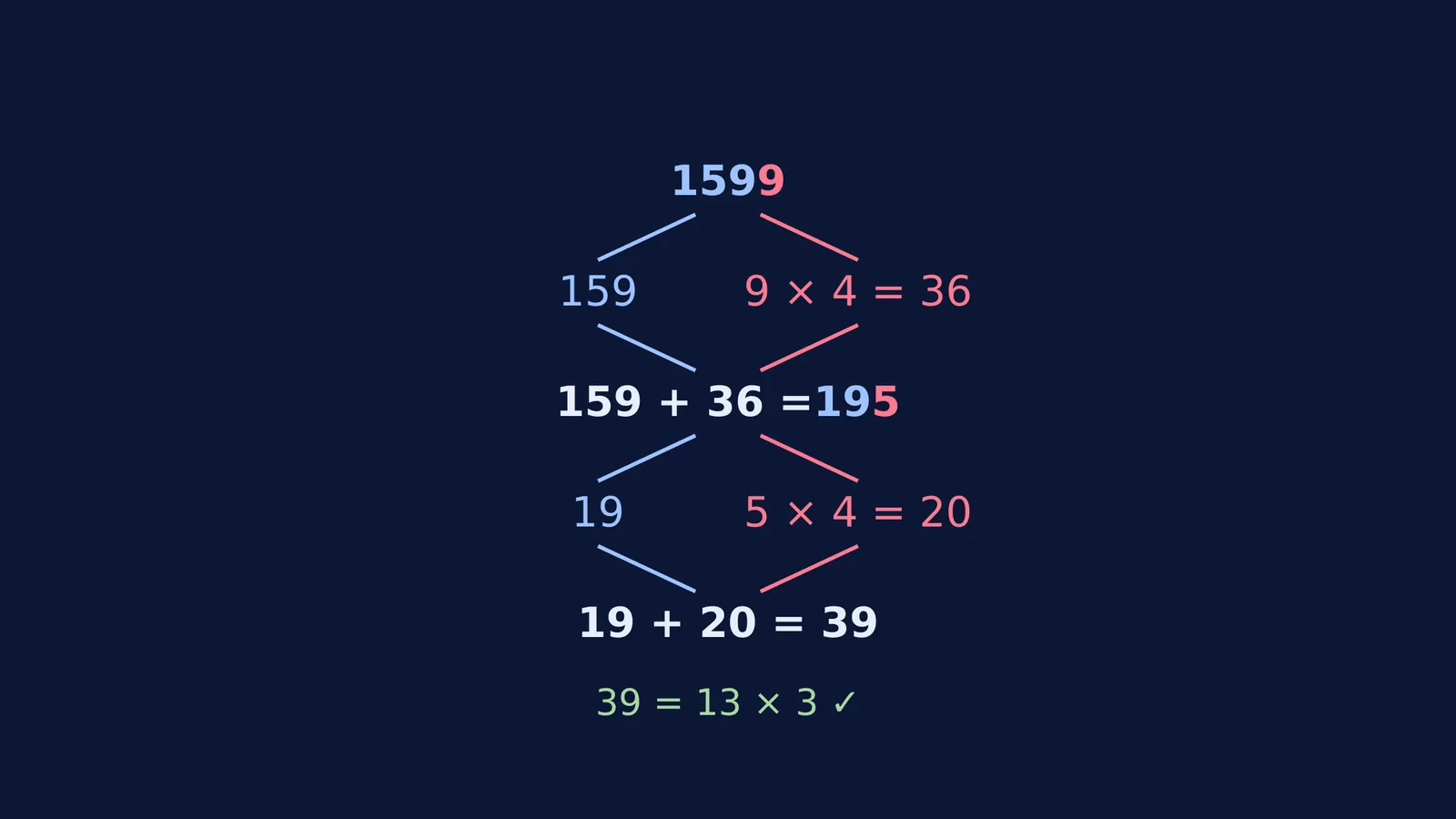
Let us apply the rule to check if 1599 is a multiple of 13.
The last digit is 9. The remaining truncated number is 159.
Multiply the last digit by four: 9 × 4 = 36.
Add this product to the remaining number: 159 + 36 = 195.
Since 195 might still be too large to check comfortably, you can apply the rule again to 195:
The last digit is 5. The remaining truncated number is 19.
Multiply the last digit by four: 5 × 4 = 20.
Add this to the rest: 19 + 20 = 39.
You know that 39 is exactly 13 × 3. Because 39 is a multiple of 13, the rule tells us that the original number 1599 is also divisible by 13. (Indeed, 1599 = 13 × 123).
You can also use this test to quickly discard numbers that are not divisible by 13. For instance, testing a larger number like 45,238:
The last digit is 8. The remaining number is 4523.
Multiply by four: 8 × 4 = 32.
Add to the rest: 4523 + 32 = 4555.
Apply the rule to 4555: last digit 5. 5 × 4 = 20. Add to 455 to get 475.
Apply the rule to 475: last digit 5. 5 × 4 = 20. Add to 47 to get 67.
The multiples of 13 near 60 are 52 and 65 (since 13 × 5 = 65). Because 67 is not a multiple of 13, the original number 45,238 fails the test and is not divisible by 13.
How does modular arithmetic prove the rule?
Why does multiplying the last digit by four give a mathematically reliable test? The proof relies on modular arithmetic and the specific properties of the number 39.
Any positive integer can be written algebraically as 10x + y, where y is the ones digit and x is the number formed by all the remaining digits. We want to know if 10x + y is a multiple of 13.
Because 4 and 13 share no common factors (they are co-prime), multiplying our expression by 4 will not change its fundamental divisibility by 13. If a number is a multiple of 13, then four times that number is also a multiple of 13.
So, we multiply the expression by 4: 4(10x + y) = 40x + 4y.
Next, we break apart the 40x term to find a known multiple of 13. We split 40x into 39x + x: 40x + 4y = 39x + x + 4y.
We know that 39 is a multiple of 13. In modulo 13 mathematics, 39x is congruent to 0. This means the 39x term divides perfectly and contributes nothing to the remainder when dividing by 13. We can confidently drop it from our divisibility check.
What remains is exactly the rule: x + 4y. The mathematics proves that the original number 10x + y is divisible by 13 if and only if x + 4y is also divisible by 13.
Where to practice number theory
Learning the formal proofs behind these arithmetic shortcuts builds a stronger foundation for competitive mathematics. If you are preparing for exams that test your reasoning with primes, co-primes and divisibility tests, taking the time to understand algebraic proofs is just as important as memorising the rules.
You can map out the properties of numbers and explore related topics in the Fermi Concept Library, which covers every concept in physics, chemistry, biology, mathematics and computing, each with its own lesson and its place in the map. When you want to see how these foundational rules appear in IOQM number theory questions: divisibility and modular patterns, the Fermi Problem Library offers worked problems with a step-by-step solver that explains the reasoning rather than printing an answer. These tools help clarify the underlying logic behind mathematical tricks.


