

On this page
If you are sorting 12 students into teams of 4, the math changes depending on whether the teams have specific names.
If the groups have distinct roles—like a Red team, a Blue team and a Green team—there are 34,650 ways to arrange them. But if the groups are identical and have no labels, there are just 5,775 ways.
The difference comes down to whether the order of the groups themselves matters, which is a common trap in permutations and combinations.
How do you calculate labeled groups?
Imagine you are assigning 12 students to three specific projects. According to the multinomial theorem, the number of ways to assign items to labeled bins of fixed sizes is found by dividing the total arrangements of people (12!) by the internal arrangements of each group.
The calculation is: 12! / (4! × 4! × 4!) = 34,650 ways.
This formula works because picking a group of four for the Red team is a distinct outcome from picking those exact same four students for the Blue team. The labels make the groups distinguishable, so each unique distribution to the named teams counts as a separate valid arrangement in our calculations.
Why do we divide by 3! for unlabelled groups?
If you are just dividing 12 people into three generic study groups, the groups themselves have no identity. A group of Alice, Bob, Charlie and David is exactly the same whether they were picked first, second or third.
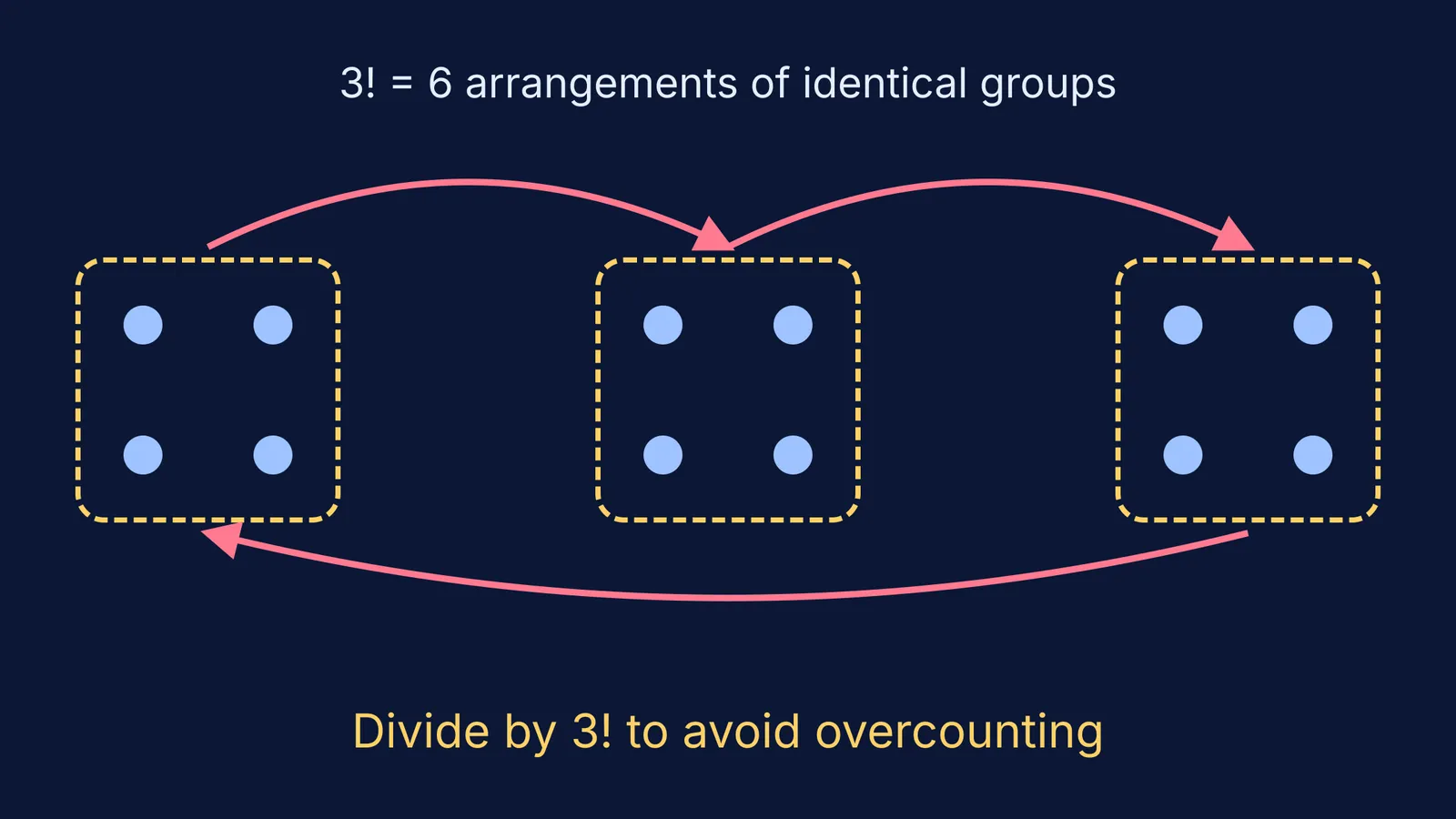
When dealing with a partition of a set into subsets of equal size, you must correct for overcounting identical arrangements by dividing by the factorial of the number of identical groups.
Since there are 3 groups of the same size, they can be arranged in 3! (which is 3 × 2 × 1 = 6) different orders. We divide the labeled total by 6: 34,650 / 6 = 5,775 ways.
How does the overcounting work in a smaller example?
To see why this division is necessary, imagine a much smaller problem: dividing 4 people (A, B, C and D) into 2 unlabeled groups of 2.
First, we calculate the labeled arrangements using the multinomial coefficient: 4! / (2! × 2!) = 24 / 4 = 6 ways.
If the groups were labeled Team 1 and Team 2, those 6 ways would be:
Team 1: AB, Team 2: CD
Team 1: AC, Team 2: BD
Team 1: AD, Team 2: BC
Team 1: CD, Team 2: AB
Team 1: BD, Team 2: AC
Team 1: BC, Team 2: AD
Look closely at arrangement 1 and arrangement 4. In both cases, A is paired with B, and C is paired with D. If the groups are unlabelled, these two outcomes are identical. Because there are 2 groups, every unique pairing appears 2! (or 2) times. We must divide the total by 2 to get the real answer of 3 ways.
The exact same logic applies to dividing 12 people into 3 groups of 4, where every unique arrangement appears 3! (or 6) times.
What if the groups have different sizes?
If you divide 12 people into groups of 5, 4 and 3, you do not need to divide by a factorial even if the groups are unlabelled.
The calculation is just the multinomial coefficient: 12! / (5! × 4! × 3!) = 27,720 ways.
Because the sizes are different, the groups are already distinguishable by their headcount. You cannot accidentally swap the group of 5 with the group of 3 and get the same arrangement. You only divide by a factorial when there are groups of the exact same size, as the sizes themselves act as natural, built-in labels.
How can you master combinatorics counting?
Combinatorics problems—whether they are about dividing groups, keeping letters together using the bundle method, or choosing at least one or at most two items—often feel like a minefield of overcounting. Students frequently understand the basic formulas but struggle to spot whether a problem implies labelled or unlabelled groups, much like deciding between probability with and without replacement.
This is where the Fermi Problem Library helps. It provides worked problems with a step-by-step solver that explains the reasoning rather than printing an answer. If you are stuck on whether to divide by a factorial, Fermi's AI tutor notices where a student is stuck and decides whether to explain, ask, or show. It holds a line of reasoning across a session to help you deeply understand counting rules.
To explore every concept in mathematics, you can also use the Concept Library to find each topic's lesson and its place in the map.
What to do next: When you face a grouping problem, always ask one question first: "If I swap the people in Group A with the people in Group B, is it a new arrangement or the same one?" If it is the same, you must divide out the permutations.


