

On this page
Division is simply multiplication played in reverse. Once you understand how to multiply positive and negative numbers, the rules for division follow naturally. In earlier years, you explored integers in Class 6 using addition and subtraction. Now, as you move into multiplying and dividing, the focus shifts to tracking the signs correctly.
Just like working with fractions in Class 7, mastering the sign rules for integers is a foundation for all the algebra that follows.
What are the rules for dividing integers?
The rules for dividing integers depend entirely on the signs of the dividend (the number being divided) and the divisor (the number you divide by). According to Cuemath, there are two core rules to remember:
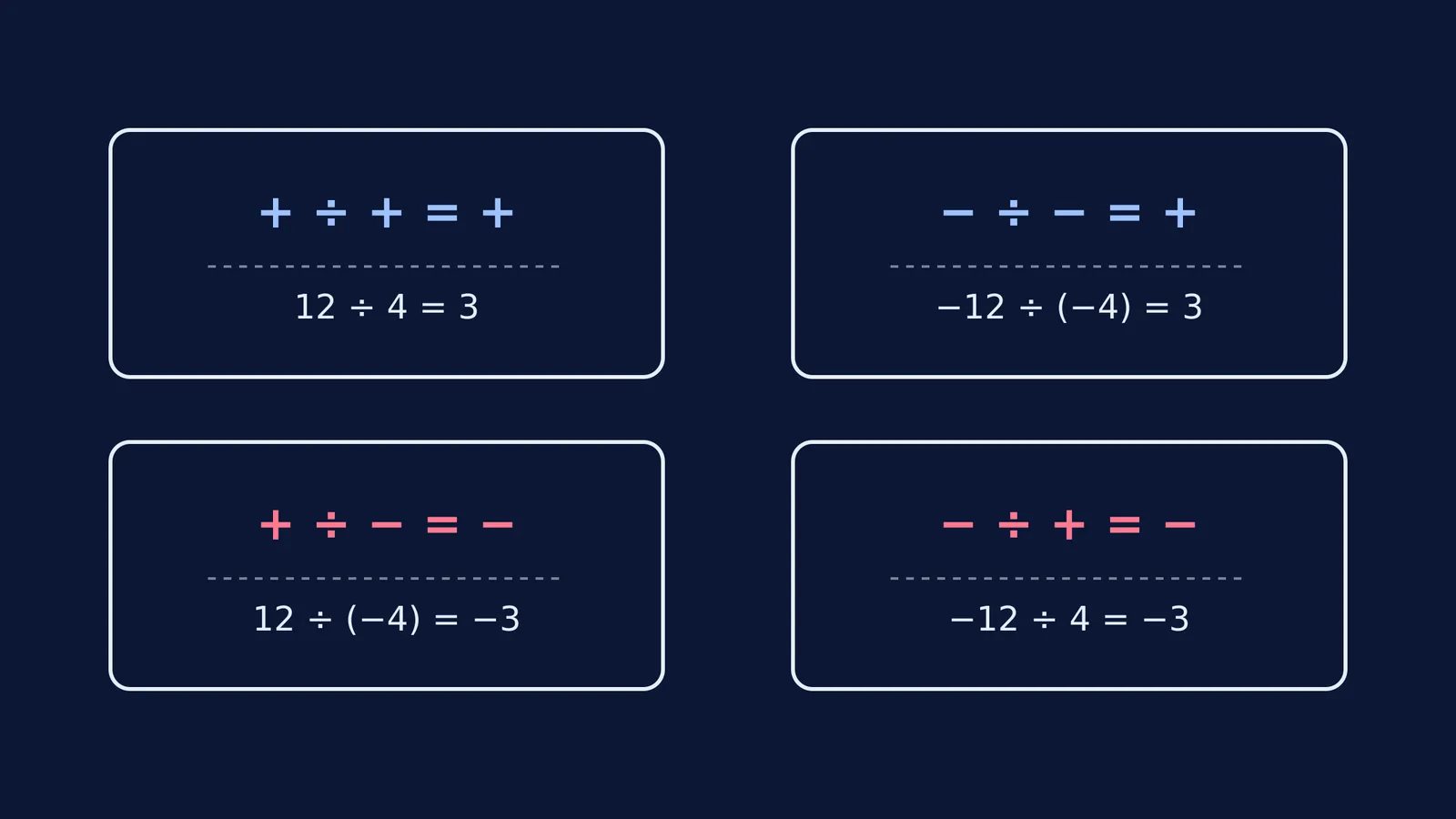
Same signs yield a positive quotient. If you divide a positive integer by a positive integer, or a negative by a negative, the result is always positive.
Different signs yield a negative quotient. If one integer is positive and the other is negative, the result is always negative. It does not matter which one is larger.
Here are some short examples to illustrate:
12 ÷ 4 = 3
(−12) ÷ (−4) = 3
(−12) ÷ 4 = −3
12 ÷ (−4) = −3
When learning these rules, it helps to isolate the steps. First, ignore the signs and divide the numbers normally. Then, look at the original signs to decide if your final answer should carry a positive or negative sign. If you find yourself forgetting the rules during homework, the Fermi Concept Library has every concept in physics, chemistry, biology, mathematics and computing, each with its own lesson and its place in the map.
Why is 0 ÷ n always 0?
A common question in exams involves dividing zero by a non-zero integer. The answer is always zero. To see why, we have to write the division as a multiplication problem.
If we ask, "What is 0 ÷ 5?", we are really asking, "What number multiplied by 5 gives 0?"
Expressed mathematically: x × 5 = 0
Because any number multiplied by zero is zero, x must be 0. Therefore, 0 ÷ 5 = 0. This rule holds true for any non-zero integer, whether it is positive or negative.
Why is n ÷ 0 undefined?
Things break down when we try to divide an integer by zero. In mathematics, dividing by zero is "undefined."
Let us use the same inverse multiplication logic to see why. If you try to calculate 5 ÷ 0, you are asking for a number x such that:
Expressed mathematically: x × 0 = 5
There is no number that can be multiplied by zero to produce 5. Because it is impossible to find a solution, the operation is undefined.
Even the case of 0 ÷ 0 is problematic. If we ask what x solves x × 0 = 0, the answer could be 5, 12, or −100. Because there is no single, unique answer, 0 ÷ 0 is considered "indeterminate." Grasping these boundary cases is where an interactive approach helps. Fermi's AI tutor teaches — it holds a line of reasoning across a whole session, notices where a student is stuck, and decides whether to explain, ask, or show.
A checklist for solving division problems
To avoid dropping marks on simple errors, use this framework for every division problem:
Divide the absolute values: Treat both numbers as positive and find the numerical quotient.
Count the negative signs: If there are zero or two negative signs, your answer is positive. If there is exactly one negative sign, your answer is negative.
Check for zero: Is the divisor zero? If so, stop—the answer is undefined.
Multiply back: Take your final quotient and multiply it by the divisor. You should get the exact dividend (including its sign) back.
Building strong habits now prevents sign errors in algebra later. To practice applying this checklist to mixed problem sets, the Fermi Problem Library provides worked problems with a step-by-step solver that explains the reasoning rather than printing an answer.


