

On this page
In probability theory, rolling two independent dice is a classic way to understand how random variables combine. Unlike drawing physical items from a bag with and without replacement, the outcome of the first roll has absolutely no effect on the second.
What is the probability distribution of the maximum of two dice?
When you roll two fair, six-sided dice, there are 36 possible outcomes in the sample space. The probability mass function (PMF) for the maximum value k is P(M = k) = (2k - 1)/36.
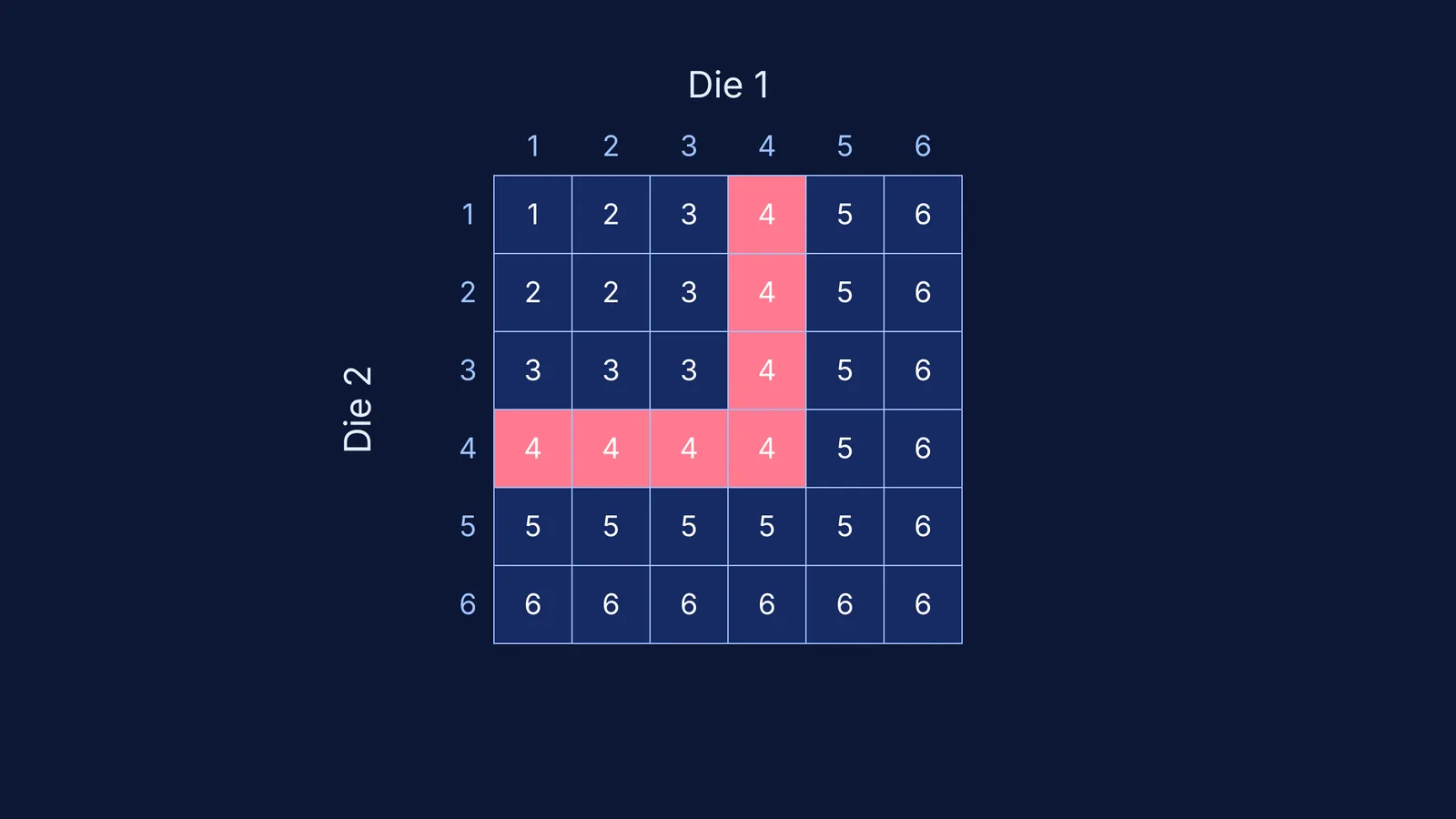
To see why, you can count the outcomes on a 6 × 6 grid. Suppose we want to find the probability that the maximum of the two dice is exactly 4.
First, Die 1 could show a 4 while Die 2 shows 1, 2, 3, or 4. This gives 4 outcomes.
Second, Die 2 could show a 4 while Die 1 shows 1, 2, 3, or 4. This also gives 4 outcomes.
However, the outcome where both dice show a 4 (the pair 4, 4) is counted in both groups.
To find the true total, we add the two groups and subtract the overlap: 4 + 4 - 1 = 7. In general, for a maximum of k, there are k + k - 1 = 2k - 1 favourable outcomes. Since a pair of standard dice has 6 × 6 = 36 total outcomes, the probability of any maximum k is (2k - 1)/36.
Is there a faster way to find the formula?
Yes, by using the cumulative distribution function (CDF). The probability that the maximum is less than or equal to k is simply the probability that both Die 1 and Die 2 are ≤ k.
Because the dice are independent, we multiply their individual probabilities: P(M ≤ k) = P(Die 1 ≤ k) × P(Die 2 ≤ k) = (k/6) × (k/6) = k²/36.
To find the probability that the maximum is exactly k, we take the probability that it is ≤ k and subtract the probability that it is ≤ k - 1: P(M = k) = k²/36 - (k - 1)²/36
Expanding (k - 1)² gives k² - 2k + 1. When we subtract this from k², the k² terms cancel out, leaving exactly (2k - 1)/36.
How do we know the probabilities sum to 1?
A valid probability distribution must always sum to exactly 1. We can verify our formula by adding the probabilities for all six possible maximum values (k = 1 to 6).
Using the 2k - 1 formula, the number of outcomes for each maximum are:
k = 1: 1 outcome
k = 2: 3 outcomes
k = 3: 5 outcomes
k = 4: 7 outcomes
k = 5: 9 outcomes
k = 6: 11 outcomes
Adding the numerators gives 1 + 3 + 5 + 7 + 9 + 11 = 36. Dividing by the 36 total outcomes yields 36/36 = 1, confirming the distribution is valid. This also elegantly demonstrates the mathematical rule that the sum of the first n odd numbers is always n².
What is the mean of the maximum?
The expected value, or mean, of a discrete random variable is the sum of each outcome multiplied by its corresponding probability.
For the maximum of two dice, the expected value E[M] is calculated as: E[M] = 1(1/36) + 2(3/36) + 3(5/36) + 4(7/36) + 5(9/36) + 6(11/36)
Multiplying these numerators out gives the sum: E[M] = (1 + 6 + 15 + 28 + 45 + 66) / 36 = 161/36
This means the expected value of the maximum of two dice is approximately 4.47. Consider what this tells us about the game. A single fair six-sided die has an expected value of 3.5. Rolling a second die and taking the highest number shifts the average outcome up by nearly a full point.
How to build your probability intuition
Understanding sample spaces and reading grids is a core skill for exam mathematics, whether you are calculating the maximum of dice or finding odds in favour and odds against an event.
If you get stuck trying to set up these visualisations, Fermi's AI tutor works out what you already know and builds a plan for the session, helping you see the logic behind the grid rather than just memorising the 2k - 1 rule. When you want to practise, the Fermi Problem Library has worked problems with a step-by-step solver that explains the reasoning rather than printing an answer.


