

On this page
In short
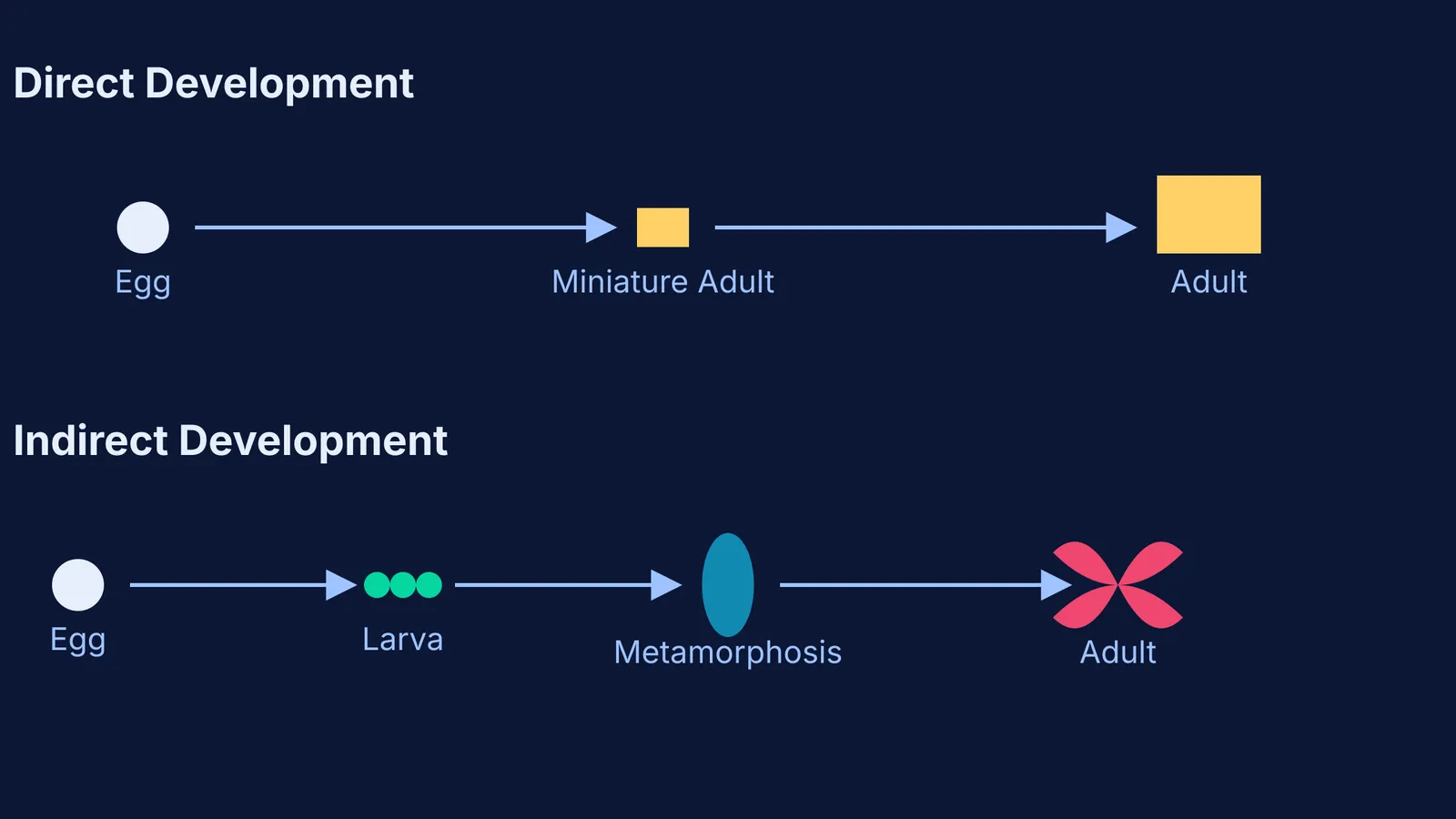
In direct development, a newborn animal resembles a miniature adult, while indirect development involves a distinct larval stage that undergoes metamorphosis. An estimated 70% of marine bottom invertebrate species follow indirect development, allowing their larvae to disperse widely before transforming into adults.
When you observe a butterfly emerging from a chrysalis or a tadpole growing legs, you are watching indirect development in action. For biology students preparing for board exams and competitive tests, understanding how animals grow from egg to adult is a core part of animal diversity. The Animal Kingdom is broadly divided by how species handle this transition: they either skip the intermediate forms entirely or embrace distinct larval stages.
Here is how direct and indirect development differ, why a larval stage exists, and a framework to remember them across phyla.
What is direct development in animals?
Direct development occurs when a young animal is born or hatched looking like a miniature version of its parents. There is no larval stage and no metamorphosis. The offspring simply grows larger and sexually matures over time.
Because these young animals are born into the same environment as their parents, they often compete for the same food sources. To give their offspring a head start, animals with direct development typically invest a lot of energy into each egg, providing large amounts of yolk, or they nourish the young internally before birth.
Mammals, guided by the hormones of parturition and lactation, along with birds and reptiles, are classic examples of direct development. However, it also occurs in invertebrates; for instance, the common earthworm (*Pheretima*) hatches directly from its cocoon as a small worm, bypassing any larval phase.
What is indirect development?
In indirect development, the young animal hatches in a form that looks completely different from the adult. This early form is called a larva (or nymph, in some insects). To become an adult, the larva must undergo metamorphosis—a restructuring of its body, organs, and sometimes even its diet and habitat.
Larvae are usually adapted for a very specific task: eating and growing. A caterpillar, for instance, is essentially a feeding tube, whereas the adult butterfly is designed for flight and reproduction.
This strategy is common. According to a review in *Biological Reviews*, approximately 70% of marine bottom invertebrate species have a long planktotrophic pelagic larval stage (Thorson, 1950). Among amphibians, an analysis of extant species found that 33–44% retain the ancestral aquatic larval stage (Liedtke et al., 2022).
Why do animals have a larval stage?
If metamorphosis is so energy-intensive, why is indirect development so widespread? The answer lies in survival and dispersal.
Less competition: Larvae often live in different habitats and eat different foods than adults. A tadpole breathes through gills and eats algae in the water, while an adult frog breathes air and hunts insects on land. This ensures parents and offspring do not compete for resources.
Wider dispersal: For sessile (stationary) or slow-moving animals like sponges, corals and starfish, a free-swimming larva is the only way to spread to new territories.
Number over size: Animals with indirect development often produce large numbers of small eggs with very little yolk. They rely on the larvae hatching quickly and finding their own food, playing a biological numbers game to ensure a few survive.
This environmental shift often mirrors other biological adaptations, such as how animals handle nitrogenous waste depending on whether they live in water or on land (a shift you can explore further in our guide to ammonotelic, ureotelic and uricotelic animals).
Examples across phyla: a framework for exams
In biology exams, you are often asked to identify the mode of development for a specific phylum. If you need to review how these traits evolved, the Fermi Concept Library contains every concept in physics, chemistry, biology, mathematics and computing, each with its own lesson and its place in the map. You can also build a mental framework by grouping them into three broad categories:
Exclusively or mostly indirect: The lower invertebrates heavily rely on larval stages to disperse. Porifera (sponges) have distinct ciliated larvae, such as the amphiblastula. Coelenterata (cnidarians like jellyfish), Ctenophora (comb jellies), and Echinodermata (starfish) also feature indirect development with highly mobile, free-swimming larvae. For these animals, the larval stage is the only time in their lives they can travel long distances.
Mixed development: Aschelminthes (roundworms), Annelida (segmented worms), and Arthropoda have species that employ both strategies. While butterflies, beetles, and houseflies undergo indirect development with metamorphosis, primitive insects like silverfish develop directly. Similarly, while marine annelids usually have a trochophore larva, the terrestrial earthworm skips this stage entirely.
Direct development dominant: Higher vertebrates generally favour direct development, allocating more resources to fewer offspring. The major exceptions are amphibians (like frogs and salamanders) and many species of fish, which still rely on an aquatic larval stage. Reptiles, birds, and mammals, however, are strictly direct developers, protecting their young in shelled eggs or inside the mother's womb until they look like miniature adults.
If you find yourself stuck on distinguishing these life cycles in tricky multiple-choice questions, the Fermi Problem Library has worked problems with a step-by-step solver that explains the reasoning rather than printing an answer.


