

On this page
Why does dipole moment depend on the choice of origin?
Textbooks define an electric dipole as equal and opposite charges, +q and −q, separated by distance 2a, with dipole moment p = q × 2a pointing from negative to positive. Competitive exams like JEE Advanced often test systems of three or more charges distributed across coordinate axes, requiring the general definition p = Σ qᵢ rᵢ, where rᵢ is the position vector of charge qᵢ.
Because position vectors depend on your coordinate origin, different choices could appear to give different vectors. As explained in The Feynman Lectures on Physics, Vol. II, Section 6-5, the dipole moment vector changes when the origin shifts—unless the total net charge is zero. For any neutral system, the dipole moment is an invariant physical vector.
What happens to the dipole vector under a coordinate shift?
To see why, consider charges qᵢ at position vectors rᵢ from origin O, giving dipole moment p = Σ qᵢ rᵢ. Moving the origin to O' shifted by vector r₀ changes each position vector to r'ᵢ = rᵢ − r₀.
Evaluating the new dipole moment p' about O' yields:
p' = Σ qᵢ (rᵢ − r₀) = Σ qᵢ rᵢ − r₀ Σ qᵢ = p − Q_net r₀
In Introduction to Electrodynamics, physicist David J. Griffiths notes this multipole expansion property: when Q_net = 0, the second term vanishes, leaving p' = p for any shift r₀. If Q_net ≠ 0, shifting the origin by r₀ alters the dipole moment by −Q_net r₀.
How does a three-charge system prove the origin rule?
Consider three point charges arranged in the xy-plane:
Charge q₁ = −2q at (0, 0)
Charge q₂ = +q at (a, 0)
Charge q₃ = +q at (0, a)
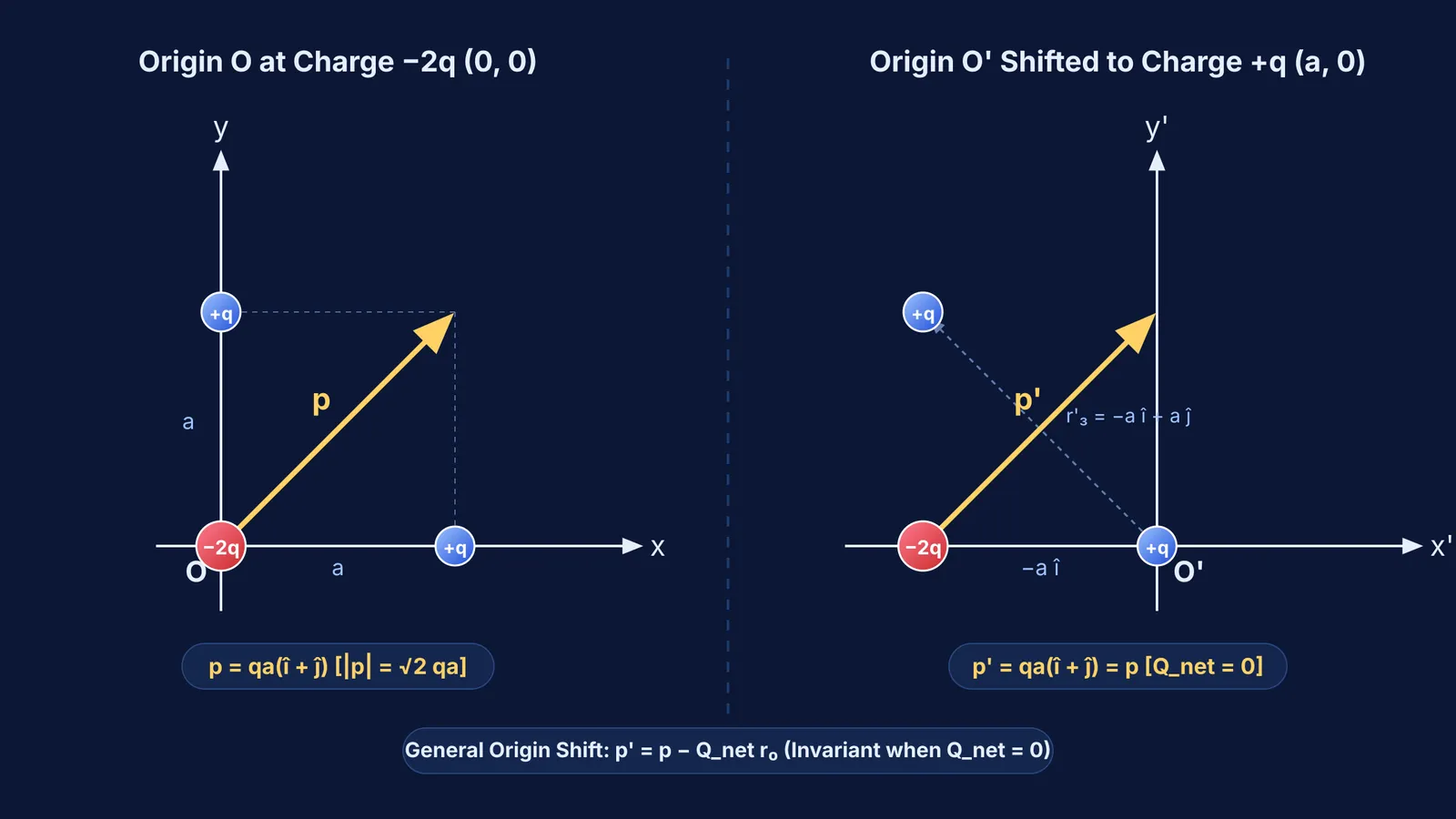
Here Q_net = (−2q) + (+q) + (+q) = 0. Because net charge vanishes, the dipole moment must be identical about any origin. We can verify this about two different points:
Origin O at (0, 0): Position vectors are r₁ = 0, r₂ = a i^, and r₃ = a j^. The dipole moment is p = (−2q)(0) + q(a i^) + q(a j^) = q a (i^ + j^), with magnitude |p| = √2 q a directed at 45° to the x-axis. As shown in OpenStax University Physics Volume 2, this equals the vector sum of two orthogonal dipoles pairing −q with each +q.
Origin O' shifted to (a, 0): Shifting by r₀ = a i^ gives r'₁ = −a i^, r'₂ = 0, and r'₃ = −a i^ + a j^. The new dipole moment is p' = (−2q)(−a i^) + q(0) + q(−a i^ + a j^) = 2 q a i^ − q a i^ + q a j^ = q a (i^ + j^).
The vector p' equals p exactly, showing that shifting coordinates leaves the physical dipole vector unchanged.
What if the net charge of the system is not zero?
When net charge is non-zero, origin independence fails. Suppose the three charges are positive: q₁ = +q at (0, 0), q₂ = +q at (a, 0), and q₃ = +q at (0, a), so Q_net = 3q ≠ 0.
About Origin O(0, 0), p_O = q a (i^ + j^). Moving the origin to the centroid at (a/3, a/3) gives r'₁ = −(a/3)(i^ + j^), r'₂ = (2a/3) i^ − (a/3) j^, and r'₃ = −(a/3) i^ + (2a/3) j^, which sums to p_centroid = 0.
The dipole moment dropped from √2 q a to zero simply by shifting axes. As David J. Griffiths notes in Introduction to Electrodynamics, for a charged system, dipole moment has no intrinsic physical meaning and merely reflects coordinate placement. Only when Q_net = 0 does the dipole moment represent an invariant physical property.
Overlooking this causes errors when finding the electric field of a dipole on its axis and equatorial line or calculating the force on a dipole in a non-uniform field. When analyzing complex distributions, the Fermi Problem Library provides worked problems with a step-by-step solver that explains the reasoning rather than printing an answer, checking whether a system is neutral before applying dipole approximations.
How should you choose the origin in exam problems?
In timed exams, recognizing origin independence gives you a reliable shortcut:
Check total charge first: If net charge is zero, choose the origin that minimizes vector algebra.
Place the origin on the largest charge: Setting the origin at −2q makes its position vector zero, eliminating that term from the sum.
Use symmetry: Placing the origin on an axis of symmetry lets opposing components cancel out immediately.
Watch for charged systems: If net charge is non-zero, keep the question's specified reference origin. Never shift origins casually without applying the −Q_net r₀ correction vector.
For deeper review across electrostatics, the Fermi Concept Library maps every concept in physics, chemistry, biology, mathematics and computing, each with its own lesson and its place in the map. Choosing coordinate origins deliberately turns tedious vector calculations into simple arithmetic, steering you clear of common electrostatics mistakes and superposition errors.


