

On this page
You already know how to calculate the electric field of an electric dipole on its axis and on its equatorial plane. But what if the point lies somewhere in between?
Finding the electric field at a general point (r, θ) requires a vector trick: instead of breaking the position vector into components, we break the dipole moment itself into two pieces. This derivation is a standard part of university electromagnetism and competitive exams like the JEE.
How do you find the electric field of a dipole at any point (r, θ)?
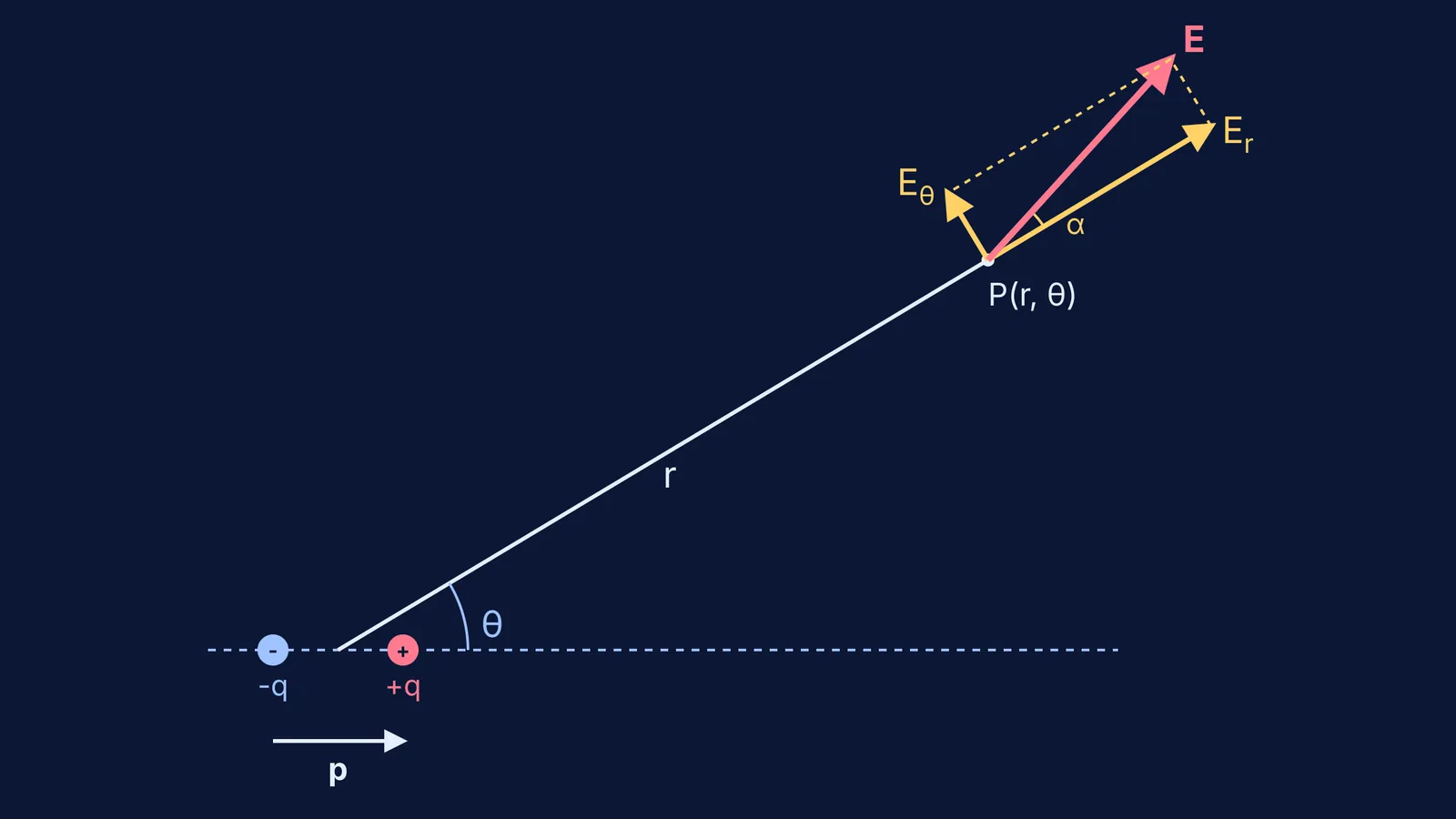
Let a dipole have a dipole moment p (pointing from the negative to the positive charge). We want to find the electric field at a point P that is a distance r from the centre of the dipole, at an angle θ from the dipole's axis. We use Coulomb's constant/Book%3A_University_Physics_II_-_Thermodynamics_Electricity_and_Magnetism_(OpenStax)/05%3A_Electric_Charges_and_Fields/5.08%3A_Electric_Dipoles) k = 1/(4πε₀).
To solve this, we split the dipole moment vector p into two perpendicular components:
The radial component: p cos θ, which points directly along the line connecting the dipole's centre to point P.
The tangential component: p sin θ, which points perpendicular to that radial line.
For the radial component, point P lies on its axis. We can use the standard axial field formula, replacing p with p cos θ. The radial electric field (Er) is: Er = 2kp cos θ / r³
For the tangential component, point P lies on its equatorial line. We use the standard equatorial formula, replacing p with p sin θ. The tangential electric field (Eθ) is: Eθ = kp sin θ / r³
Since Er and Eθ are perpendicular to each other, the magnitude of the net electric field E is their vector sum: E = √(Er² + Eθ²)
Substituting our expressions: E = (kp/r³)√((2cos θ)² + (sin θ)²) E = (kp/r³)√(4cos²θ + sin²θ)
By using the trigonometric identity sin²θ = 1 − cos²θ, we can rewrite the terms inside the square root: 4cos²θ + (1 − cos²θ) = 3cos²θ + 1
This gives the final formula for the magnitude of the electric field at any point: E = (kp/r³)√(3cos²θ + 1)
What is the direction of the resultant electric field?
The net electric field vector does not point exactly along the radial line. It is tilted by an angle α relative to the position vector r.
We can find this angle using basic right-angled trigonometry: tan α = Eθ / Er
Plug in the field components: tan α = (kp sin θ / r³) / (2kp cos θ / r³)
The constants, the r³ term, and p all cancel out, leaving: tan α = sin θ / (2cos θ) = (1/2)tan θ
So, the total angle that the electric field makes with the dipole's axis is θ + α. If you are working on the mechanics of these fields, see how to calculate the net force on a dipole in a non-uniform field.
How do the axial and equatorial formulas fit in?
This general formula contains the two special cases you likely learned first.
On the axis (θ = 0°): The cosine of 0° is 1. The square root becomes √(3(1)² + 1) = √4 = 2. The field is 2kp/r³.
On the equator (θ = 90°): The cosine of 90° is 0. The square root becomes √(0 + 1) = 1. The field is kp/r³.
If you are reviewing electromagnetism for exams, the Concept Library holds every concept in physics, chemistry, biology, mathematics and computing, each with its own lesson and its place in the map. Derivations like this one test your ability to combine vectors and trigonometry. When it is time to test yourself, the Fermi Problem Library has worked problems with a step-by-step solver that explains the reasoning rather than printing an answer.


