

On this page
In short
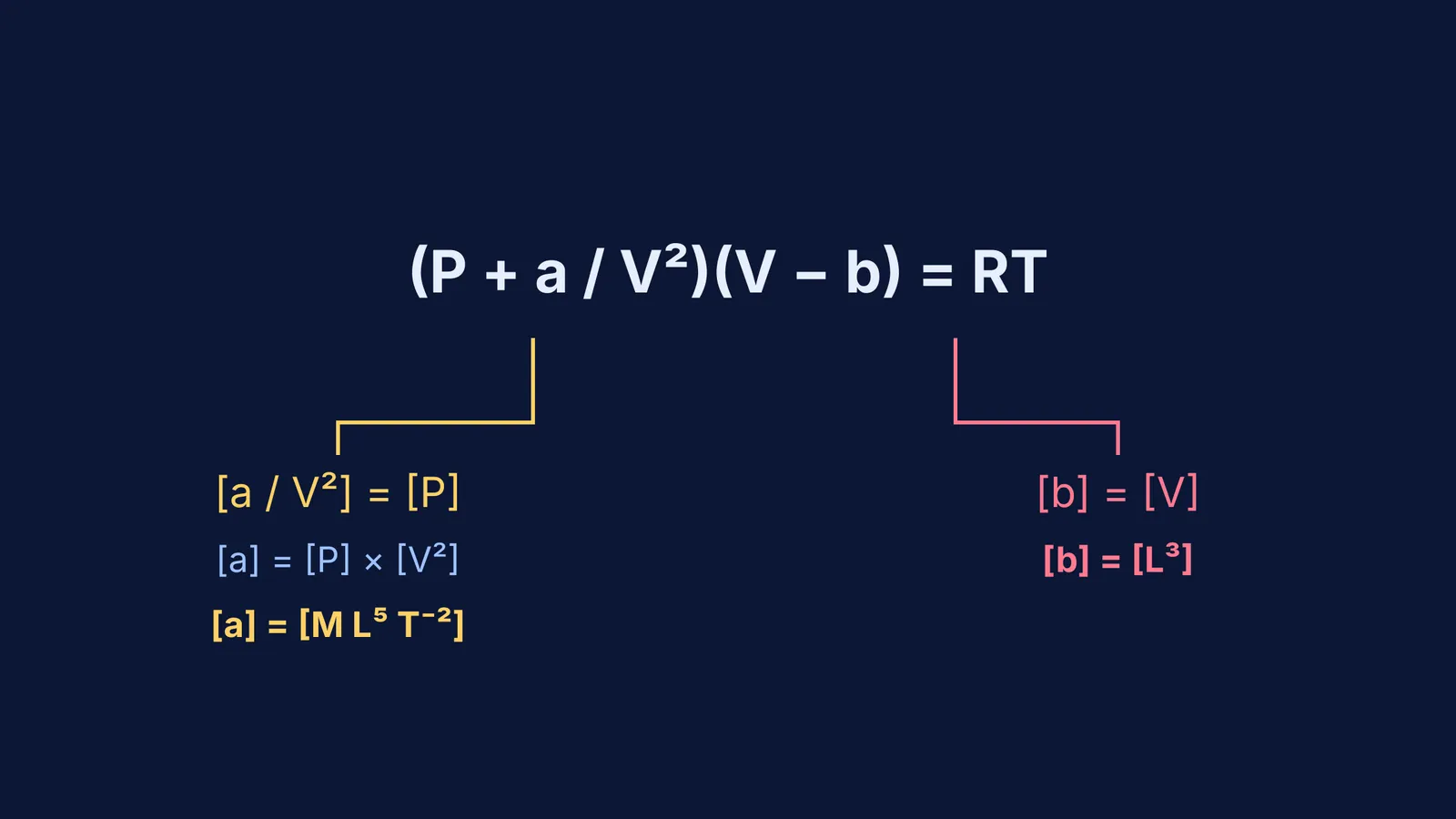
The van der Waals equation corrects the ideal gas law for real gases by using constants a for intermolecular forces and b for molecular size. By the principle of dimensional homogeneity, the constant a has dimensions [M L⁵ T⁻²] and b has dimensions [L³] for one mole of gas.
When studying real gases, the ideal gas law PV = nRT is often replaced by the van der Waals equation. This modified formula introduces two new constants, a and b, to account for the physical realities of gas molecules.
Finding the dimensions of these constants is a classic problem in exams. It relies entirely on a single rule of dimensional analysis.
What is the van der Waals equation?
The van der Waals equation of state is a modification of the ideal gas law designed to account for the non-ideal behaviour of real gases (HyperPhysics). For n moles of a gas, it is written as:
(P + an² / V²)(V − nb) = nRT
For exactly one mole of gas (n = 1), the equation simplifies to:
(P + a / V²)(V − b) = RT
The constant a corrects for the attractive intermolecular forces between gas molecules. These forces pull molecules together, slightly reducing the pressure they exert on the walls of their container. The constant b corrects for the physical volume occupied by the molecules themselves, which reduces the free space available for them to move in.
Why can we only add like quantities?
To find the dimensions of a and b, we use the principle of dimensional homogeneity. This principle states that you can only add or subtract physical quantities if they have the exact same dimensions. You cannot add a mass to a length, or a pressure to a volume.
If an equation contains a term like (X + Y), then X and Y must share the same dimensional formula.
How to find dimensions of a and b in a van der Waals type equation?
Look at the first bracket in the one-mole van der Waals equation: (P + a / V²).
Because the term a / V² is being added to the pressure P, it must have the exact same dimensions as pressure.
The dimensions of pressure P (force per unit area) are [M L⁻¹ T⁻²].
The dimensions of volume V are [L³].
Therefore, the volume squared V² has dimensions [L⁶].
We set up the dimensional equation: [a / V²] = [P]
Substituting the known dimensions: [a] / [L⁶] = [M L⁻¹ T⁻²]
Multiply both sides by [L⁶]: [a] = [M L⁻¹ T⁻²] × [L⁶]
[a] = [M L⁵ T⁻²]
So, the dimensions of the constant a (for one mole) are [M L⁵ T⁻²]. If you are practising unit conversions, you can read more in our guide on Converting a quantity between unit systems using dimensions.
Finding the dimensions of b is even more straightforward. Look at the second bracket: (V − b).
Since b is being subtracted from the volume V, it must have the exact same dimensions as volume.
The dimensions of volume V are [L³]. Therefore, the dimensions of b are directly: [b] = [L³]
If you are working with n moles, the term is nb. Because n represents the amount of substance (with dimension [mol]), the dimensions for the molar constants become [M L⁵ T⁻² mol⁻²] for a, and [L³ mol⁻¹] for b.
What about other equations of state?
Sometimes exams will invent a new, fictional equation of state to test if you truly understand the principle, rather than just memorising the dimensions of a and b.
Suppose you are given an equation like: (P + α / (T V²))(V − βT) = RT
You can use the exact same logic to find the dimensions of the unknown constants α and β.
Look at the volume bracket: (V − βT). Since βT is subtracted from volume, it must have the dimensions of volume.
[β][T] = [V] [β] = [L³] / [K] So the dimensions of β are [L³ K⁻¹].
Look at the pressure bracket: (P + α / (T V²)). The added term must have the dimensions of pressure.
[α / (T V²)] = [P] [α] = [P] × [T] × [V²]
Substitute the standard dimensions: [M L⁻¹ T⁻²] for pressure, [K] for temperature, and [L⁶] for volume squared. [α] = [M L⁻¹ T⁻²] × [K] × [L⁶] [α] = [M L⁵ T⁻² K]
By relying on the rule that only like quantities can be added, you can solve for the dimensions of constants in any van der Waals type equation, no matter how complex the formula appears at first glance.
Whenever you face a long formula, applying this simple addition and subtraction rule breaks the problem into manageable pieces. If you want to test your understanding of how units and constants behave in physics equations, you can practise with the step-by-step solver in the Fermi Problem Library. You can also explore the physical meaning of these corrections in our post on Real gases and the van der Waals equation, with worked numbers.


