

On this page
Put a slab of glass, paper or plastic between the plates of a charged capacitor and the field inside it gets weaker. The plates carry the same charge, yet the field falls by a factor called the dielectric constant, K. Here is where that factor comes from.
What happens to molecules inside a dielectric?
A dielectric is an insulator. Its electrons cannot flow through it as in a metal, but they can shift a little inside each molecule.
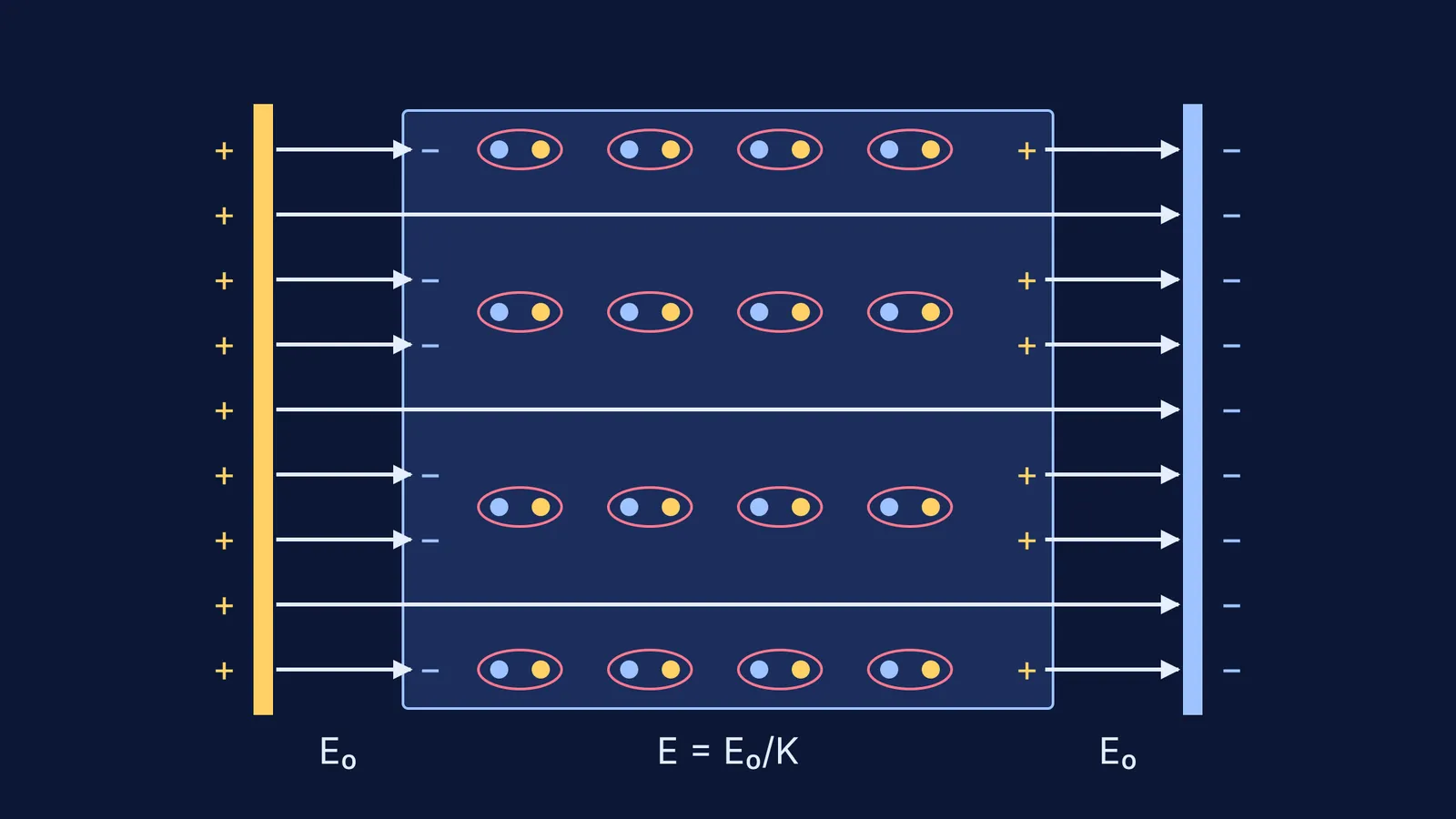
OpenStax University Physics describes it this way: in an unpolarised molecule the electron cloud sits evenly around the positive centres, while a polarised molecule has extra negative charge on one side (OpenStax, Molecular model of a dielectric). Some molecules, like water, are already dipoles and turn to line up with the field; others are stretched into dipoles by it. Either way you get rows of tiny dipoles, negative end towards the positive plate.
Why does a dielectric reduce the electric field?
Look along one row of dipoles. Inside the slab, the opposite charges on neighbouring dipoles cancel each other (OpenStax).
At the two faces, nothing cancels. The face next to the positive plate keeps a thin layer of negative charge, and the far face a layer of positive charge. This is bound charge (or induced charge): it is tied to the molecules and cannot be drawn off with a wire.
Those two layers act like a weaker capacitor inside the first, with a field pointing against the applied field E₀. Add the two and the net field is smaller.
OpenStax defines the dielectric constant as the ratio K = E₀/E, the field without the dielectric divided by the field with it (OpenStax). Rearranged, that is the formula you will use: E = E₀/K.
In the field-line picture, some of the lines leaving the positive plate end on the bound negative charge at the slab's surface, and fewer lines cross the slab. With K = 3, two lines in every three stop at the surface, so the field inside is a third of E₀.
How big is K for common materials?
These values at room temperature come from Table 8.1 of OpenStax University Physics, Volume 2:
Vacuum: K = 1, by definition.
Dry air at 1 atm: K = 1.00059, so air is treated as a vacuum in most problems.
Paper: K = 3.7.
Glass: K = 4 to 6.
Mica: K = 6.0.
Water: K = 80.
Water's large K comes from its polar molecules, which turn easily to line up with an applied field, and the same polarity makes water a good solvent for many substances (OpenStax).
A worked example with numbers
Two plates, each with area A = 0.010 m², sit d = 1.0 mm apart. A 100 V battery charges them, then the battery is removed, so the free charge Q stays fixed. Now a mica sheet (K = 6.0, from the OpenStax table above) is slid in to fill the gap.
Field before: E₀ = V₀/d = 100 / 0.0010 = 1.0 × 10⁵ V/m.
Free charge density: σ = ε₀E₀ = (8.85 × 10⁻¹²)(1.0 × 10⁵) = 8.85 × 10⁻⁷ C/m², so Q = σA ≈ 8.9 nC.
Field after: E = E₀/K = 1.0 × 10⁵ / 6.0 ≈ 1.7 × 10⁴ V/m.
Voltage after: V = Ed ≈ 17 V. The voltage drops by the same factor K, matching V = V₀/K in OpenStax section 8.4.
Bound charge density: σb = σ(1 − 1/K) = 8.85 × 10⁻⁷ × 5/6 ≈ 7.4 × 10⁻⁷ C/m², or about 7.4 nC on each face.
Check against the picture: the bound charge cancels five-sixths of E₀ and one-sixth survives. Since V fell by six with Q fixed, C rises by six, the C = KC₀ result from the same OpenStax section.
That second case is worth practising on its own. Our post on inserting a dielectric slab with the battery connected or disconnected walks through both, and energy density in an electric field shows where the stored energy goes when E drops. For circuits, see capacitors in DC circuits at steady state.
A 30-second check before you write the answer
Is the free charge fixed (battery removed) or is the voltage fixed (battery connected)?
Does the dielectric fill the gap fully, or only part of it?
Did you use Q for the free charge only, not the bound charge?
Did E and V both change by the factor K, and in the right direction?
If polarisation or capacitance still feels shaky, each concept in the Fermi Concept Library has its own lesson and its place in the map. To try the battery-connected version yourself, the Fermi Problem Library has worked problems with a step-by-step solver that explains the reasoning rather than printing an answer.


