

On this page
In short Dicot embryo development follows an orderly sequence from a single-celled zygote to a mature plant structure. A mature dicot embryo consists of exactly two cotyledons and a central embryonal axis Source: NCERT. The embryo passes through distinct proembryo, globular, and heart-shaped stages before reaching maturity.
When fertilisation occurs in a flowering plant, the newly formed zygote embarks on a journey of cell division and differentiation. In dicots (plants with two seed leaves), this process—known as embryogeny—follows a highly precise sequence.
Understanding these stages is essential for studying plant reproduction.
What are the stages of dicot embryo development?
Embryogeny begins at the micropylar end of the 7-celled, 8-nucleate embryo sac, but the zygote typically waits for some endosperm to form first. This delay ensures the developing embryo has a guaranteed supply of nutrition.
The development follows this exact sequence Source: NCERT:
Zygote: The diploid cell formed after fertilisation.
Proembryo: The early multicellular structure formed after the zygote's first divisions.
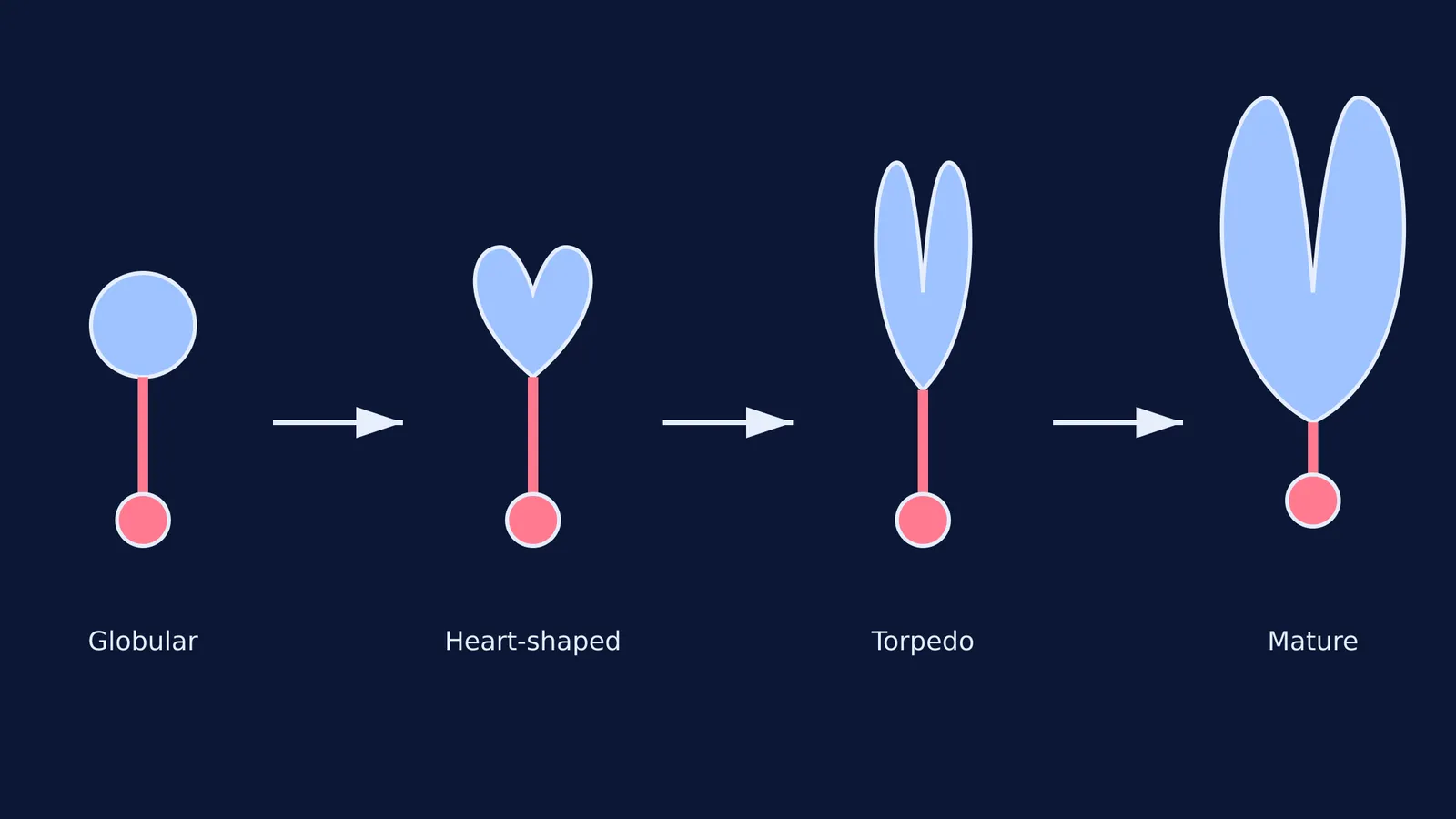
Globular embryo: A spherical mass of dividing cells.
Heart-shaped embryo: The stage where cotyledons begin to emerge.
Mature embryo: The final, fully developed stage.
The zygote first divides into a terminal (apical) cell and a basal cell. The basal cell divides multiple times to form a structure called the suspensor. The suspensor acts like a stalk, pushing the embryo deeper into the endosperm so it can absorb food. Meanwhile, the terminal cell divides to become the proembryo.
If you have a concept gap on how a single cell divides into distinct layers, the Fermi Concept Library has a lesson on every concept in biology, showing its place in the map of plant reproduction.
What is the difference between globular and heart-shaped stages?
As the proembryo continues to grow, it changes shape dramatically.
The globular stage is defined by a spherical, solid ball of cells. At this point, the primary meristematic tissues—which will later become the plant's skin, vascular system, and ground tissue—begin to differentiate.
The heart-shaped stage marks the beginning of bilateral symmetry. Two distinct bumps begin to grow outward from the top of the globular mass. These bumps are the developing cotyledons. Because they grow faster than the tissue between them, a notch forms in the centre, giving the entire embryo the appearance of a heart.
What parts make up the mature embryo?
After the heart-shaped stage, the cotyledons elongate further (sometimes called the torpedo stage) until the embryo reaches maturity. In some plants, the mature embryo curves to fit inside the seed, taking on a horseshoe shape.
A mature dicot embryo consists of exactly two cotyledons and a central embryonal axis Source: NCERT.
The embryonal axis is the central pillar of the structure:
Epicotyl: The portion of the axis above the level where the cotyledons attach. It terminates in the plumule, which will eventually grow into the plant's shoot system.
Hypocotyl: The cylindrical portion below the cotyledon attachment. It terminates in the radicle, which will become the plant's primary root. The radicle is covered by a protective root cap.
The two fleshy cotyledons serve as food reservoirs. They store the energy the young seedling will need to survive after germination, before its first true leaves can begin photosynthesis. (This is distinct from special reproductive cases like apomixis and polyembryony, where seeds form without standard fertilisation).
Are you ready for plant embryogeny questions?
When reviewing the topic, use this checklist:
Memorise the sequence: Zygote → Proembryo → Globular → Heart-shaped → Mature.
Know the function of the suspensor (pushing the embryo into the endosperm).
Identify which part of the axis forms the root (radicle) and shoot (plumule).
Contrast the dicot's two cotyledons with the monocot's single scutellum.
If you get stuck on post-fertilisation timeline problems, the Fermi Problem Library has worked problems with a step-by-step solver that explains the reasoning rather than just printing an answer.


