

On this page
When you want to turn an acyl chloride into a ketone, your first thought might be to use a Grignard reagent (RMgX). The problem is that Grignard reagents are highly reactive organometallics. They will certainly attack the acyl chloride to form your ketone, but the reaction will not stop there.
Because Grignard reagents are such strong nucleophiles, they immediately attack the newly formed ketone in the reaction flask. This second nucleophilic attack adds another alkyl group to the carbonyl carbon, pushing the electrons up to the oxygen and creating a tertiary alcohol. To stop at the ketone stage and prevent this over-addition, you need a milder nucleophile. This is where dialkylcadmium (R₂Cd) comes in.
Why do we use dialkylcadmium instead of a Grignard reagent?
The key to a successful ketone synthesis is selecting a reagent that is reactive enough to attack the highly electrophilic acid chloride, but not reactive enough to attack the less electrophilic ketone.
As Henry Gilman and Joseph F. Nelson showed in their 1936 paper, organocadmium reagents react with acyl chlorides to produce ketones with high selectivity. Because dialkylcadmium is much less nucleophilic than a Grignard reagent or an organolithium compound, it simply does not react with the carbonyl group of the resulting ketone under standard conditions. The difference in reactivity creates a natural stopping point.
If you are practising these organic conversions for your exams, the Fermi Problem Library has worked problems with a step-by-step solver that explains the reasoning rather than printing an answer.
How is dialkylcadmium prepared from Grignard reagents?
You still need a Grignard reagent to start the process, but you use it to prepare the dialkylcadmium in situ. You do this by reacting two equivalents of the Grignard reagent with anhydrous cadmium chloride (CdCl₂):
2 RMgX + CdCl₂ → R₂Cd + 2 Mg(X)Cl
This exchange of magnesium for cadmium softens the reactivity of the alkyl groups. This specific selectivity is most effective when the organocadmium reagent is used salt-free. If metal halides (like the Mg(X)Cl by-product) are left concentrated in the mixture, they can act as Lewis acids and form a more nucleophilic "ate complex" with the cadmium. This complex is sometimes reactive enough to attack the ketone, which ruins the selectivity you worked so hard to achieve.
How do acyl chlorides react with dialkylcadmium?
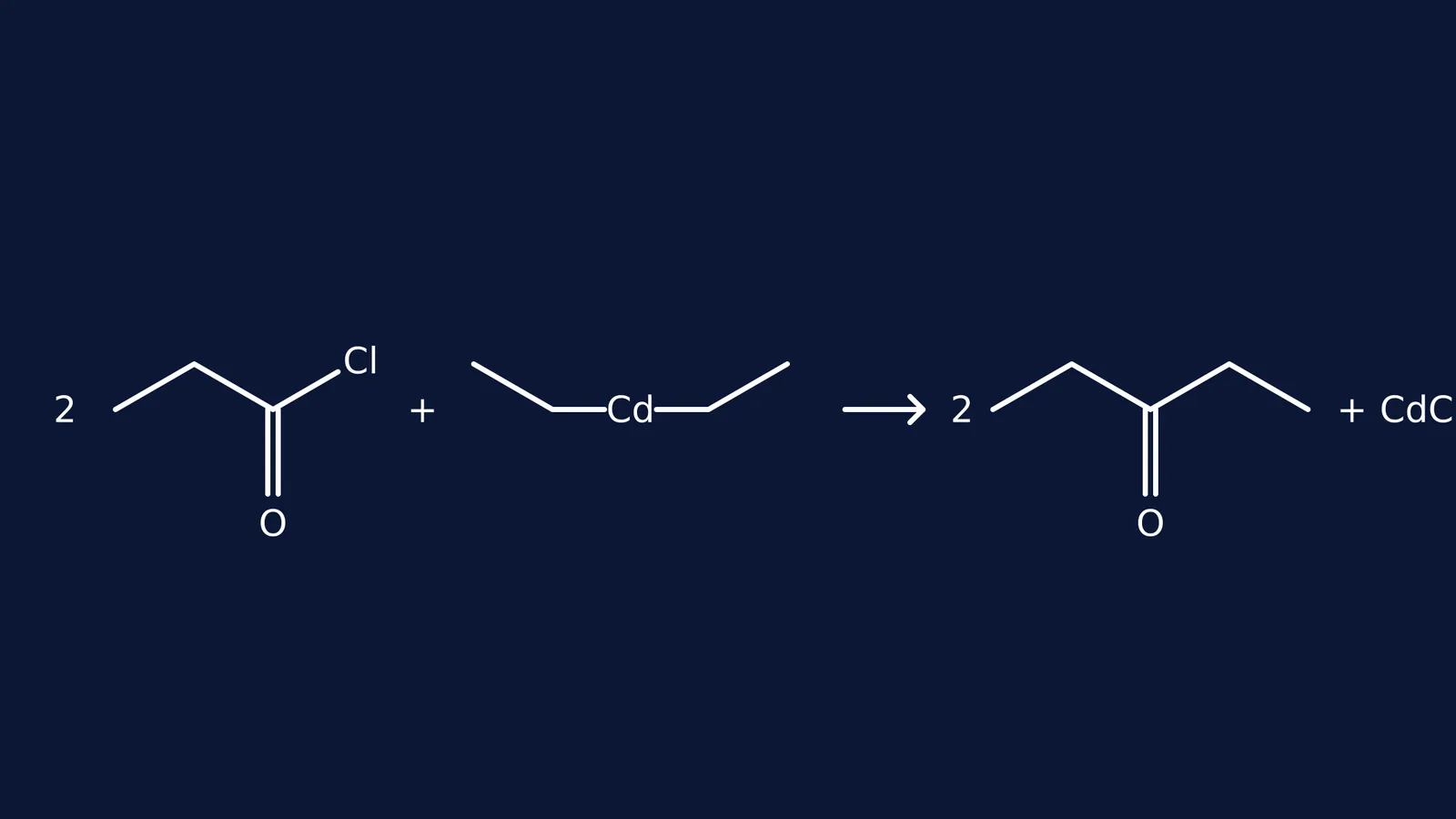
Once you have prepared and isolated your dialkylcadmium, you react it directly with your chosen acyl chloride (R'COCl):
2 R'COCl + R₂Cd → 2 R'COR + CdCl₂
The mechanism proceeds via a nucleophilic acyl substitution. The alkyl group from the dialkylcadmium acts as the nucleophile, attacking the electrophilic carbonyl carbon of the acyl chloride to form a tetrahedral intermediate. The chloride ion, which is an excellent leaving group, is then expelled. This restores the carbon-oxygen double bond to form the ketone.
If you're unsure how to track the electrons or what reactions you might see next, the Concept Library holds every concept in physics, chemistry, biology, mathematics and computing.
The checklist for acyl chloride reactions
When planning a synthesis from an acyl chloride on an exam, check your desired product to pick the right reagent:
If you want a tertiary alcohol with two identical alkyl groups: use excess Grignard reagent (RMgX).
If you want to stop at the ketone: use dialkylcadmium (R₂Cd) or a Gilman reagent (R₂CuLi).
Organocadmium reagents were the standard laboratory method for this conversion for decades. Today, because cadmium compounds are highly toxic and pose an environmental hazard, most modern laboratories prefer Gilman reagents (organocuprates). Gilman reagents offer the exact same selectivity for acyl chlorides over ketones without the dangers of cadmium. However, the dialkylcadmium route remains a classic, testable mechanism in many chemistry syllabuses.
For more on carbonyl chemistry, read about Clemmensen vs Wolff-Kishner: reducing a C=O group to CH2 or Rosenmund, Stephen and Etard reactions: three routes to aldehydes.


