

On this page
Have you ever tried to fit a long curtain pole into a small car, or wondered about the longest item you could pack in a rectangular box? In geometry, this is known as the "longest rod problem," and it requires finding the space diagonal of a cuboid. The answer relies entirely on one of the most famous tools in mathematics: Pythagoras' theorem.
What is the longest rod that fits in a room?
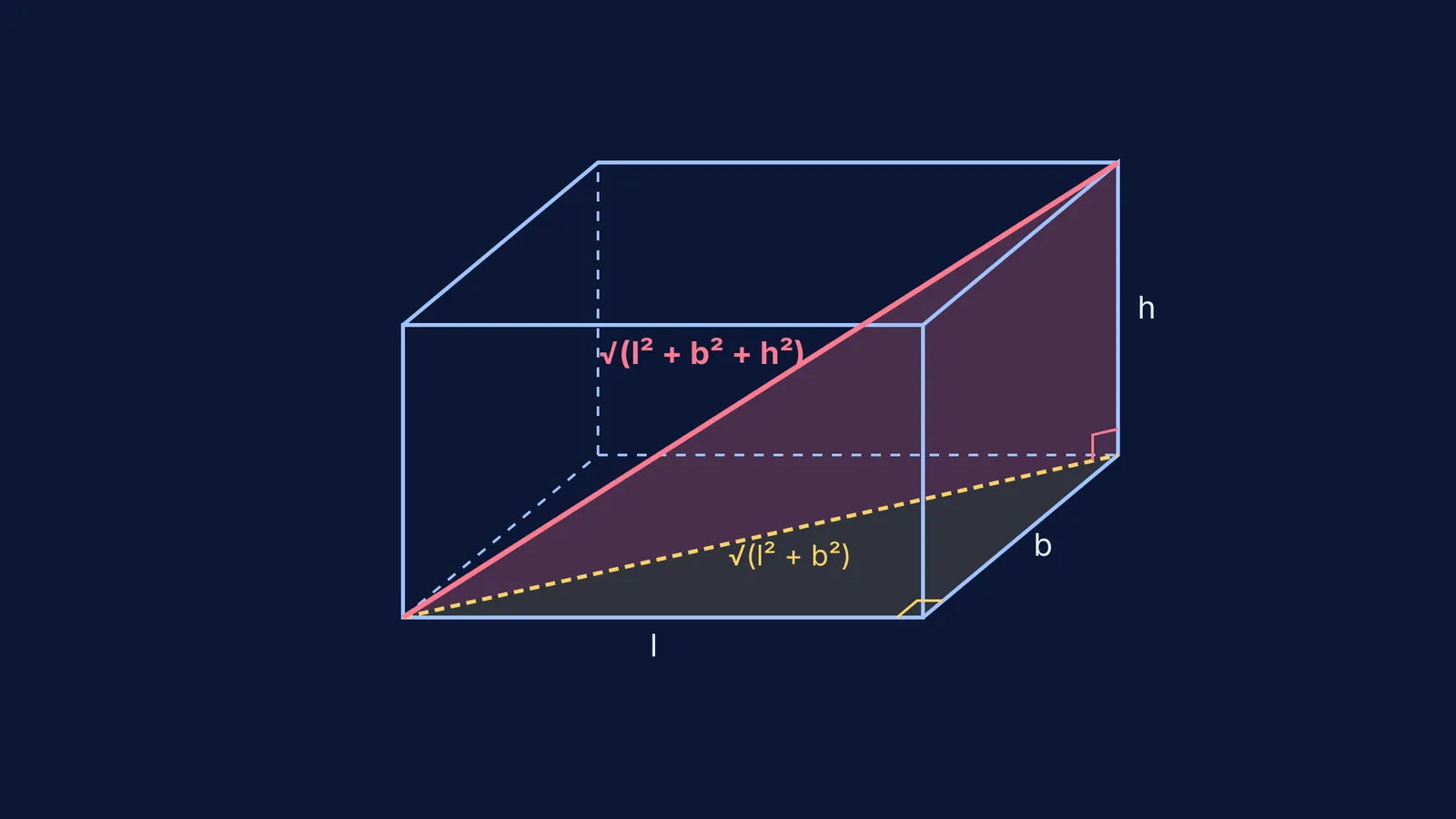
When we talk about a cuboid—a 3D box or a standard room with length (l), breadth (b) and height (h)—the longest straight line you can draw inside it connects one bottom corner to the opposite top corner. This line passes right through the empty space of the room, earning it the name "space diagonal" or "body diagonal".
If you have a room that measures 12 m in length, 9 m in breadth, and 8 m in height, the longest rod you can fit inside is exactly 17 m long. But how do we reach that number? We build two right-angled triangles and use Pythagoras' theorem on both of them. Because the rod crosses all three dimensions of the space, a single 2D calculation will not give you the full length.
How do you find the length of the diagonal of a cuboid?
To understand the formula, we have to look at the geometry in two steps. The trick is to see the "hidden" flat triangles inside the 3D space.
First, look at the floor. The floor is a flat rectangle with sides l and b. If you lay a rod flat on the floor from one corner to the opposite corner, you form a right-angled triangle. According to Pythagoras, the square of this face diagonal is l² + b². Therefore, the face diagonal itself has a length of √(l² + b²).
Next, lift one end of that rod straight up to the ceiling. You have just created a second right-angled triangle standing up vertically inside the room. Its base is the face diagonal we just found, and its height is the height of the room, h.
When we apply Pythagoras' theorem to this second triangle, we square the base (which gives back l² + b² without the root) and add the square of the height (h²). Taking the square root of the total gives us our final formula: √(l² + b² + h²).
Returning to our 12 m × 9 m × 8 m room, the calculation looks like this:
Floor diagonal squared = 12² + 9² = 144 + 81 = 225
Space diagonal squared = 225 + 8² = 225 + 64 = 289
Length of the longest rod = √289 = 17 m.
If you struggle to remember 3D formulas, the Fermi Concept Library can help you break them back down into their 2D parts.
Why is spatial reasoning important for STEM?
Visualising that second triangle—the one standing up inside the room—can be difficult because you are looking at a 2D drawing of a 3D space. This ability to see and manipulate objects in your mind is known as spatial reasoning.
Educational research shows that projective geometry and reasoning about the dynamic relationship between 2D and 3D objects offers a meaningful context in which to develop spatial reasoning for STEM learning. It is not just about memorising formulas; students who build strong spatial skills find it easier to tackle advanced problems in physics, architecture and engineering. If you find it hard to picture the shapes in problems involving the section formula in 3D or the rule of the diagonal in the Sulba Sutras, practising with physical boxes or drawing out the triangles step by step can build that mental muscle over time.
A framework for solving 3D geometry problems
When you face an unfamiliar 3D geometry question in an exam, do not try to process the entire shape at once. Use this systematic approach to break it down:
Draw the 2D cross-sections: If you are looking at a cuboid, draw the floor as a simple rectangle. Add the side walls as separate rectangles next to it.
Look for the hidden right angles: In 3D space, lines that appear slanted on paper often meet at 90 degrees in reality. The corner where a wall meets the floor is always a right angle.
Map the forces or vectors: If you are dealing with physics, map out where gravity or tension applies along those lines.
Write down the knowns: List the length, width, and height before you write any formulas.
Apply Pythagoras step by step: Solve for the flat faces first, then move to the diagonal lines that cut through the internal space.
By breaking a large, intimidating box into a series of flat triangles, you reduce the longest rod problem into a basic calculation you already know how to do.


