

On this page
Calculating the determinant of a large matrix can be a time-consuming chore of multiplying, subtracting, and tracking signs. But if you are working with an upper or lower triangular matrix, all of that heavy lifting vanishes into a single step.
For these specific types of matrices, the determinant is simply the product of the entries along the main diagonal. This property is not just a neat trick; it is a fundamental tool for solving systems of equations and quickly identifying whether a matrix has an inverse.
What is the determinant of a triangular matrix?
An upper triangular matrix is a square matrix where every entry below the main diagonal is zero, and a lower triangular matrix has every entry above the diagonal as zero. A diagonal matrix has zeros everywhere except on the main diagonal, making it both upper and lower triangular.
According to the Georgia Institute of Technology's Interactive Linear Algebra textbook, the determinant of any n × n matrix that is upper-triangular or lower-triangular is defined simply as the product of its diagonal entries.
For example, if you have a 3 × 3 upper triangular matrix with diagonal entries 4, 3, and −1, its determinant is exactly 4 × 3 × (−1) = −12. You can entirely ignore the non-zero numbers sitting above the diagonal.
Why does the determinant equal the product of the diagonal entries?
If you try to calculate the determinant the long way, using cofactor expansion, the reason for this shortcut becomes obvious.
Imagine expanding the determinant of an upper triangular matrix along its first column. Because every entry below the top-left one is zero, the formula collapses. You only need to multiply that first entry by the determinant of the smaller matrix left over when you cross out the first row and column.
This leftover matrix is also upper triangular. If you expand it along its own first column, you get the next diagonal entry multiplied by an even smaller triangular matrix. As you repeat this process, every term except the product of the main diagonal elements gets multiplied by zero and drops out.
In fact, this property is the core engine behind how computers calculate determinants. Finding the determinant of a large matrix via cofactor expansion takes a massive amount of processing power. Instead, software uses Gaussian elimination to reduce a standard matrix into an upper triangular form. Once it is triangular, the computer simply multiplies the diagonal entries together.
If this step-by-step collapse is hard to picture, you might have some concept gaps around cofactor expansion. The Fermi Concept Library breaks down the mechanics of determinants and matrices so you can see exactly why these terms cancel out.
How to use this shortcut to spot singular matrices fast?
A square matrix is called "singular" if it does not have an inverse. A matrix is singular if and only if its determinant is exactly zero.
Because the determinant of a triangular matrix is just the product of its diagonal entries, you can spot a singular triangular matrix instantly. If even one entry on the main diagonal is zero, the entire product becomes zero. The Georgia Tech text notes that a triangular matrix is invertible if and only if all of its diagonal entries are non-zero.
This is incredibly useful in timed exams like JEE Main. If a question asks whether a given triangular matrix is invertible, you do not need to do any calculations. Just scan the main diagonal. If there is a zero, it is singular.
If you are dealing with matrix equations and find that you frequently apply the wrong method or get lost in the arithmetic, the Fermi Problem Library has worked problems with a step-by-step solver that explains the reasoning rather than printing an answer. This helps you recognise the structure of a matrix before you start calculating.
A worked example for exams
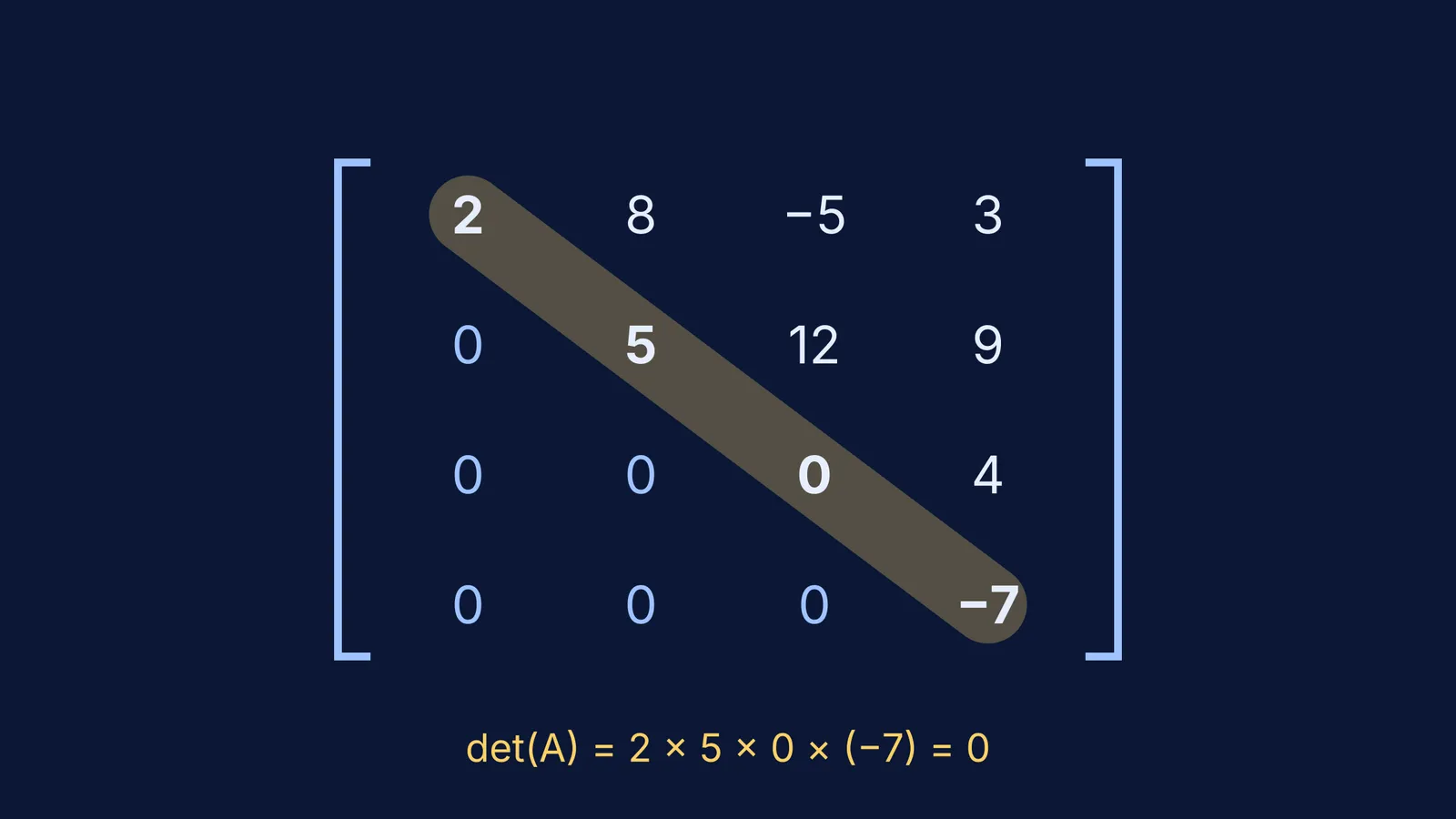
Let's say you encounter a 4 × 4 matrix in a test where the rows are: Row 1: 2, 8, −5, 3 Row 2: 0, 5, 12, 9 Row 3: 0, 0, 0, 4 Row 4: 0, 0, 0, −7
At first glance, a 4 × 4 determinant looks intimidating. However, notice the structure. All the entries below the main diagonal (the numbers 2, 5, 0, −7) are zeros. This makes it an upper triangular matrix.
Instead of expanding cofactors across four rows, apply the rule. Multiply the diagonal entries from top-left to bottom-right: Determinant = 2 × 5 × 0 × (−7)
Because the third diagonal entry is zero, the entire product is zero. The determinant is 0, meaning this matrix is singular and has no inverse. Spotting this pattern turns a tedious calculation into a quick observation.
To build on these shortcuts, you can explore finding the area of a triangle using determinants, which relies on similar matrix properties. You can also save time in exams by finding Aⁿ for a matrix by spotting the pattern rather than multiplying a matrix by itself repeatedly.


