

On this page
Many students expand a determinant equation straight away, get a page of algebra and drop a sign. A better approach is three moves: pull out a factor with row operations, spot roots by making two rows equal, and check the count against the degree.
What does it mean to solve a determinant equation for x?
When x appears inside a determinant, the determinant becomes a polynomial in x, and solving the equation means finding that polynomial's roots. The NCERT Class 12 chapter on Determinants starts with a 2×2 case: setting the determinant with rows (3, x) and (x, 1) equal to the one with rows (3, 2) and (4, 1) gives 3 − x² = 3 − 8, so x = ±2√2. That is a degree-2 equation, and it has two roots.
A 3×3 determinant expands to a cubic, which is slow to factorise. The current NCERT chapter (reprint 2026-27) has no separate section on the properties of determinants, so you may need to learn the shortcuts from other problem sets. They turn the cubic into a product you can read the roots from.
Which determinant properties do you need?
Three determinant properties do almost all the work:
Adding a multiple of one row (or column) to another row (or column) does not change the determinant.
If every entry of one row (or column) is multiplied by a number, the determinant is multiplied by that number, so a common factor in a row can be taken outside.
If two rows (or two columns) are equal, the determinant is zero.
The first creates a common factor, the second pulls it out, and the third lets you guess roots without algebra.
How do you solve a 3×3 determinant equation step by step?
Take this equation: the determinant with rows (x + 1, 2, 3), (1, x + 2, 3) and (1, 2, x + 3) equals 0.
Look for a pattern. Every row adds up to x + 6.
Create the factor. Replace column 1 by C1 + C2 + C3. This does not change the determinant, and column 1 becomes (x + 6, x + 6, x + 6).
Pull it out. Take x + 6 outside. Column 1 is now (1, 1, 1), with the other columns unchanged.
Make zeros. Do R2 − R1 and R3 − R1. Row 2 becomes (0, x, 0) and row 3 becomes (0, 0, x).
Expand along column 1. Only the top entry is non-zero, so the determinant is (x + 6) times x times x.
Solve. (x + 6)x² = 0 gives x = −6, x = 0 and x = 0.
Notice that x = 0 was visible before any work: put it into the original and all three rows become (1, 2, 3), so the determinant is zero. For a final check, at x = 1 the original determinant works out to 7, and (1 + 6) × 1² = 7.
How do you know you have found every root?
Count by degree. Every non-constant polynomial of degree n has exactly n complex roots when repeated roots are counted with their multiplicity, which is the fundamental theorem of algebra. If x appears only on the diagonal of a 3×3 determinant, once in each entry, the leading term is x³, so you should finish with three roots.
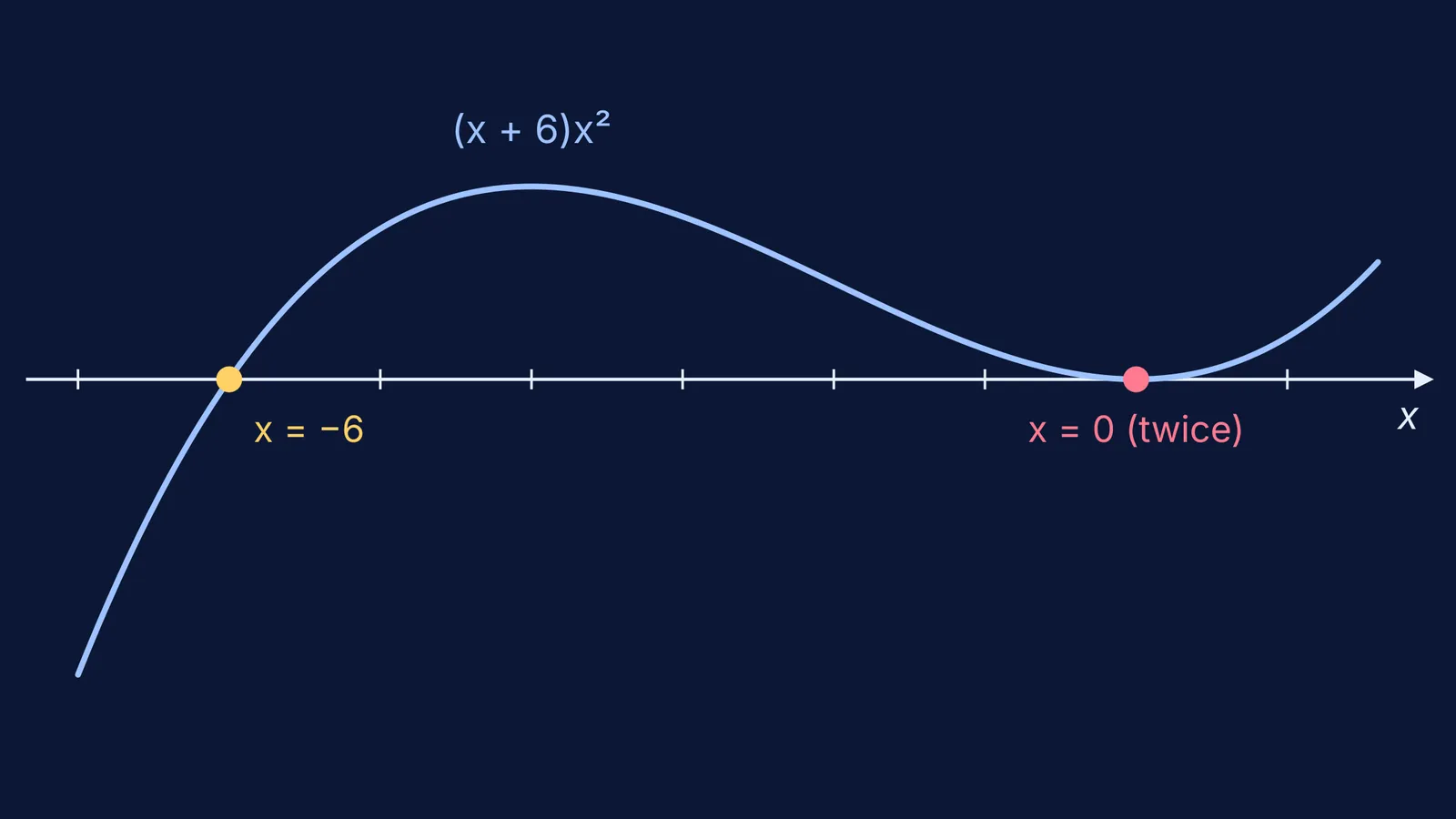
In the example, the roots are −6 once and 0 twice: three in total. On the graph of (x + 6)x², the curve crosses the x-axis at −6 but only touches it at 0, which is what a repeated root looks like. If you have only two roots for a cubic, one is repeated or you lost a factor, usually by dividing by an expression in x that could be zero.
The habit works for 2×2 questions too: NCERT's Exercise 4.1 has an equation that reduces to x² = 36, so the answer is x = ±6, not just 6.
A checklist for your next determinant equation
If row or column sums are equal, add all columns into one and pull the factor out.
Try simple values (0, 1, −1, a, −a) that make two rows or columns equal; each is a root.
Subtract rows to create zeros, then expand along the line with the most zeros.
Never cancel a factor containing x; set it to zero instead.
Count roots against the degree, including repeats.
Check one easy value of x in both the original and your factorised form.
For the other time-saving properties, see our guide to matrices and determinants for JEE; for a determinant set to zero in geometry, see area of a triangle using determinants.
When a row operation goes wrong and you cannot see where, the Fermi Problem Library has worked problems with a step-by-step solver that explains the reasoning rather than printing an answer.
Try the checklist on the determinant with rows (x, a, a), (a, x, a), (a, a, x): you should get three roots, and two of them are the same.


