

On this page
Does the determinant of a sum equal the sum of determinants?
When studying matrix algebra, students often wonder if the determinant distributes over addition. If A and B are square matrices of order n, does |A + B| equal |A| + |B|?
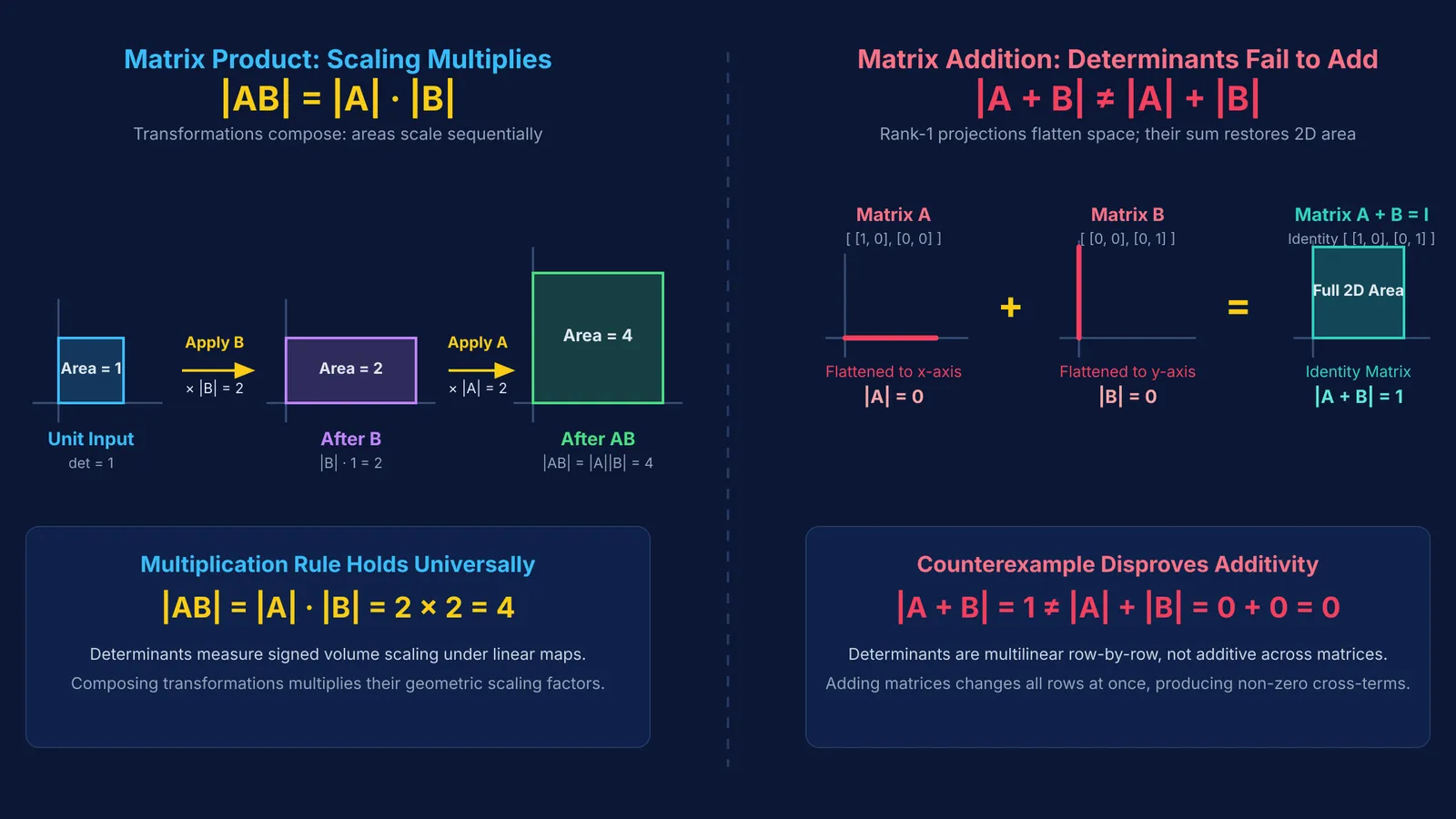
The answer is no. As shown in Wolfram MathWorld's determinant reference, determinants do not distribute over matrix addition. In general, |A + B| ≠ |A| + |B|. While matrix addition combines corresponding entries term by term, the determinant of an n × n matrix is a degree-n polynomial of its entries. Adding two matrices alters every entry simultaneously, producing cross-terms that prevent determinants from adding. In contrast, matrix multiplication preserves determinants cleanly through the product theorem |AB| = |A||B|.
Understanding this distinction prevents frequent errors in exams like JEE Main and CBSE Class 12, where multiple-choice questions set algebraic traps around matrix sums.
What is a simple counterexample where |A + B| ≠ |A| + |B|?
A direct counterexample using 2 × 2 singular matrices, highlighted in MIT OpenCourseWare's Linear Algebra Lecture 18 notes, demonstrates why determinants do not add.
Consider two simple matrices:
Matrix A has row 1 as [1, 0] and row 2 as [0, 0].
Matrix B has row 1 as [0, 0] and row 2 as [0, 1].
Evaluating their determinants:
|A| = (1 × 0) − (0 × 0) = 0.
|B| = (0 × 1) − (0 × 0) = 0.
Adding A and B gives the 2 × 2 identity matrix I:
A + B has row 1 as [1, 0] and row 2 as [0, 1].
Its determinant is |A + B| = |I| = (1 × 1) − (0 × 0) = 1.
Here, |A + B| = 1, but |A| + |B| = 0 + 0 = 0. Because 1 ≠ 0, the sum rule fails. The equality also fails for invertible matrices. If A = I and B = I, then |A| = 1 and |B| = 1, giving a sum of 2. Yet |A + B| = |2I| = 2² |I| = 4, so 4 ≠ 2.
Reviewing matrices and determinants traps for JEE reinforces why testing simple diagonal matrices quickly disproves false identities.
Why does |AB| = |A||B| hold for matrix products?
While addition fails, multiplication holds universally for square matrices of the same size. In MacTutor's history of matrices and determinants, historians record that Augustin-Louis Cauchy proved the multiplication theorem |AB| = |A||B| in an 1812 memoir presented to the Institut de France.
The geometric meaning of determinants makes this multiplication property intuitive. A 2 × 2 real matrix transforms the plane, scaling the area of any region by the factor |A|. A 3 × 3 matrix scales three-dimensional volume by |A|.
Multiplying two matrices AB represents the composition of two transformations:
First, B transforms space and scales volumes by |B|.
Next, A acts on that result and scales volumes by an additional factor of |A|.
The combined transformation scales volume by |A| × |B|. Because composition of maps multiplies geometric scaling factors, |AB| equals |A||B|.
This rule extends directly to powers: |Aⁿ| = |A|ⁿ for positive integers n, a shortcut useful when finding patterns in matrix powers.
How do you find the determinant of an inverse matrix?
The product theorem yields an immediate derivation for the determinant of an inverse matrix, as detailed in Wolfram MathWorld's matrix determinant guide.
If A is an invertible n × n matrix, multiplying A by its inverse gives the identity matrix: A · A⁻¹ = I
Taking the determinant of both sides: |A · A⁻¹| = |I|
Applying the product rule: |A| · |A⁻¹| = 1
Because an invertible matrix has |A| ≠ 0, dividing by |A| produces: |A⁻¹| = 1 / |A|
Inverting a matrix simply reciprocates its scaling factor. A geometric transformation with scaling factor |A| = 2 has an inverse transformation with scaling factor |A⁻¹| = 1/2. This relationship is central when evaluating properties of the adjoint and inverse matrix.
The Fermi Problem Library provides worked problems with a step-by-step solver that explains the reasoning rather than printing an answer, helping students verify inverse determinant expressions systematically.
What row linearity allows you to split in JEE problems?
If determinants do not distribute across matrix sums, why can certain determinants be split into a sum of two?
The resolution is single-row linearity. In MIT OpenCourseWare's Linear Algebra Lecture 18, Professor Gilbert Strang explains that a determinant is multilinear: it is linear in one row at a time, provided all other rows stay fixed.
If row 1 contains binomial entries [a₁ + x, b₁ + y] while row 2 remains [c, d] in each matrix:
|[a₁ + x, b₁ + y]; [c, d]| = |[a₁, b₁]; [c, d]| + |[x, y]; [c, d]|.
This splits a single row. Full matrix addition A + B changes all n rows, expanding into 2ⁿ determinants rather than two.
The Fermi Concept Library covers every concept in physics, chemistry, biology, mathematics and computing, each with its own lesson and its place in the map. When working through multi-step matrix proofs, Fermi's AI tutor holds a line of reasoning across the session, notices where a student is stuck, and decides whether to explain, ask, or show how row operations preserve or change the determinant.


